
涡虫眼睛再生的时间调控
Temporal regulation of planarian eye regeneration.
作者信息
Deochand Michelle E, Birkholz Taylor R, Beane Wendy S
机构信息
Department of Biological Sciences Western Michigan University Kalamazoo MI, USA.
出版信息
Regeneration (Oxf). 2016 Oct 28;3(4):209-221. doi: 10.1002/reg2.61. eCollection 2016 Aug.
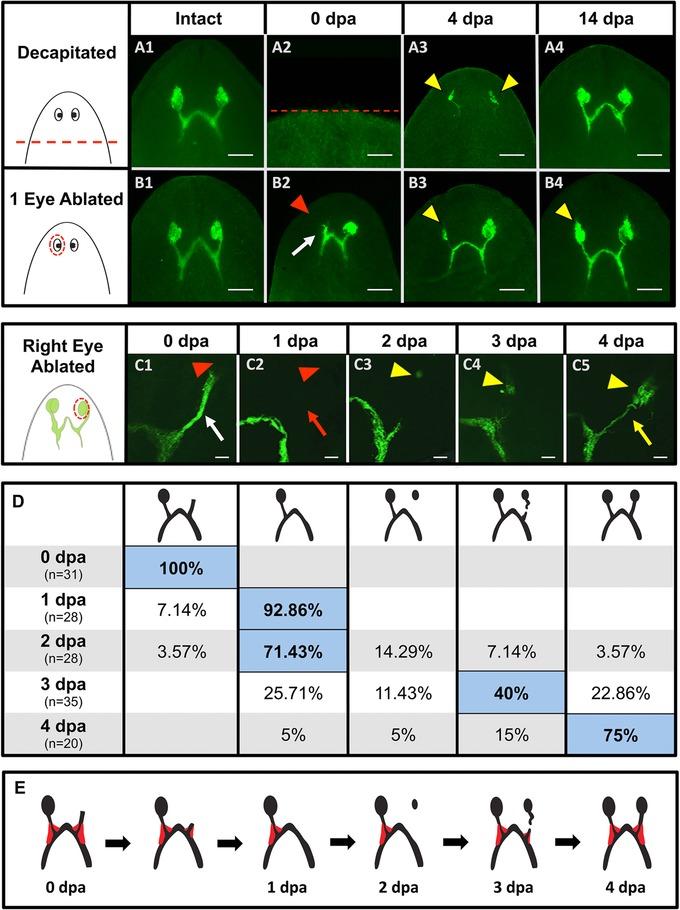
While tissue regeneration is typically studied using standard injury models, in nature injuries vary greatly in the amount and location of tissues lost. Planarians have the unique ability to regenerate from many different injuries (including from tiny fragments with no brain), allowing us to study the effects of different injuries on regeneration timelines. We followed the timing of regeneration for one organ, the eye, after multiple injury types that involved tissue loss (single- and double-eye ablation, and decapitation) in . Our data reveal that the timing of regeneration remained constant despite changing injury parameters. Optic tissue regrowth, nerve re-innervation, and functional recovery were similar between injury types (even when the animal was simultaneously regrowing its brain). Changes in metabolic rate (i.e., starving vs. fed regenerates) also had no effect on regeneration timelines. In addition, our data suggest there may exist a role for optic nerve degeneration following eye ablation. Our results suggest that the temporal regulation of planarian eye regeneration is tightly controlled and resistant to variations in injury type.
虽然组织再生通常使用标准损伤模型进行研究,但在自然界中,损伤在组织丢失的数量和位置上有很大差异。涡虫具有从许多不同损伤(包括没有大脑的微小碎片)中再生的独特能力,这使我们能够研究不同损伤对再生时间线的影响。我们追踪了在涉及组织损失的多种损伤类型(单眼和双眼切除以及断头)后,一个器官——眼睛的再生时间。我们的数据显示,尽管损伤参数发生变化,但再生时间保持不变。不同损伤类型之间的视神经组织再生、神经重新支配和功能恢复相似(即使动物同时在再生其大脑)。代谢率的变化(即饥饿与喂食的再生体)对再生时间线也没有影响。此外,我们的数据表明,眼切除后视神经退化可能存在某种作用。我们的结果表明,涡虫眼睛再生的时间调控受到严格控制,并且对损伤类型的变化具有抗性。



 Zotero 插件