
跨表型关联测试揭示了果蝇中介导营养反应的基因。
Cross-phenotype association tests uncover genes mediating nutrient response in Drosophila.
作者信息
Nelson Christopher S, Beck Jennifer N, Wilson Kenneth A, Pilcher Elijah R, Kapahi Pankaj, Brem Rachel B
机构信息
Buck Institute for Research on Aging, 8001 Redwood Blvd., Novato, CA, 94947, USA.
Department of Urology, University of California, San Francisco, CA, USA.
出版信息
BMC Genomics. 2016 Nov 4;17(1):867. doi: 10.1186/s12864-016-3137-9.
BACKGROUND
Obesity-related diseases are major contributors to morbidity and mortality in the developed world. Molecular diagnostics and targets of therapies to combat nutritional imbalance are urgently needed in the clinic. Invertebrate animals have been a cornerstone of basic research efforts to dissect the genetics of metabolism and nutrient response. We set out to use fruit flies reared on restricted and nutrient-rich diets to identify genes associated with starvation resistance, body mass and composition, in a survey of genetic variation across the Drosophila Genetic Reference Panel (DGRP).
RESULTS
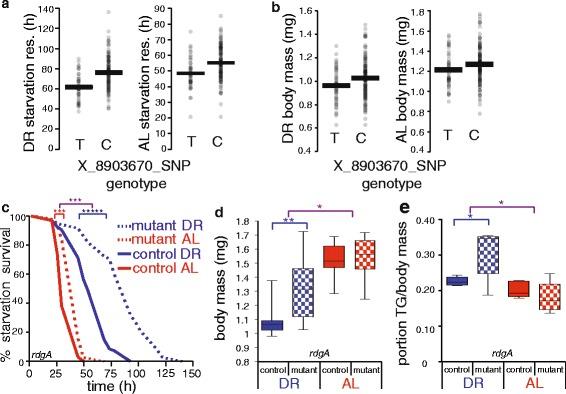
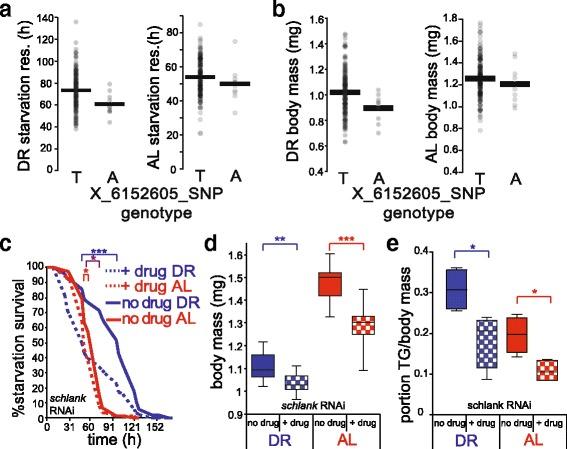
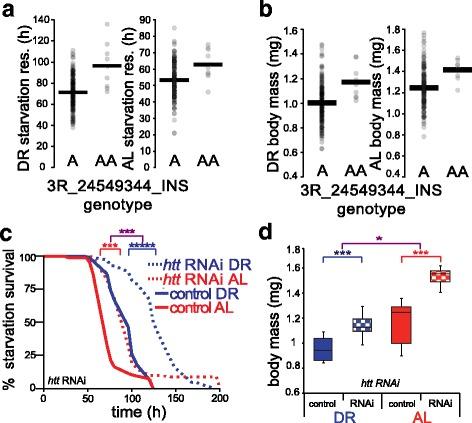
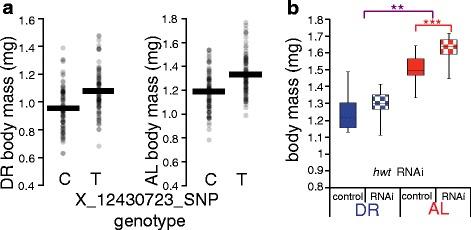
We measured starvation resistance, body weight and composition in DGRP lines on each of two diets and used several association mapping strategies to harness this panel of phenotypes for molecular insights. We tested DNA sequence variants for a relationship with single metabolic traits and with multiple traits at once, using a scheme for cross-phenotype association mapping; we focused our association tests on homologs of human disease genes and common polymorphisms; and we tested for gene-by-diet interactions. The results revealed gene and gene-by-diet associations between 17 variants and body mass, whole-body triglyceride and glucose content, or starvation resistance. Focused molecular experiments validated the role in body mass of an uncharacterized gene, CG43921 (which we rename heavyweight), and previously unknown functions for the diacylglycerol kinase rdgA, the huntingtin homolog htt, and the ceramide synthase schlank in nutrient-dependent body mass, starvation resistance, and lifespan.
CONCLUSIONS
Our findings implicate a wealth of gene candidates in fly metabolism and nutrient response, and ascribe novel functions to htt, rdgA, hwt and schlank.
背景
在发达国家,肥胖相关疾病是导致发病和死亡的主要因素。临床上迫切需要分子诊断方法和对抗营养失衡的治疗靶点。无脊椎动物一直是剖析代谢遗传学和营养反应基础研究工作的基石。我们着手利用在限制饮食和营养丰富饮食条件下饲养的果蝇,在果蝇遗传参考面板(DGRP)的遗传变异调查中,鉴定与抗饥饿能力、体重和组成相关的基因。
结果
我们测量了DGRP品系在两种饮食条件下的抗饥饿能力、体重和组成,并使用多种关联图谱策略利用这一系列表型获得分子层面的见解。我们采用交叉表型关联图谱方案,测试DNA序列变异与单一代谢性状以及同时与多个性状之间的关系;我们将关联测试集中在人类疾病基因的同源物和常见多态性上;并且我们测试了基因与饮食的相互作用。结果揭示了17个变异与体重、全身甘油三酯和葡萄糖含量或抗饥饿能力之间的基因以及基因与饮食的关联。针对性的分子实验验证了一个未表征基因CG43921(我们将其重新命名为heavyweight)在体重方面的作用,以及二酰基甘油激酶rdgA、亨廷顿蛋白同源物htt和神经酰胺合酶schlank在营养依赖的体重、抗饥饿能力和寿命方面的未知功能。
结论
我们的研究结果表明大量基因候选物参与果蝇的代谢和营养反应,并赋予htt、rdgA、hwt和schlank新的功能。
 Zotero 插件