
微小RNA-497通过靶向Fos相关抗原-1抑制结肠癌细胞的上皮-间质转化和转移。
miR-497 suppresses epithelial-mesenchymal transition and metastasis in colorectal cancer cells by targeting fos-related antigen-1.
作者信息
Zhang Nan, Shen Quan, Zhang Pingping
机构信息
Department of General Surgery, First Affiliated Hospital of Henan University of Chinese Medicine.
Department of Hepatobiliary Surgery, Henan Provincial People's Hospital, Zhengzhou.
出版信息
Onco Targets Ther. 2016 Oct 25;9:6597-6604. doi: 10.2147/OTT.S114609. eCollection 2016.
OBJECTIVE
MicroRNAs have key roles in tumor metastasis. The acquisition of metastatic capability by cancer cells is associated with epithelial-mesenchymal transition (EMT). Here, we describe the role and molecular mechanism of miR-497 in colorectal cancer (CRC) cell EMT, migration, and invasion.
METHODS
Quantitative real-time polymerase chain reaction and Western blot assays were performed to detect the expression levels of miR-497 and Fos-related antigen-1 (Fra-1) in the CRC cells. HCT116 and SW480 cells with miR-497 overexpression or Fra-1 low expression were constructed by lipofection. Target prediction and luciferase reporter assays were performed to investigate whether Fra-1 is one of the targets of miR-497. Western blot and Transwell assays were performed to detect the effects of miR-497 and Fra-1 on CRC cell EMT, migration and invasion.
RESULTS
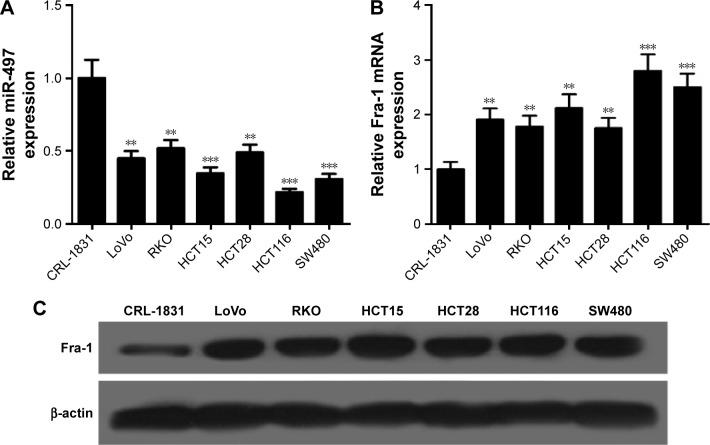
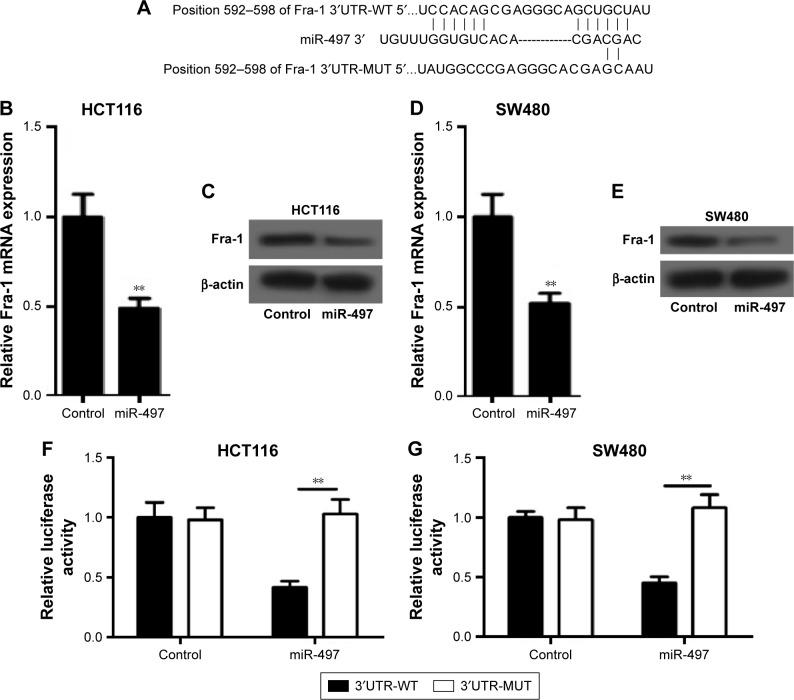
We searched the miRanda, TargetScan, and PicTar databases and found that Fra-1, a key driver of CRC metastasis, is a potential target of miR-497. Quantitative real-time polymerase chain reaction and Western blot analysis verified downregulation of miR-497 and upregulation of Fra-1 in CRC cells. Western blot and Transwell assays showed that overexpression of miR-497 suppresses CRC cell EMT, migration, and invasion. Luciferase gene reporter assay revealed that Fra-1 is a downstream target of miR-497 as miR-497 bound directly to the 3' untranslated region of Fra-1 messenger RNA. An inverse correlation was also found between miR-497 and Fra-1 in HCT116 and SW480 cells. Furthermore, knockdown of Fra-1 recuperated the effects of miR-497 overexpression.
CONCLUSION
miR-497 suppresses CRC cell EMT, migration, and invasion partly by targeting Fra-1.
目的
微小RNA在肿瘤转移中起关键作用。癌细胞获得转移能力与上皮-间质转化(EMT)相关。在此,我们描述了miR-497在结直肠癌(CRC)细胞EMT、迁移和侵袭中的作用及分子机制。
方法
采用定量实时聚合酶链反应和蛋白质免疫印迹分析检测CRC细胞中miR-497和Fos相关抗原1(Fra-1)的表达水平。通过脂质体转染构建miR-497过表达或Fra-1低表达的HCT116和SW480细胞。进行靶标预测和荧光素酶报告基因检测以研究Fra-1是否为miR-497的靶标之一。采用蛋白质免疫印迹和Transwell检测来检测miR-497和Fra-1对CRC细胞EMT、迁移和侵袭的影响。
结果
我们检索了miRanda、TargetScan和PicTar数据库,发现Fra-1是CRC转移的关键驱动因子,是miR-497的潜在靶标。定量实时聚合酶链反应和蛋白质免疫印迹分析证实CRC细胞中miR-497表达下调,Fra-1表达上调。蛋白质免疫印迹和Transwell检测表明,miR-497过表达可抑制CRC细胞的EMT、迁移和侵袭。荧光素酶基因报告基因检测显示Fra-1是miR-497的下游靶标,因为miR-497直接与Fra-1信使核糖核酸的3'非翻译区结合。在HCT116和SW480细胞中还发现miR-497与Fra-1呈负相关。此外,敲低Fra-1可恢复miR-497过表达的作用。
结论
miR-497通过靶向Fra-1部分抑制CRC细胞的EMT、迁移和侵袭。


 Zotero 插件