
Ncf1影响破骨细胞形成,但对绝经后骨质流失并不关键。
Ncf1 affects osteoclast formation but is not critical for postmenopausal bone loss.
作者信息
Stubelius Alexandra, Andersson Annica, Holmdahl Rikard, Ohlsson Claes, Islander Ulrika, Carlsten Hans
机构信息
Department of Rheumatology and Inflammation Research, Centre for Bone and Arthritis Research (CBAR), Sahlgrenska Academy, University of Gothenburg, Box 480, 405 30, Göteborg, Sweden.
Medical Inflammation Research, Karolinska Institutet, Stockholm, Sweden.
出版信息
BMC Musculoskelet Disord. 2016 Nov 9;17(1):464. doi: 10.1186/s12891-016-1315-1.
BACKGROUND
Increased reactive oxygen species and estrogen deficiency contribute to the pathophysiology of postmenopausal osteoporosis. Reactive oxygen species contribute to bone degradation and is necessary for RANKL-induced osteoclast differentiation. In postmenopausal bone loss, reactive oxygen species can also activate immune cells to further enhance bone resorption. Here, we investigated the role of reactive oxygen species in ovariectomy-induced osteoporosis in mice deficient in Ncf1, a subunit for the NADPH oxidase 2 and a well-known regulator of the immune system.
METHODS
B10.Q wild-type (WT) mice and mice with a spontaneous point mutation in the Ncf1-gene (Ncf1*/*) were ovariectomized (ovx) or sham-operated. After 4 weeks, osteoclasts were generated ex vivo, and bone mineral density was measured using peripheral quantitative computed tomography. Lymphocyte populations, macrophages, pre-osteoclasts and intracellular reactive oxygen species were analyzed by flow cytometry.
RESULTS
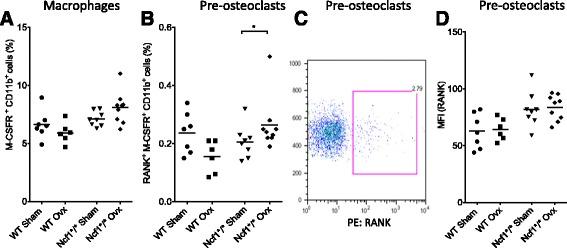
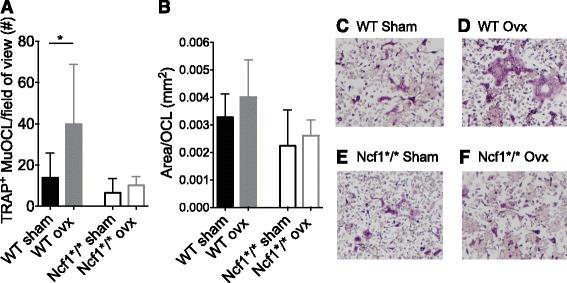
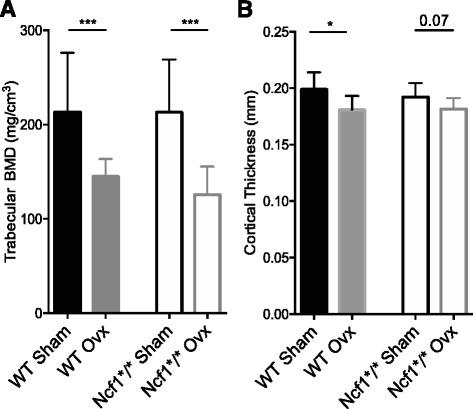
After ovx, Ncf1*/-mice formed fewer osteoclasts ex vivo compared to WT mice. However, trabecular bone mineral density decreased similarly in both genotypes after ovx. Ncf1/*-mice had a larger population of pre-osteoclasts, whereas lymphocytes were activated to the same extent in both genotypes.
CONCLUSION
Ncf1*/*-mice develop fewer osteoclasts after ovx than WT mice. However, irrespective of genotype, bone mineral density decreases after ovx, indicating that a compensatory mechanism retains bone degradation after ovx.
背景
活性氧增加和雌激素缺乏促成了绝经后骨质疏松症的病理生理过程。活性氧会导致骨降解,并且是核因子κB受体活化因子配体(RANKL)诱导破骨细胞分化所必需的。在绝经后骨质流失过程中,活性氧还可激活免疫细胞以进一步增强骨吸收。在此,我们研究了活性氧在Ncf1基因缺陷的小鼠卵巢切除诱导的骨质疏松症中的作用,Ncf1是烟酰胺腺嘌呤二核苷酸磷酸(NADPH)氧化酶2的一个亚基,也是免疫系统的一个著名调节因子。
方法
将B10.Q野生型(WT)小鼠和Ncf1基因发生自发点突变的小鼠(Ncf1*/*)进行卵巢切除(ovx)或假手术。4周后,在体外生成破骨细胞,并使用外周定量计算机断层扫描测量骨密度。通过流式细胞术分析淋巴细胞群体(数量)、巨噬细胞、前破骨细胞和细胞内活性氧。
结果
卵巢切除后,与WT小鼠相比,Ncf1*/小鼠在体外形成的破骨细胞较少。然而,卵巢切除后,两种基因型的小梁骨密度下降情况相似。Ncf1/*小鼠的前破骨细胞群体较大,而两种基因型的淋巴细胞活化程度相同。
结论
卵巢切除后,Ncf1*/*小鼠形成的破骨细胞比WT小鼠少。然而,无论基因型如何,卵巢切除后骨密度都会下降,这表明存在一种补偿机制维持卵巢切除后的骨降解。
 Zotero 插件