
人类白细胞抗原匹配胜过供体年龄:在肾脏配对交换时代影响活体供肾移植长期成功的供受体配对特征
HLA Matching Trumps Donor Age: Donor-Recipient Pairing Characteristics That Impact Long-Term Success in Living Donor Kidney Transplantation in the Era of Paired Kidney Exchange.
作者信息
Milner John, Melcher Marc L, Lee Brian, Veale Jeff, Ronin Matthew, D'Alessandro Tom, Hil Garet, Fry Phillip C, Shannon Patrick W
机构信息
Northshore University Health System, Chicago, IL.
Department of Surgery, Stanford University, Stanford, CA.
出版信息
Transplant Direct. 2016 Jun 6;2(7):e85. doi: 10.1097/TXD.0000000000000597. eCollection 2016 Jul.
BACKGROUND
We sought to identify donor characteristics influencing long-term graft survival, expressed by a novel measure, kidney life years (KLYs), in living donor kidney transplantation (LDKT).
METHODS
Cox and multiple regression analyses were applied to data from the Scientific Registry for Transplant Research from 1987 to 2015. Dependent variable was KLYs.
RESULTS
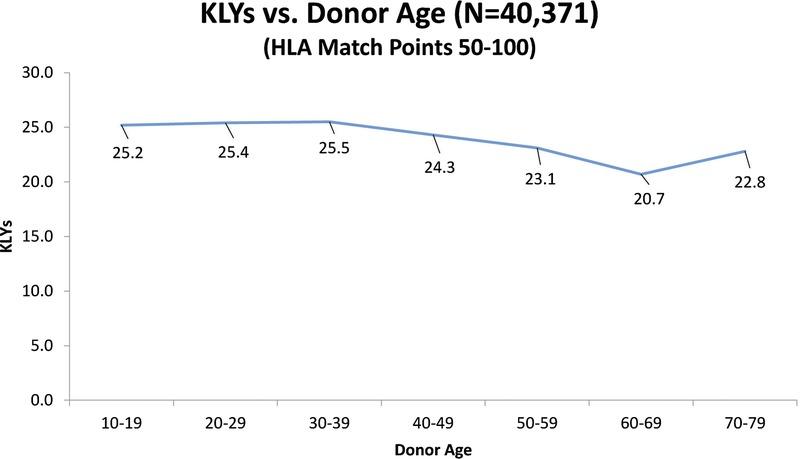
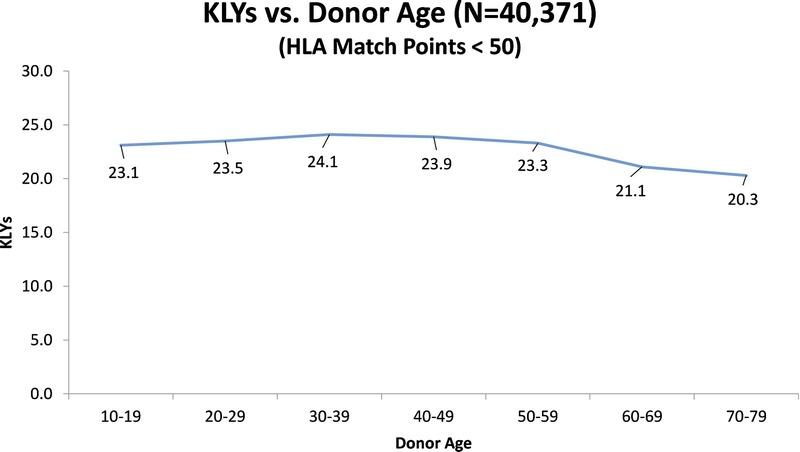
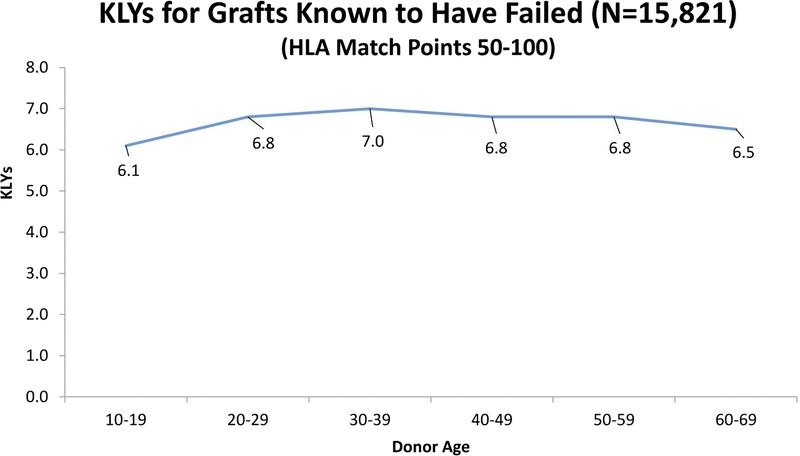
Living donor kidney transplantation (129 273) were performed from 1987 to 2013 in the United States. To allow sufficient time to assess long-term results, outcomes of LDKTs between 1987 and 2001 were analyzed. After excluding cases where a patient died with a functioning graft (8301) or those missing HLA data (9), 40 371 cases were analyzed. Of 18 independent variables, the focus became the 4 variables that were the most statistically and clinically significant in that they are potentially modifiable in donor selection ( <0.0001; ie, HLA match points, donor sex, donor biological sibling and donor age). HLA match points had the strongest relationship with KLYs, was associated with the greatest tendency toward graft longevity on Cox regression, and had the largest increase in KLYs (2.0 year increase per 50 antigen Match Points) based on multiple regression.
CONCLUSIONS
In cases when a patient has multiple potential donors, such as through paired exchange, graft life might be extended when a donor with favorable matching characteristics is selected.
背景
我们试图确定影响长期移植肾存活的供体特征,采用一种新的衡量指标——肾生存年数(KLYs),来评估活体供肾移植(LDKT)情况。
方法
对1987年至2015年移植研究科学登记处的数据进行Cox回归分析和多元回归分析。因变量为KLYs。
结果
1987年至2013年期间美国共进行了129273例活体供肾移植。为有足够时间评估长期结果,分析了1987年至2001年期间活体供肾移植的结果。排除患者移植肾仍有功能时死亡的病例(8301例)以及缺少HLA数据的病例(9例)后,共分析了40371例病例。在18个自变量中,重点关注4个在统计学和临床意义上最为显著的变量,因为它们在供体选择中可能是可改变的(<0.0001;即HLA匹配点数、供体性别、供体生物学同胞关系和供体年龄)。HLA匹配点数与KLYs的关系最为密切,在Cox回归中与移植肾长期存活的趋势相关性最大,基于多元回归分析,每增加50个抗原匹配点数,KLYs增加幅度最大(增加2.0年)。
结论
在患者有多个潜在供体的情况下,如通过配对交换,选择具有良好匹配特征的供体可能会延长移植肾的存活时间。

 Zotero 插件