
度洛西汀单药治疗日本慢性下腰痛患者的随机、双盲、安慰剂对照III期试验
Randomized, Double-blind, Placebo-controlled Phase III Trial of Duloxetine Monotherapy in Japanese Patients With Chronic Low Back Pain.
作者信息
Konno Shinichi, Oda Natsuko, Ochiai Toshimitsu, Alev Levent
机构信息
Department of Orthopedic Surgery, Fukushima Medical University, Fukushima, Japan.
Shionogi and Co. Ltd, Osaka, Japan.
出版信息
Spine (Phila Pa 1976). 2016 Nov 15;41(22):1709-1717. doi: 10.1097/BRS.0000000000001707.
STUDY DESIGN
A 14-week, randomized, double-blind, multicenter, placebo-controlled study of Japanese patients with chronic low back pain (CLBP) who were randomized to either duloxetine 60 mg once daily or placebo.
OBJECTIVE
This study aimed to assess the efficacy and safety of duloxetine monotherapy in Japanese patients with CLBP.
SUMMARY OF BACKGROUND DATA
In Japan, duloxetine is approved for the treatment of depression, diabetic neuropathic pain, and pain associated with fibromyalgia; however, no clinical study of duloxetine has been conducted for CLBP.
METHODS
The primary efficacy measure was the change in the Brief Pain Inventory (BPI) average pain score from baseline to Week 14. Secondary efficacy measures included BPI pain (worst pain, least pain, pain right now), Patient's Global Impression of Improvement, Clinical Global Impressions of Severity, and Roland-Morris Disability Questionnaire, among other measures, and safety and tolerability.
RESULTS
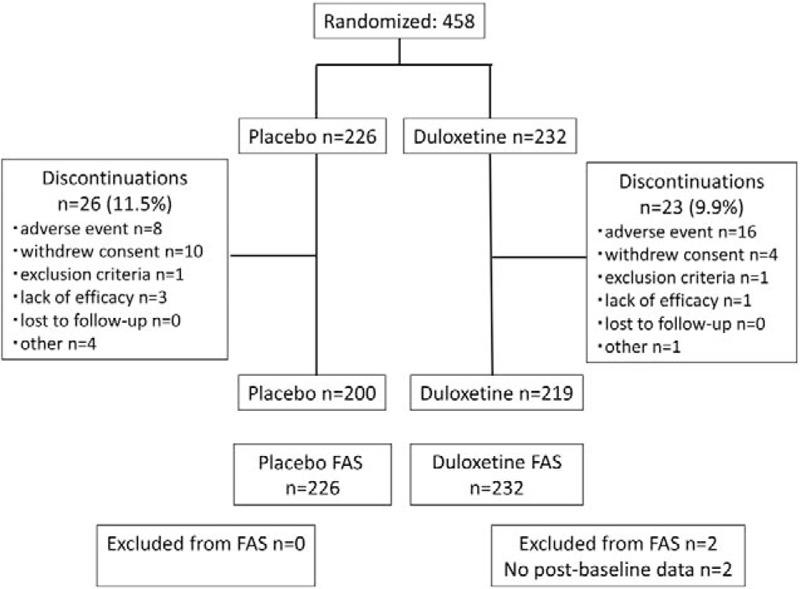
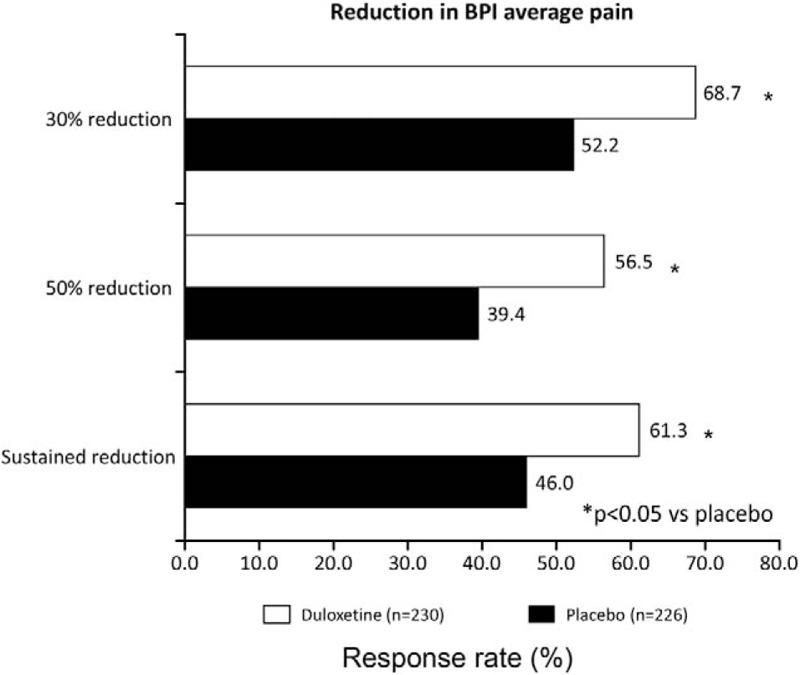
In total, 458 patients were randomized to receive either duloxetine (n = 232) or placebo (n = 226). The BPI average pain score improved significantly in the duloxetine group compared with that in the placebo group at Week 14 [-2.43 ± 0.11 vs. -1.96 ± 0.11, respectively; between-group difference (95% confidence interval), - 0.46 [-0.77 to-0.16]; P = 0.0026]. The duloxetine group showed significant improvement in many secondary measures compared with the placebo group, including BPI pain (least pain, pain right now) (between-group difference: -1.69 ± 0.10, P = 0.0009; -2.42 ± 0.12, P P = 0.0230, respectively), Patient's Global Impression of Improvement (2.46 ± 0.07, P = 0.0026), Clinical Global Impressions of Severity (-1.46 ± 0.06, P = 0.0019), and Roland-Morris Disability Questionnaire (-3.86 ± 0.22, P = 0.0439). Adverse events occurring at a significantly higher incidence in the duloxetine group were somnolence, constipation, nausea, dizziness, and dry mouth, most of which were mild or moderate in severity and were resolved or improved.
CONCLUSION
Duloxetine 60 mg was effective and well tolerated in Japanese CLBP patients.
LEVEL OF EVIDENCE
研究设计
一项为期14周的随机、双盲、多中心、安慰剂对照研究,纳入慢性下腰痛(CLBP)的日本患者,随机分为每日一次服用60毫克度洛西汀组或安慰剂组。
目的
本研究旨在评估度洛西汀单药治疗日本CLBP患者的疗效和安全性。
背景数据总结
在日本,度洛西汀被批准用于治疗抑郁症、糖尿病性神经病理性疼痛以及与纤维肌痛相关的疼痛;然而,尚未针对CLBP开展过度洛西汀的临床研究。
方法
主要疗效指标为简明疼痛量表(BPI)从基线至第14周的平均疼痛评分变化。次要疗效指标包括BPI疼痛(最痛、最轻疼痛、当下疼痛)、患者总体改善印象、临床总体严重程度印象、罗兰-莫里斯功能障碍问卷等指标,以及安全性和耐受性。
结果
总共458例患者被随机分组,分别接受度洛西汀(n = 232)或安慰剂(n = 226)治疗。在第14周时,度洛西汀组的BPI平均疼痛评分与安慰剂组相比有显著改善[-2.43±0.11 vs. -1.96±0.11;组间差异(95%置信区间),-0.46 [-0.77至-0.16];P = 0.0026]。与安慰剂组相比,度洛西汀组在许多次要指标上有显著改善,包括BPI疼痛(最轻疼痛、当下疼痛)(组间差异:-1.69±0.10,P = 0.0009;-2.4±0.12,P = 0.0230)、患者总体改善印象(2.46±0.07,P = 0.0026)、临床总体严重程度印象(-1.46±0.06,P = 0.0019)以及罗兰-莫里斯功能障碍问卷(-3.86±0.22,P = 0.0439)。度洛西汀组中发生率显著更高的不良事件为嗜睡、便秘、恶心、头晕和口干,其中大多数为轻度或中度,且已缓解或改善。
结论
60毫克度洛西汀对日本CLBP患者有效且耐受性良好。
证据级别
2级。


 Zotero 插件