
人类信息采样中的趋近诱导偏差。
Approach-Induced Biases in Human Information Sampling.
作者信息
Hunt Laurence T, Rutledge Robb B, Malalasekera W M Nishantha, Kennerley Steven W, Dolan Raymond J
机构信息
Wellcome Trust Centre for Neuroimaging, University College London, London, United Kingdom.
Sobell Department of Motor Neuroscience, University College London, London, United Kingdom.
出版信息
PLoS Biol. 2016 Nov 10;14(11):e2000638. doi: 10.1371/journal.pbio.2000638. eCollection 2016 Nov.
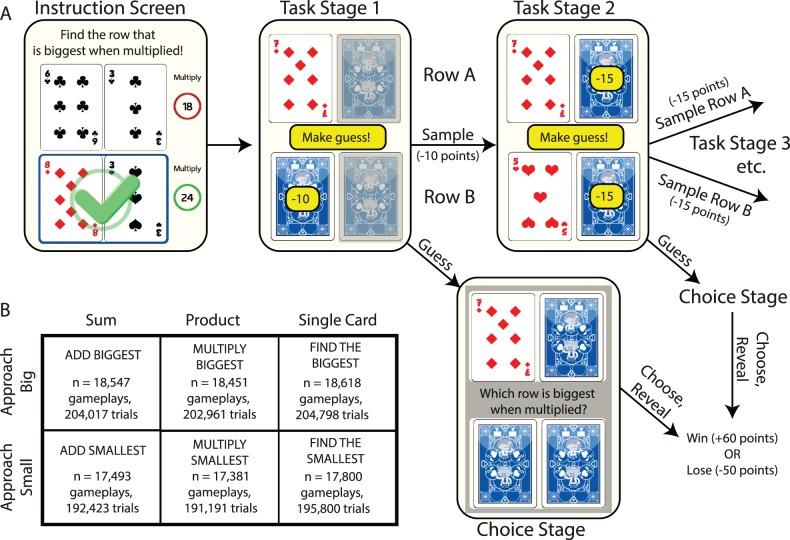
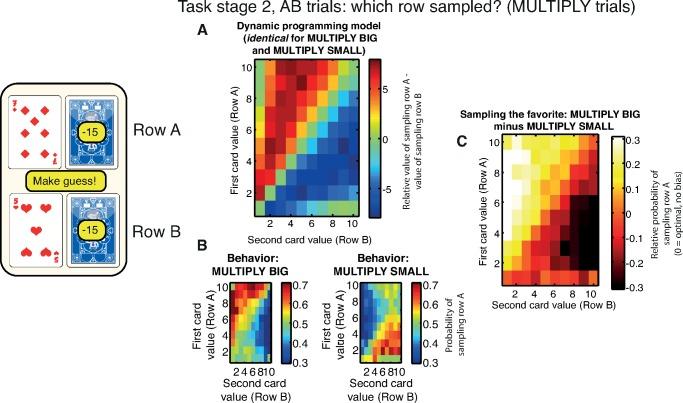
Information sampling is often biased towards seeking evidence that confirms one's prior beliefs. Despite such biases being a pervasive feature of human behavior, their underlying causes remain unclear. Many accounts of these biases appeal to limitations of human hypothesis testing and cognition, de facto evoking notions of bounded rationality, but neglect more basic aspects of behavioral control. Here, we investigated a potential role for Pavlovian approach in biasing which information humans will choose to sample. We collected a large novel dataset from 32,445 human subjects, making over 3 million decisions, who played a gambling task designed to measure the latent causes and extent of information-sampling biases. We identified three novel approach-related biases, formalized by comparing subject behavior to a dynamic programming model of optimal information gathering. These biases reflected the amount of information sampled ("positive evidence approach"), the selection of which information to sample ("sampling the favorite"), and the interaction between information sampling and subsequent choices ("rejecting unsampled options"). The prevalence of all three biases was related to a Pavlovian approach-avoid parameter quantified within an entirely independent economic decision task. Our large dataset also revealed that individual differences in the amount of information gathered are a stable trait across multiple gameplays and can be related to demographic measures, including age and educational attainment. As well as revealing limitations in cognitive processing, our findings suggest information sampling biases reflect the expression of primitive, yet potentially ecologically adaptive, behavioral repertoires. One such behavior is sampling from options that will eventually be chosen, even when other sources of information are more pertinent for guiding future action.
信息采样往往偏向于寻找能够证实自己先验信念的证据。尽管这些偏差是人类行为的普遍特征,但其潜在原因仍不清楚。许多关于这些偏差的解释都诉诸于人类假设检验和认知的局限性,事实上唤起了有限理性的概念,但却忽略了行为控制中更基本的方面。在这里,我们研究了巴甫洛夫式趋近在使人类选择采样何种信息产生偏差方面的潜在作用。我们从32445名人类受试者那里收集了一个大型的全新数据集,他们做出了超过300万个决策,这些受试者参与了一个赌博任务,该任务旨在测量信息采样偏差的潜在原因和程度。我们识别出了三种与趋近相关的新偏差,通过将受试者的行为与最优信息收集的动态规划模型进行比较来形式化这些偏差。这些偏差反映了采样信息的数量(“积极证据趋近”)、选择采样哪些信息(“采样偏好选项”)以及信息采样与后续选择之间的相互作用(“拒绝未采样选项”)。所有这三种偏差的普遍程度都与在一个完全独立的经济决策任务中量化的巴甫洛夫式趋近 - 回避参数有关。我们的大型数据集还表明,收集信息数量上的个体差异是跨多个游戏环节的稳定特质,并且可能与人口统计学指标相关,包括年龄和教育程度。除了揭示认知处理方面的局限性,我们的研究结果还表明,信息采样偏差反映了原始的、但可能具有生态适应性的行为模式的表现。一种这样的行为是从最终会被选择的选项中进行采样,即使其他信息来源对指导未来行动更相关。


 Zotero 插件