
2009 - 2013年越南医护人员的感染控制与结核病情况:一项横断面调查
Infection control and tuberculosis among health care workers in Viet Nam, 2009-2013: a cross-sectional survey.
作者信息
Tiemersma Edine W, Huong Nguyen Thien, Yen Pham Hoang, Tinh Bui Thi, Thuy Tran Thi Bich, Van Hung Nguyen, Mai Nguyen Thanh, Verver Suzanne, Gebhard Agnes, Nhung Nguyen Viet
机构信息
KNCV Tuberculosis Foundation, Benoordenhoutseweg 46, 2596 BC, The Hague, The Netherlands.
KNCV Tuberculosis Foundation Vietnam Country Office, 130 Mai Anh Tuan Street, Hanoi, Vietnam.
出版信息
BMC Infect Dis. 2016 Nov 10;16(1):664. doi: 10.1186/s12879-016-1993-1.
BACKGROUND
Data on tuberculosis (TB) among health care workers (HCW) and TB infection control (TBIC) indicators are rarely available at national level. We assessed multi-year trends in notification data of TB among HCW and explored possible associations with TBIC indicators.
METHODS
Notified TB incidence among HCW and 3 other TBIC indicators were collected annually from all 64 provincial and 3 national TB facilities in Vietnam. Time trends in TB notification between 2009 and 2013 were assessed using linear regression analysis. Multivariate regression models were applied to assess associations between the facility-specific 5-year notification rate and TBIC indicators.
RESULTS
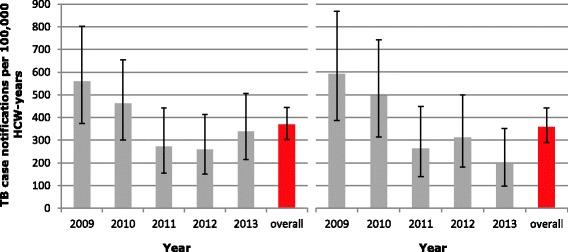
Forty-seven (70 %) of 67 facilities contributed data annually over five years; 15 reported at least one HCW with TB in 2009 compared to six in 2013. The TB notification rate dropped from 593 to 197 per 100,000 HCW (p = 0.02). Among 104 TB cases reported, 30 were employed at TB wards, 24 at other clinical wards, ten in the microbiology laboratory, six at the MDR-TB ward, and 34 in other positions. The proportion of facilities with a TBIC plan and focal person remained relatively stable between 70 % and 84 %. The proportion of facilities providing personal protective equipment (PPE) to their staff increased over time. Facilities with a TBIC focal person were 7.6 times more likely to report any TB cases than facilities without a focal person.
CONCLUSIONS
The TB notification rates among HCW seemed to decrease over time. Availability of PPE increased over the same period. Appointing a TBIC focal person was associated with reporting of TB cases among HCW. It remains unclear whether TBIC measures helped in reduction of the TB notification rates in HCW.
背景
在国家层面,医护人员结核病(TB)数据以及结核病感染控制(TBIC)指标的数据很少能获取到。我们评估了医护人员结核病通报数据的多年趋势,并探讨了其与TBIC指标之间可能存在的关联。
方法
每年从越南所有64个省级结核病防治机构和3个国家级结核病防治机构收集医护人员结核病通报发病率以及其他3项TBIC指标。使用线性回归分析评估2009年至2013年期间结核病通报的时间趋势。应用多变量回归模型评估特定机构的5年通报率与TBIC指标之间的关联。
结果
67个机构中有47个(70%)在5年期间每年提供数据;2009年有15个机构报告至少有1名医护人员患结核病,而2013年为6个。医护人员结核病通报率从每10万人593例降至197例(p = 0.02)。在报告的104例结核病病例中,30例受雇于结核病病房,24例在其他临床病房,10例在微生物实验室,6例在耐多药结核病病房,34例在其他岗位。有TBIC计划和责任人的机构比例在70%至84%之间保持相对稳定。为员工提供个人防护装备(PPE)的机构比例随时间增加。有TBIC责任人的机构报告任何结核病病例的可能性是没有责任人机构的7.6倍。
结论
医护人员的结核病通报率似乎随时间下降。同期PPE的可获得性增加。指定TBIC责任人与医护人员结核病病例的报告相关。目前尚不清楚TBIC措施是否有助于降低医护人员的结核病通报率。

 Zotero 插件