
CD169阳性淋巴结巨噬细胞在乳腺癌患者中的临床意义
The Clinical Significance of CD169-Positive Lymph Node Macrophage in Patients with Breast Cancer.
作者信息
Shiota Takuya, Miyasato Yuko, Ohnishi Koji, Yamamoto-Ibusuki Mutsuko, Yamamoto Yutaka, Iwase Hirotaka, Takeya Motohiro, Komohara Yoshihiro
机构信息
Department of Cell Pathology Graduate School of Medical Sciences, Kumamoto University, Kumamoto, Japan.
Department of Molecular-Targeting Therapy for Breast Cancer, Kumamoto University Hospital, Kumamoto, Japan.
出版信息
PLoS One. 2016 Nov 18;11(11):e0166680. doi: 10.1371/journal.pone.0166680. eCollection 2016.
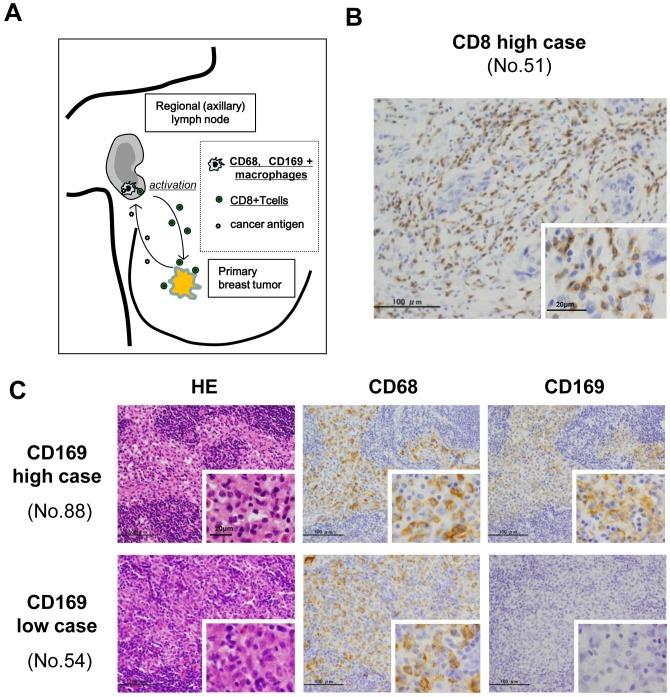
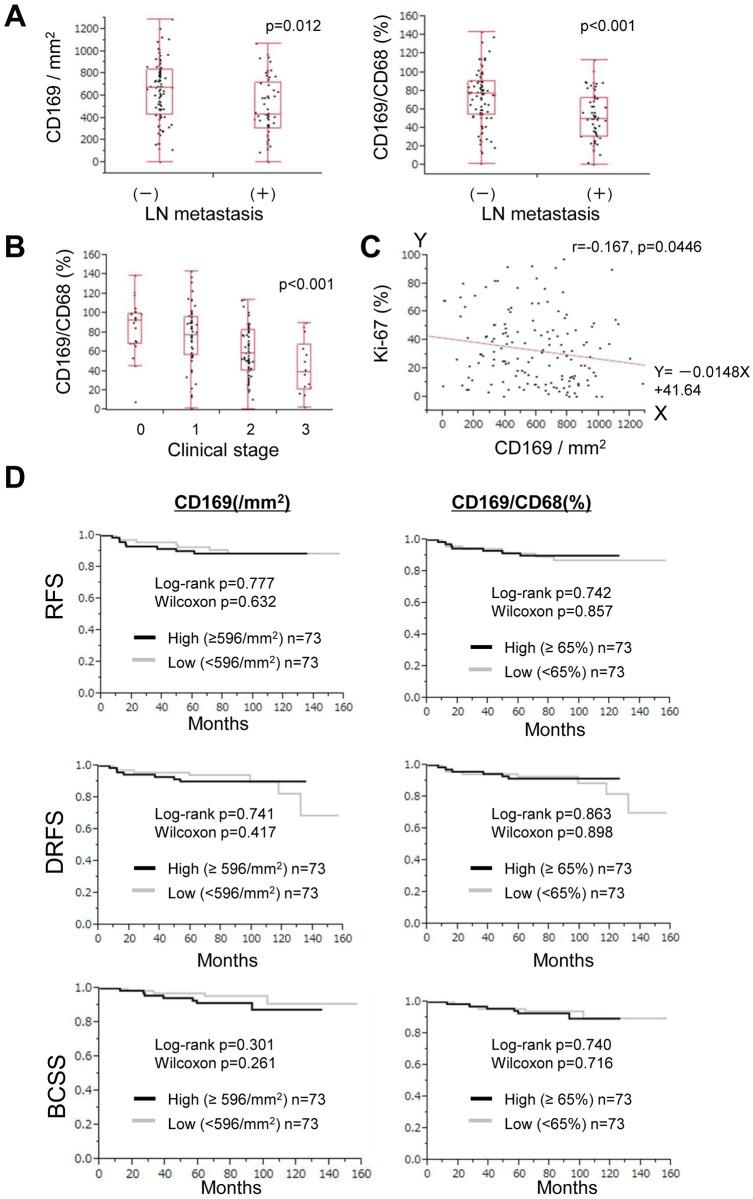
The immune status of patients can impact on the clinical course of cancer. Lymph node (LN) macrophages play critical roles in anti-cancer immunity via the activation of cytotoxic T-lymphocytes (CTLs). In this study, the prognostic significance of CD169+ LN macrophages was examined in patients with breast cancer. For this purpose the number of CD169+ cells and their ratio relative to total macrophages (CD68+) in regional LNs (RLNs), as well as the number of CD8+ CTLs in tumor tissues, were investigated using immunohistochemistry of paraffin-embedded tissue samples from 146 patients with breast cancer. The association of these data with clinicopathological factors was then analyzed. The number of cells positive for the pan-macrophage marker CD68 remained relatively uniform, while the number of CD169+ cells varied across all cases. Moreover, a high density of CD169+ cells correlated with early clinical stage and no LN metastasis, while a higher CD169+ to CD68+ ratio was significantly associated with small tumor size and a low Ki-67+ rate. There was also a significant correlation between the number of CD8+ CTLs and that of CD169+ macrophages in high grade breast cancer cases with a Ki-67 index greater than 40%. However, neither the density nor the ratio of CD169+ cells, nor the density of CD8+ CTLs, were associated with relapse-free survival, distant relapse-free survival, or breast cancer-specific survival. These findings suggest that CD169+ macrophages in RLNs might be a useful marker for assessing clinical stage, including LN states, in patients with breast cancer.
患者的免疫状态会影响癌症的临床进程。淋巴结(LN)巨噬细胞通过激活细胞毒性T淋巴细胞(CTL)在抗癌免疫中发挥关键作用。在本研究中,检测了CD169⁺ LN巨噬细胞在乳腺癌患者中的预后意义。为此,使用来自146例乳腺癌患者的石蜡包埋组织样本进行免疫组织化学,研究了区域淋巴结(RLN)中CD169⁺细胞的数量及其相对于总巨噬细胞(CD68⁺)的比例,以及肿瘤组织中CD8⁺ CTL的数量。然后分析这些数据与临床病理因素的关联。泛巨噬细胞标志物CD68阳性细胞的数量相对保持一致,而CD169⁺细胞的数量在所有病例中各不相同。此外,CD169⁺细胞的高密度与临床早期和无淋巴结转移相关,而较高的CD169⁺与CD68⁺比例与肿瘤小尺寸和低Ki-67⁺率显著相关。在Ki-67指数大于40%的高级别乳腺癌病例中,CD8⁺ CTL的数量与CD169⁺巨噬细胞的数量之间也存在显著相关性。然而,CD169⁺细胞的密度或比例,以及CD8⁺ CTL的密度,均与无复发生存率、远处无复发生存率或乳腺癌特异性生存率无关。这些发现表明,RLN中的CD169⁺巨噬细胞可能是评估乳腺癌患者临床分期(包括淋巴结状态)的有用标志物。

 Zotero 插件