
丹参酮IIA联合阿霉素以协同方式抑制非小细胞肺癌A549细胞系的恶性生物学行为。
Tanshinone IIA combined with adriamycin inhibited malignant biological behaviors of NSCLC A549 cell line in a synergistic way.
作者信息
Xie Jun, Liu Jia-Hui, Liu Heng, Liao Xiao-Zhong, Chen Yuling, Lin Mei-Gui, Gu Yue-Yu, Liu Tao-Li, Wang Dong-Mei, Ge Hui, Mo Sui-Lin
机构信息
The First Affiliated Hospital, Sun Yat-sen University, Guangzhou, 510080, People's Republic of China.
School of Chinese Medicine, The University of Hong Kong, Hong Kong S.A.R., People's Republic of China.
出版信息
BMC Cancer. 2016 Nov 18;16(1):899. doi: 10.1186/s12885-016-2921-x.
BACKGROUND
The study was designed to develop a platform to verify whether the extract of herbs combined with chemotherapy drugs play a synergistic role in anti-tumor effects, and to provide experimental evidence and theoretical reference for finding new effective sensitizers.
METHODS
Inhibition of tanshinone IIA and adriamycin on the proliferation of A549, PC9 and HLF cells were assessed by CCK8 assays. The combination index (CI) was calculated with the Chou-Talalay method, based on the median-effect principle. Migration and invasion ability of A549 cells were determined by wound healing assay and transwell assay. Flow cytometry was used to detect the cell apoptosis and the distribution of cell cycles. TUNEL staining was used to detect the apoptotic cells. Immunofluorescence staining was used to detect the expression of Cleaved Caspase-3. Western blotting was used to detect the proteins expression of relative apoptotic signal pathways. CDOCKER module in DS 2.5 was used to detect the binding modes of the drugs and the proteins.
RESULTS
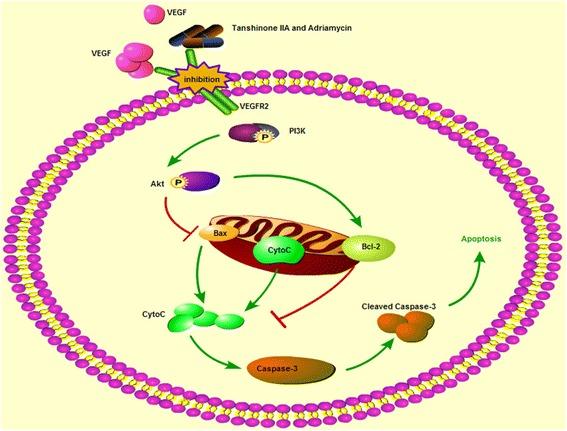
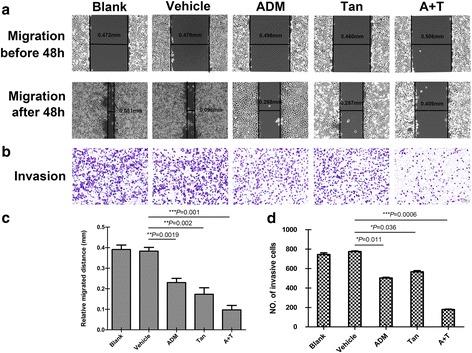
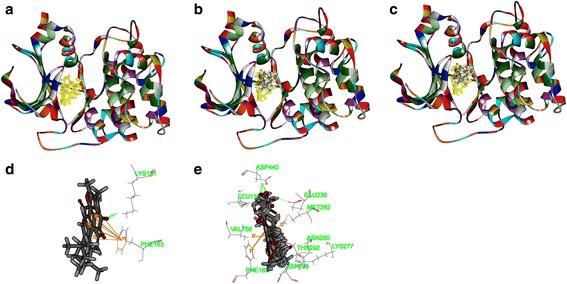
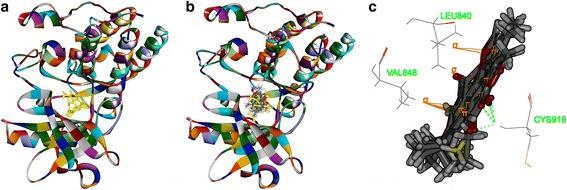
Both tanshinone IIA and adriamycin could inhibit the growth of A549, PC9, and HLF cells in a dose- and time-dependent manner, while the proliferative inhibition effect of tanshinone IIA on cells was much weaker than that of adriamycin. Different from the cancer cells, HLF cells displayed a stronger sensitivity to adriamycin, and a weaker sensitivity to tanshinone IIA. When tanshinone IIA combined with adriamycin at a ratio of 20:1, they exhibited a synergistic anti-proliferation effect on A549 and PC9 cells, but not in HLF cells. Tanshinone IIA combined with adriamycin could synergistically inhibit migration, induce apoptosis and arrest cell cycle at the S and G2 phases in A549 cells. Both groups of the single drug treatment and the drug combination up-regulated the expressions of Cleaved Caspase-3 and Bax, but down-regulated the expressions of VEGF, VEGFR2, p-PI3K, p-Akt, Bcl-2, and Caspase-3 protein. Compared with the single drug treatment groups, the drug combination groups were more statistically significant. The molecular docking algorithms indicated that tanshinone IIA could be docked into the active sites of all the tested proteins with H-bond and aromatic interactions, compared with that of adriamycin.
CONCLUSIONS
Tanshinone IIA can be developed as a novel agent in the postoperative adjuvant therapy combined with other anti-tumor agents, and improve the sensibility of chemotherapeutics for non-small cell lung cancer with fewer side effects. In addition, this experiment can not only provide a reference for the development of more effective anti-tumor medicine ingredients, but also build a platform for evaluating the anti-tumor effects of Chinese herbal medicines in combination with chemotherapy drugs.
背景
本研究旨在开发一个平台,以验证草药提取物与化疗药物联合使用是否在抗肿瘤作用中发挥协同作用,并为寻找新的有效增敏剂提供实验证据和理论参考。
方法
采用CCK8法评估丹参酮IIA和阿霉素对A549、PC9和HLF细胞增殖的抑制作用。根据中效原理,采用Chou-Talalay法计算联合指数(CI)。通过伤口愈合试验和Transwell试验检测A549细胞的迁移和侵袭能力。采用流式细胞术检测细胞凋亡和细胞周期分布。采用TUNEL染色检测凋亡细胞。采用免疫荧光染色检测Cleaved Caspase-3的表达。采用蛋白质印迹法检测相关凋亡信号通路的蛋白质表达。使用DS 2.5中的CDOCKER模块检测药物与蛋白质的结合模式。
结果
丹参酮IIA和阿霉素均能以剂量和时间依赖性方式抑制A549、PC9和HLF细胞的生长,而丹参酮IIA对细胞的增殖抑制作用远弱于阿霉素。与癌细胞不同,HLF细胞对阿霉素表现出较强的敏感性,对丹参酮IIA表现出较弱的敏感性。当丹参酮IIA与阿霉素以20:1的比例联合使用时,它们对A549和PC9细胞表现出协同抗增殖作用,但对HLF细胞无此作用。丹参酮IIA与阿霉素联合可协同抑制A549细胞的迁移。诱导凋亡并使细胞周期停滞在S期和G2期。单药治疗组和联合用药组均上调了Cleaved Caspase-3和Bax的表达,但下调了VEGF、VEGFR2、p-PI3K、p-Akt、Bcl-2和Caspase-3蛋白的表达。与单药治疗组相比,联合用药组在统计学上更具显著性。分子对接算法表明,与阿霉素相比,丹参酮IIA可通过氢键和芳香相互作用对接至所有测试蛋白的活性位点。
结论
丹参酮IIA可开发为与其他抗肿瘤药物联合使用的新型术后辅助治疗药物,并以较少的副作用提高非小细胞肺癌对化疗药物的敏感性。此外,本实验不仅可为开发更有效的抗肿瘤药物成分提供参考,还可为评估中药与化疗药物联合的抗肿瘤作用搭建平台。






 Zotero 插件