
中国手足口病的年龄模式及传播特征
Age patterns and transmission characteristics of hand, foot and mouth disease in China.
作者信息
Zhao Jijun, Jiang Fachun, Zhong Lianfa, Sun Jianping, Ding Junhang
机构信息
Complexity Science Institute, Qingdao University, Qingdao, Shandong, China.
Qingdao Center for Disease Prevention and Control, Qingdao, Shandong, China.
出版信息
BMC Infect Dis. 2016 Nov 21;16(1):691. doi: 10.1186/s12879-016-2008-y.
BACKGROUND
Hand, foot and mouth disease (HFMD) has circulated in China and caused yearly outbreak. To understand the transmission of the disease and to assess the spatial variation in cases reported, we examined age-specific transmission characteristics and reporting rates of HFMD for 31 provinces in mainland China.
METHODS
We first analyzed incidence spatial patterns and age-specific incidence patterns using dataset from 2008 to 2012. Transmission characteristics were estimated based on catalytic model. Reporting rates were estimated using a simple mass action model from "Time Series Susceptible Infectious Recovered" (TSIR) modeling.
RESULTS
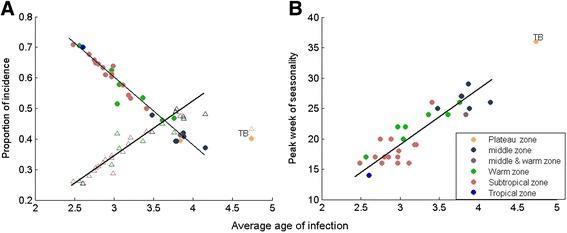
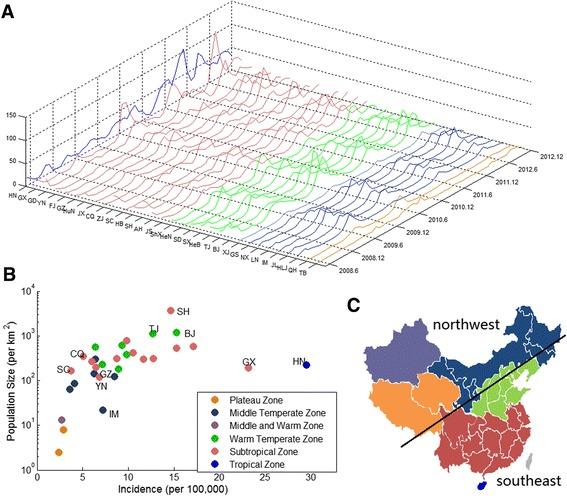
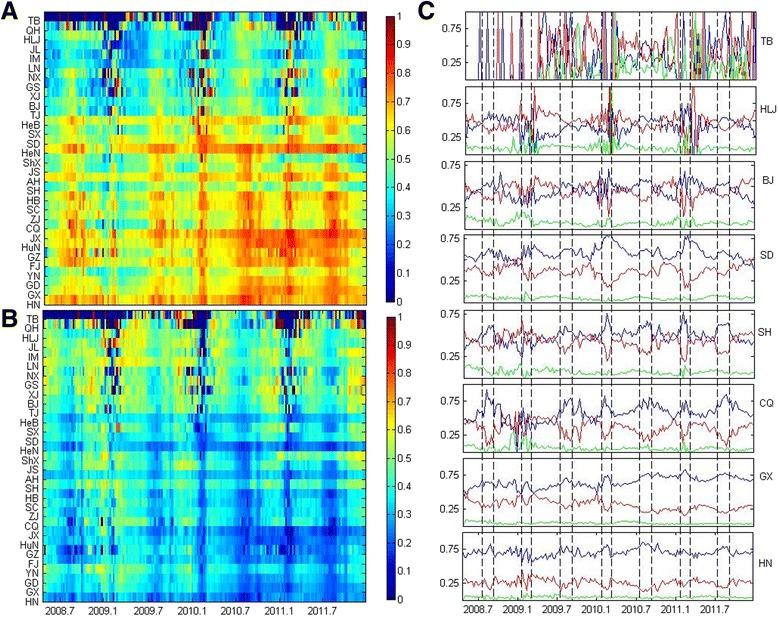
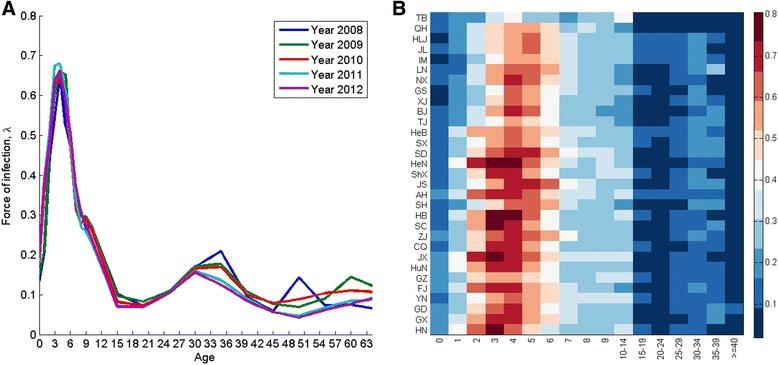
We found age-specific spatial incidence patterns: age-specific proportions of HFMD cases varied geographically in China; larger case percentage was among children of 3-5 years old in the northern part of China and was among children of 0-2 years old in the southern part of China. Our analysis results revealed that: 1) reporting rates and transmission characteristics including the average age at infection, the force of infection and the basic reproduction number varied geographically in China; 2) patterns of the age-specific force of infection for 30 provinces were similar to that of childhood infections in developed countries; the age group that had the highest infection risk was 3-5 years old in 30 provinces, and 10-14 years old in Tibet; 3) a large difference in HFMD transmission existed between northwest region and southeast region; 4) transmission characteristics determined incidence patterns: the higher the disease transmission in a province, the earlier the annual seasonality started and the more case percentage was among children 0-2 years old and less among 3-5 years old.
CONCLUSION
Because HFMD has higher transmission than most childhood infections reported, high effective vaccine coverage is needed to substantially reduce HFMD incidence. Control measures before the vaccine implementation should focus on 2-6 years old children in 30 provinces and 10-14 years old children in Tibet.
背景
手足口病(HFMD)在中国流行并每年引发疫情。为了解该疾病的传播情况并评估报告病例的空间差异,我们研究了中国大陆31个省份手足口病的年龄特异性传播特征和报告率。
方法
我们首先使用2008年至2012年的数据集分析发病率的空间模式和年龄特异性发病率模式。基于催化模型估计传播特征。使用来自“时间序列易感-感染-恢复”(TSIR)模型的简单质量作用模型估计报告率。
结果
我们发现了年龄特异性空间发病率模式:中国手足口病病例的年龄特异性比例在地理上存在差异;在中国北方,3至5岁儿童的病例百分比更高,而在中国南方,0至2岁儿童的病例百分比更高。我们的分析结果显示:1)报告率和传播特征,包括平均感染年龄、感染力和基本繁殖数在中国地理上存在差异;2)30个省份的年龄特异性感染力模式与发达国家儿童感染模式相似;30个省份感染风险最高的年龄组是3至5岁,而在西藏是10至14岁;3)西北地区和东南地区手足口病传播存在很大差异;4)传播特征决定发病率模式:一个省份疾病传播越高,年度季节性开始越早,0至2岁儿童的病例百分比越高,3至5岁儿童的病例百分比越低。
结论
由于手足口病的传播率高于大多数报告的儿童感染疾病,需要高疫苗接种覆盖率才能大幅降低手足口病发病率。疫苗实施前的控制措施应重点关注30个省份的2至6岁儿童和西藏的10至14岁儿童。

 Zotero 插件