
我们在心理健康方面是否仍存在数字鸿沟?一项为期五年的调查随访。
Do We Still Have a Digital Divide in Mental Health? A Five-Year Survey Follow-up.
作者信息
Robotham Dan, Satkunanathan Safarina, Doughty Lisa, Wykes Til
机构信息
Department of Psychology, Institute of Psychiatry, Psychology & Neuroscience, King's College London, London, United Kingdom.
出版信息
J Med Internet Res. 2016 Nov 22;18(11):e309. doi: 10.2196/jmir.6511.
BACKGROUND
Nearly everyone in society uses the Internet in one form or another. The Internet is heralded as an efficient way of providing mental health treatments and services. However, some people are still excluded from using Internet-enabled technology through lack of resources, skills, and confidence.
OBJECTIVE
Five years ago, we showed that people with severe mental illness were at risk of digital exclusion, especially middle-aged patients with psychosis and/or people from black or minority ethnic groups with psychosis. An understanding of the breadth of potential digital exclusion is vital for the implementation of digital health services. The aim of this study is to understand the context of digital exclusion for people who experience mental illness.
METHODS
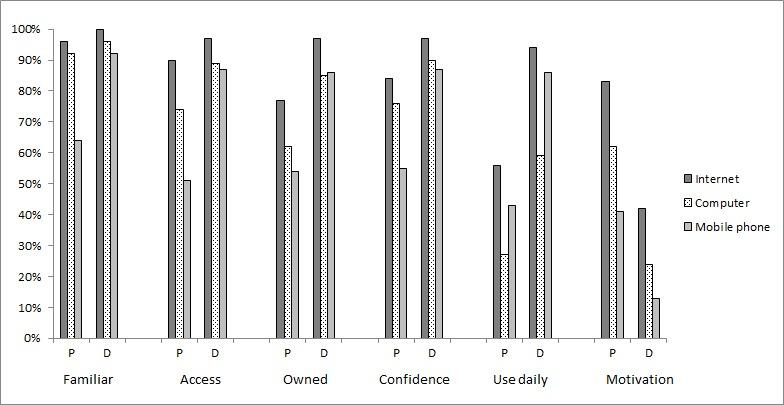
We conducted a survey involving people with a primary diagnosis of psychosis or depression in London, United Kingdom. A total of 241 participants were recruited: 121 with psychosis and 120 with depression. The majority of surveys were collected face-to-face (psychosis: n=109; depression: n=71). Participants answered questions regarding familiarity, access, use, motivation, and confidence with Internet-enabled technologies (ie, computers and mobile phones). Variables predicting digital exclusion were identified in regression analyses. The results were compared with the survey conducted in 2011.
RESULTS
Digital exclusion has declined since 2011. Online survey collection introduced biases into the sample, masking those who were likely to be excluded. Only 18.3% (20/109) of people with psychosis in our sample were digitally excluded, compared with 30% (28/93) in 2011 (χ=3.8, P=.04). People with psychosis had less confidence in using the Internet than people with depression (χ=7.4, P=.004). Only 9.9% (24/241) of participants in the total sample were digitally excluded, but the majority of these people had psychosis (n=20). Those with psychosis who were digitally excluded were significantly older than their included peers (t=3.3, P=.002) and had used services for longer (t=2.5, P=.02). Younger people were more likely to use mobile phones. Digitally excluded participants cited a lack of knowledge as a barrier to digital inclusion, and most wanted to use the Internet via computers (rather than mobile phones).
CONCLUSIONS
Digital exclusion is lower, but some remain excluded. Facilitating inclusion among this population means helping them develop skills and confidence in using technology, and providing them with access. Providing mobile phones without basic information technology training may be counterproductive because excluded people may be excluded from mobile technology too. An evidence-based digital inclusion strategy is needed within the National Health Service to help digitally excluded populations access Internet-enabled services.
背景
社会上几乎每个人都以某种形式使用互联网。互联网被誉为提供心理健康治疗和服务的有效方式。然而,由于缺乏资源、技能和信心,一些人仍然无法使用互联网技术。
目的
五年前,我们发现患有严重精神疾病的人有面临数字排斥的风险,尤其是中年精神病患者和/或患有精神病的黑人和少数族裔群体。了解潜在数字排斥的广度对于数字健康服务的实施至关重要。本研究的目的是了解患有精神疾病的人面临数字排斥的情况。
方法
我们在英国伦敦对初步诊断为精神病或抑郁症的人进行了一项调查。共招募了241名参与者:121名患有精神病,120名患有抑郁症。大多数调查问卷是面对面收集的(精神病患者:n = 109;抑郁症患者:n = 71)。参与者回答了有关对互联网技术(即计算机和手机)的熟悉程度、获取情况、使用情况、动机和信心的问题。在回归分析中确定了预测数字排斥的变量。将结果与2011年进行的调查进行了比较。
结果
自2011年以来,数字排斥有所下降。在线调查收集给样本带来了偏差,掩盖了那些可能被排斥的人。我们样本中只有18.3%(20/109)的精神病患者被数字排斥,而2011年这一比例为30%(28/93)(χ = 3.8,P = 0.04)。与抑郁症患者相比,精神病患者使用互联网的信心较低(χ = 7.4,P = 0.004)。总样本中只有9.9%(24/241)的参与者被数字排斥,但其中大多数人患有精神病(n = 20)。被数字排斥的精神病患者明显比未被排斥的同龄人年龄大(t = 3.3,P = 0.002),并且使用服务的时间更长(t = 2.5,P = 0.02)。年轻人更有可能使用手机。被数字排斥的参与者将缺乏知识视为数字融入的障碍,并且大多数人希望通过计算机(而不是手机)使用互联网。
结论
数字排斥情况有所改善,但仍有一些人被排斥在外。促进这一群体的融入意味着帮助他们培养使用技术的技能和信心,并为他们提供使用机会。在没有基本信息技术培训的情况下提供手机可能会适得其反,因为被排斥的人可能也会被排除在移动技术之外。国民保健服务体系需要一项基于证据的数字融入战略,以帮助被数字排斥的人群获取互联网服务。
 Zotero 插件