
肾移植后同种异体移植排斥反应中γ干扰素和程序性死亡1的DNA甲基化变化
Variations in DNA methylation of interferon gamma and programmed death 1 in allograft rejection after kidney transplantation.
作者信息
Boer Karin, de Wit L Elly A, Peters Fleur S, Hesselink Dennis A, Hofland Leo J, Betjes Michiel G H, Looman Caspar W N, Baan Carla C
机构信息
Department of Internal Medicine, Section Nephrology and Transplantation, Erasmus MC, University Medical Center Rotterdam, Room Na520, P.O. Box 2040, 3000 CA Rotterdam, The Netherlands.
Department of Internal Medicine, Section Endocrinology, University Medical Center Rotterdam, Rotterdam, The Netherlands.
出版信息
Clin Epigenetics. 2016 Nov 16;8:116. doi: 10.1186/s13148-016-0288-0. eCollection 2016.
BACKGROUND
The role of DNA methylation in the regulation of the anti-donor-directed immune response after organ transplantation is unknown. Here, we studied the methylation of two mediators of the immune response: the pro-inflammatory cytokine () and the inhibitory receptor () in naïve and memory CD8+ T cell subsets in kidney transplant recipients receiving immunosuppressive medication. Both recipients experiencing an episode of acute allograft rejection (rejectors) as well as recipients without rejection (non-rejectors) were included.
RESULTS
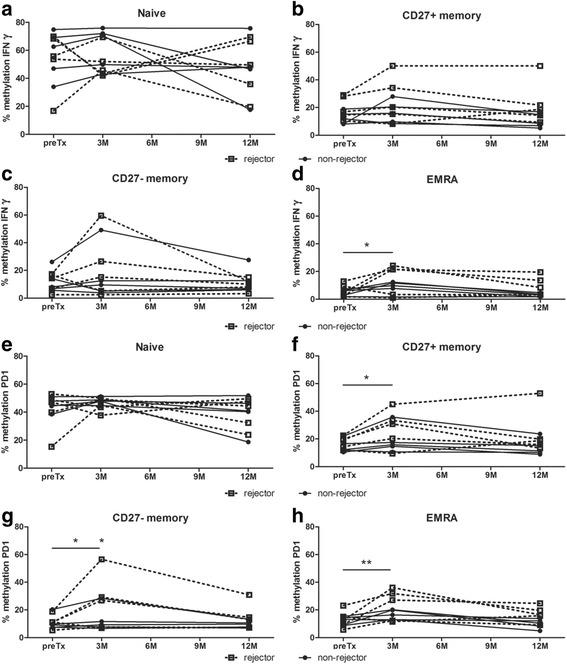
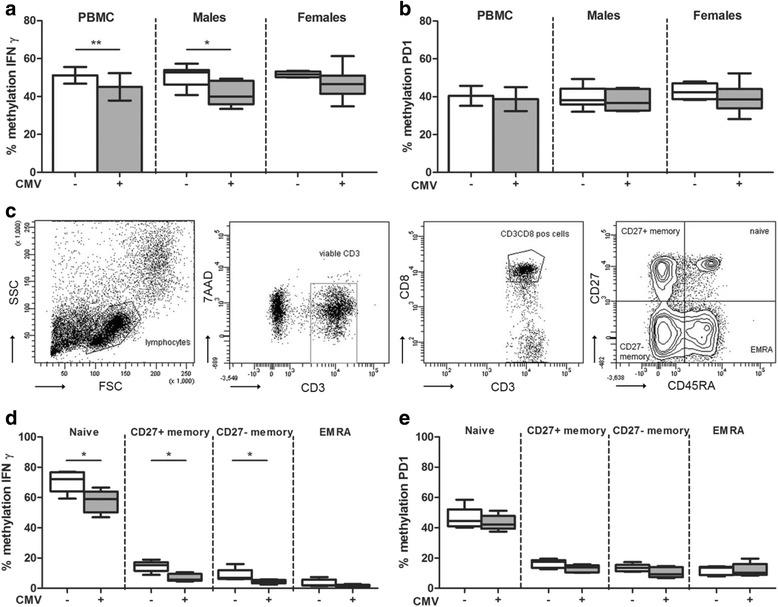
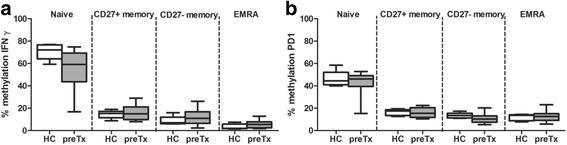
CpGs in the promoter regions of both and were significantly ( < 0.001) higher methylated in the naïve CD8+ T cells compared to the memory T cell subsets. The methylation status of both and inversely correlated with the percentage of IFNγ or PD1-producing cells. Before transplantation, the methylation status of both and was not significantly different from healthy donors. At 3 months after transplantation, irrespective of rejection and subsequent anti-rejection therapy, the methylation was significantly higher in the differentiated effector memory CD45RA+ (EMRA) CD8+ T cells ( = 0.01) whereas the PD1 methylation was significantly higher in all memory CD8+ T cell subsets (CD27+ memory; = 0.02: CD27- memory; = 0.02: EMRA; = 0.002). Comparing the increase in methylation in the first 3 months after transplantation between rejectors and non-rejectors demonstrated a significantly more prominent increase in the methylation in the CD27- memory CD8+ T cells in rejectors (increase in rejectors 14%, increase in non-rejectors 1.9%, = 0.04). The increase in DNA methylation in the other memory CD8+ T cells was not significantly different between rejectors and non-rejectors. At 12 months after transplantation, the methylation of both and returned to baseline levels.
CONCLUSIONS
The DNA methylation of both and increases the first 3 months after transplantation in memory CD8+ T cells in kidney transplant recipients. This increase was irrespective of a rejection episode indicating that general factors of the kidney transplantation procedure, including the use of immunosuppressive medication, contribute to these variations in DNA methylation.
背景
DNA甲基化在器官移植后抗供体定向免疫反应调节中的作用尚不清楚。在此,我们研究了免疫反应的两种介质的甲基化情况:促炎细胞因子()和抑制性受体(),在接受免疫抑制药物治疗的肾移植受者的初始和记忆CD8 + T细胞亚群中。纳入了经历急性移植排斥发作的受者(排斥者)以及未发生排斥的受者(非排斥者)。
结果
与记忆T细胞亚群相比,初始CD8 + T细胞中 和 启动子区域的CpG甲基化显著更高(<0.001)。 和 的甲基化状态与产生IFNγ或PD1的细胞百分比呈负相关。移植前, 和 的甲基化状态与健康供体无显著差异。移植后3个月,无论是否发生排斥及后续抗排斥治疗,分化的效应记忆CD45RA +(EMRA)CD8 + T细胞中 的甲基化显著更高(= 0.01),而所有记忆CD8 + T细胞亚群(CD27 +记忆;= 0.02:CD27 -记忆;= 0.02:EMRA;= 0.002)中PD1的甲基化显著更高。比较排斥者和非排斥者移植后前3个月甲基化的增加情况,发现排斥者CD27 -记忆CD8 + T细胞中 的甲基化增加更为显著(排斥者增加14%,非排斥者增加1.9%,= 0.04)。其他记忆CD8 + T细胞中DNA甲基化的增加在排斥者和非排斥者之间无显著差异。移植后12个月, 和 的甲基化均恢复至基线水平。
结论
肾移植受者记忆CD8 + T细胞中 和 的DNA甲基化在移植后前3个月增加。这种增加与排斥发作无关,表明肾移植过程中的一般因素,包括免疫抑制药物的使用,导致了这些DNA甲基化的变化。

 Zotero 插件