
与早产儿支气管肺发育不良/死亡率相关的生物标志物。
Biomarkers associated with bronchopulmonary dysplasia/mortality in premature infants.
作者信息
Balena-Borneman Jessica, Ambalavanan Namasivayam, Tiwari Hemant K, Griffin Russell L, Halloran Brian, Askenazi David
机构信息
Department of Biostatistics, University of Alabama at Birmingham, Birmingham, Alabama.
Department of Pediatrics, University of Alabama at Birmingham, Birmingham, Alabama.
出版信息
Pediatr Res. 2017 Mar;81(3):519-525. doi: 10.1038/pr.2016.259. Epub 2016 Nov 28.
BACKGROUND
Bronchopulmonary dysplasia (BPD) portends lifelong organ impairment and death. Our ability to predict BPD in first days of life is limited, but could be enhanced using novel biomarkers.
METHODS
Using an available clinical and urine biomarker database obtained from a prospective 113 infant cohort (birth weight ≤1,200 g and/or gestational age ≤31 wk), we evaluated the independent association of 14 urine biomarkers with BPD/mortality.
RESULTS
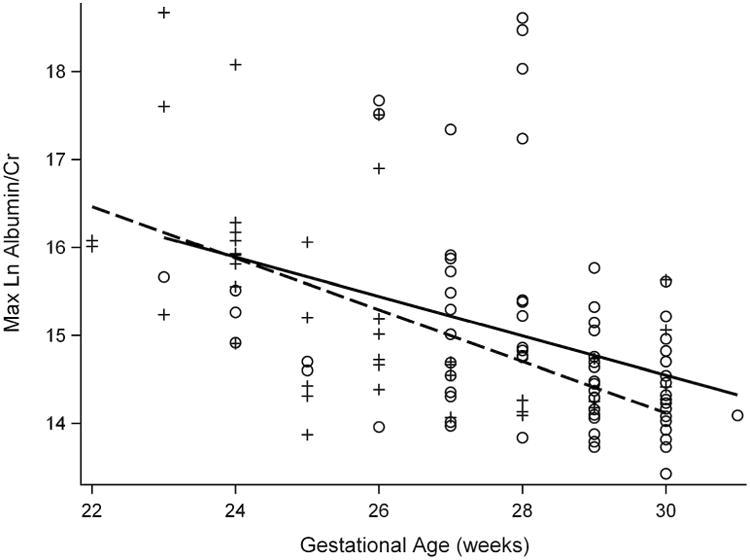
Two of the 14 urine biomarkers were independently associated with BPD/mortality after controlling for gestational age (GA), small for gestational age (SGA), and intubation status. The best performing protein was clusterin, a ubiquitously expressed protein and potential sensor of oxidative stress associated with lung function in asthma patients. When modeling for BPD/mortality, the independent odds ratio for maximum adjusted urine clusterin was 9.2 (95% CI: 3.3-32.8, P < 0.0001). In this model, clinical variables (GA, intubation status, and SGA) explained 38.3% of variance; clusterin explained an additional 9.2%, while albumin explained an additional 3.4%. The area under the curve incorporating clinical factors and biomarkers was 0.941.
CONCLUSION
Urine clusterin and albumin may improve our ability to predict BPD/mortality. Future studies are needed to validate these findings and determine their clinical usefulness.
背景
支气管肺发育不良(BPD)预示着终身器官损害和死亡。我们在生命最初几天预测BPD的能力有限,但使用新型生物标志物可能会有所增强。
方法
利用从一个前瞻性的113例婴儿队列(出生体重≤1200g和/或胎龄≤31周)获得的可用临床和尿液生物标志物数据库,我们评估了14种尿液生物标志物与BPD/死亡率的独立关联。
结果
在控制胎龄(GA)、小于胎龄(SGA)和插管状态后,14种尿液生物标志物中的两种与BPD/死亡率独立相关。表现最佳的蛋白质是簇集素,一种普遍表达的蛋白质,是哮喘患者中与肺功能相关的氧化应激的潜在传感器。在对BPD/死亡率进行建模时,最大调整后尿液簇集素的独立比值比为9.2(95%CI:3.3 - 32.8,P < 0.0001)。在该模型中,临床变量(GA、插管状态和SGA)解释了38.3%的方差;簇集素额外解释了9.2%,而白蛋白额外解释了3.4%。纳入临床因素和生物标志物的曲线下面积为0.941。
结论
尿液簇集素和白蛋白可能会提高我们预测BPD/死亡率的能力。需要进一步的研究来验证这些发现并确定它们的临床实用性。

 Zotero 插件