
在医疗评估单元确保及时进行血栓预防。
Ensuring timely thromboprophylaxis on a Medical Assessment Unit.
作者信息
Akinbobuyi Oluwatosin, Shalders Louise, Nokes Tim
机构信息
Derriford Hospital, Plymouth Hospitals NHS Trust, United Kingdom.
出版信息
BMJ Qual Improv Rep. 2016 Nov 22;5(1). doi: 10.1136/bmjquality.u212414.w4934. eCollection 2016.
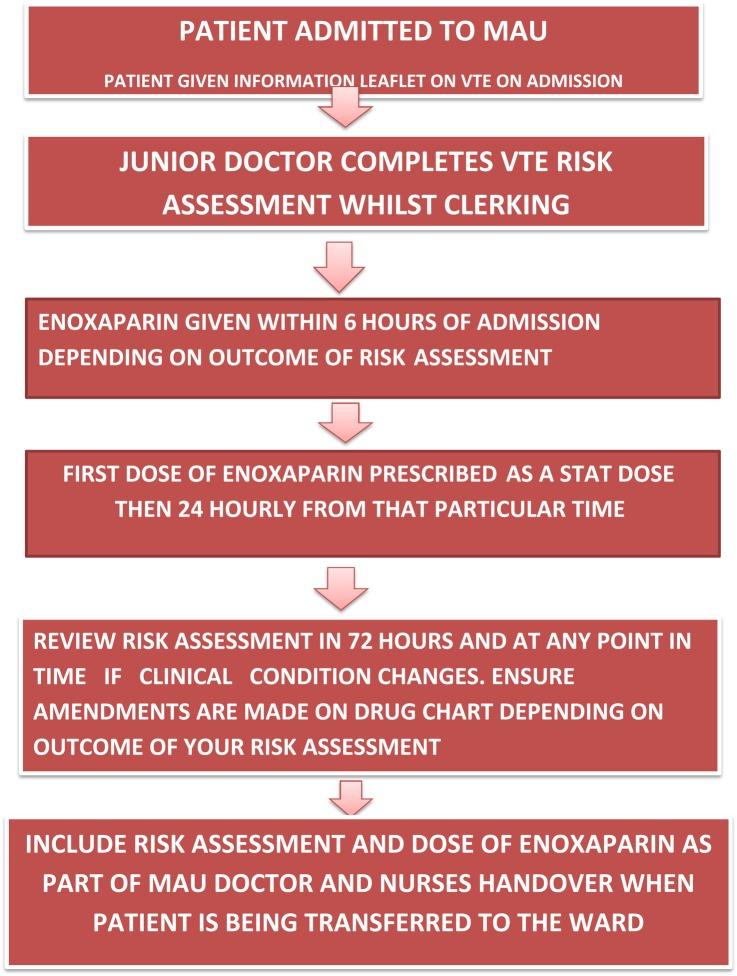
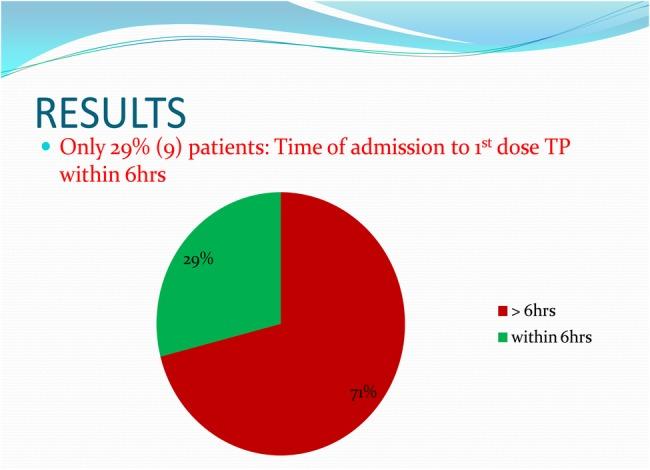
The Department of Health has defined hospital acquired venous thromboembolism (VTE) as any VTE event occurring within 90 days of hospital admission or surgery. Hospital acquired thrombosis (HAT) is common during and after hospital admission and is considered a major patient safety issue. Current NICE guideline (CG 92) 2010, recommends that medical patients assessed at risk of VTE should have pharmacological prophylaxis commenced as soon as possible after risk assessment has been completed and continued until the patient is no longer at increased risk of VTE. This quality improvement project was carried out in the medical assessment unit in Derriford Hospital, Plymouth. We aimed to increase appropriate VTE pharmacological prophylaxis to 100% prescribed in 6 hours by the end of May 2016 using the Plan-Do-Study-Act (PDSA) methodology. The primary outcome measure was whether or not enoxaparin was given within 6 hours of admission. Analysis showed that a major contributing factor to the prolonged time interval was lack of awareness of the Trust VTE guidelines which had recently been updated in accordance with NICE recommendations. Baseline measurement demonstrated that 29% of patients had first dose of enoxaparin within the 6-hour target, with a mean delay of 12 hours 22 minutes. With implementation of an education programme and development of a local VTE prevention care pathway to raise awareness of the new guidelines, a significant improvement was achieved with 71% of patients meeting the 6-hour target in PDSA cycle 1 and 83% of patients in PDSA cycle 2. The average time interval also reduced to 5 hours 52 minutes in PDSA cycle 1 and 5 hours 7 minutes in PDSA cycle 2. In conclusion, through utilization of simple change methodology, enoxaparin prescribing practice significantly improved. Potentially this may reduce morbidity (and mortality) associated with HAT together with cost implications of its management.
英国卫生部已将医院获得性静脉血栓栓塞症(VTE)定义为在入院或手术后90天内发生的任何VTE事件。医院获得性血栓形成(HAT)在入院期间及之后很常见,被视为一个重大的患者安全问题。英国国家卫生与临床优化研究所(NICE)2010年的现行指南(CG 92)建议,经评估有VTE风险的内科患者,应在完成风险评估后尽快开始进行药物预防,并持续至患者不再有VTE风险增加的情况。这个质量改进项目在普利茅斯德里福德医院的内科评估单元开展。我们的目标是通过计划-实施-研究-改进(PDSA)方法,到2016年5月底将适当的VTE药物预防比例提高到100%,且在6小时内开出医嘱。主要结局指标是入院后6小时内是否给予了依诺肝素。分析表明,导致时间间隔延长的一个主要因素是对信托机构VTE指南缺乏认识,该指南最近已根据NICE的建议进行了更新。基线测量显示,29%的患者在6小时目标时间内接受了首剂依诺肝素,平均延迟时间为12小时22分钟。通过实施一项教育计划并制定当地的VTE预防护理路径以提高对新指南的认识,取得了显著改善,在PDSA循环1中有71%的患者达到了6小时目标,在PDSA循环2中有83%的患者达到了该目标。平均时间间隔在PDSA循环1中也缩短至5小时52分钟,在PDSA循环2中缩短至5小时7分钟。总之,通过采用简单的变革方法,依诺肝素的处方实践有了显著改善。这可能会降低与HAT相关的发病率(和死亡率)及其管理的成本。
 Zotero 插件