
中国患乳腺炎奶牛中产超广谱β-内酰胺酶(ESBL)的菌株含有与插入序列(IS)相连的、带有CTX-M的临床1类整合子。
ESBL-Producing from Cows Suffering Mastitis in China Contain Clinical Class 1 Integrons with CTX-M Linked to IS.
作者信息
Ali Tariq, Ur Rahman Sadeeq, Zhang Limei, Shahid Muhammad, Zhang Shiyao, Liu Gang, Gao Jian, Han Bo
机构信息
Department of Clinical Veterinary Medicine, College of Veterinary Medicine, China Agricultural University Beijing, China.
College of Veterinary Sciences and Animal Husbandry, Abdul Wali Khan University, Garden Campus Mardan, Pakistan.
出版信息
Front Microbiol. 2016 Nov 30;7:1931. doi: 10.3389/fmicb.2016.01931. eCollection 2016.
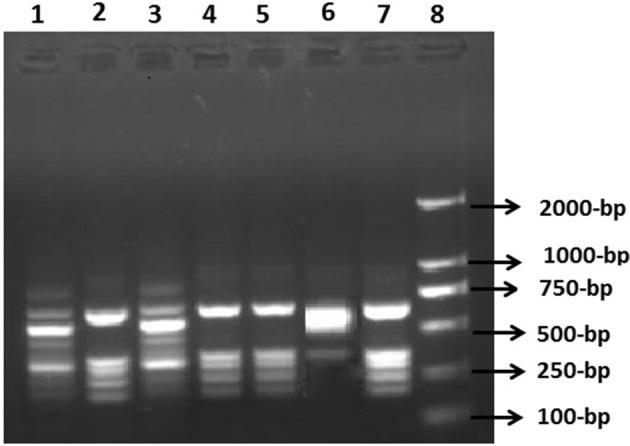
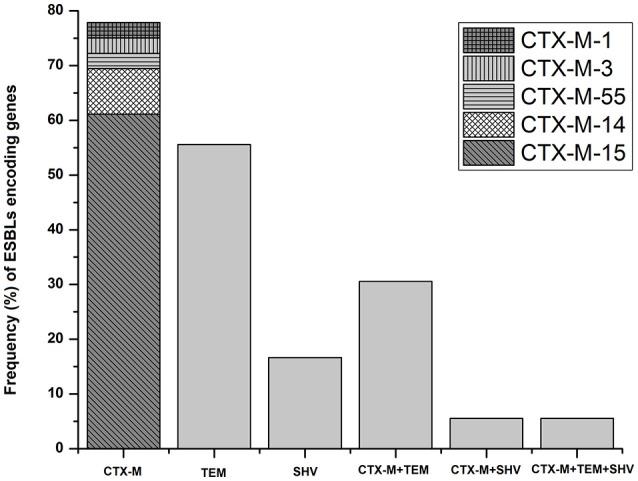
The prevalence of pathogenic multi-drug resistant (MDR) extended-spectrum β-lactamase (ESBL)-producing is rapidly increasing, becoming a global concern. In a veterinary context, ESBL-producing are mostly reported in poultry and pigs. Here, we report on the prevalence and characterize ESBL-producing isolated from diverse dairy farms in China. Overall, 36 (23.53%) out of 153 isolates from mastitic milk samples ( = 1252) were confirmed as ESBL-producers by double-disc synergy testing and PCR. Nucleotide analysis of PCR amplicons revealed that was the predominant ESBL gene detected in 28 (77.78%) isolates, with being the major (78.57%) allele encoding for ESBLs. Also, 20 (55.56%) and 6 (16.67%) of the ESBL isolates were carrying and genes, respectively, in singlet or in combination. The majority of these isolates belonged to phylo-group A (69.44%) and D (16.67%). Strikingly, all these isolates were found to be MDR showing high resistance to cephalosporins including the fourth generation cefepime and common non β-lactams. Additionally, class 1 integrons () were found in 30 (83.33%) isolates. Analysis of the class 1 integrons variable regions indicated that they were carrying up to five different gene cassettes conferring resistance to various drugs with a predominant combination of genes in tandem, conferring resistance to aminoglycosides and trimethoprim. However, no ESBL encoding genes were found in the cassettes. Interestingly, 22 (66.11%) of the ESBL isolates were also carrying insertion sequence common region 1 (IS) which was found to be associated with most of the CTX-M genes. Altogether, the current study reports on the high prevalence of ESBL-positive , particularly CTX-M-15, carrying clinical class 1 integrons and IS elements are likely indicative of their rapid and wider dissemination, posing threats to veterinary and public health. To the best of our knowledge, this is the first comprehensive study to report on the alarming high occurrence of ESBL-producing from mastitic cows in China.
产超广谱β-内酰胺酶(ESBL)的致病性多重耐药(MDR)细菌的流行率正在迅速上升,成为全球关注的问题。在兽医领域,产ESBL的细菌大多在家禽和猪中被报道。在此,我们报告了从中国不同奶牛场分离出的产ESBL细菌的流行情况并对其进行了特征分析。总体而言,通过双碟协同试验和PCR,从1252份乳腺炎乳样中分离出的153株细菌中有36株(23.53%)被确认为产ESBL菌。PCR扩增产物的核苷酸分析表明,CTX-M是在28株(77.78%)分离株中检测到的主要ESBL基因,其中CTX-M-15是编码ESBLs的主要(78.57%)等位基因。此外,20株(55.56%)和6株(16.67%)产ESBL分离株分别单独或联合携带blaSHV和blaTEM基因。这些分离株大多数属于A系统发育群(69.44%)和D系统发育群(16.67%)。令人惊讶的是,所有这些分离株均为多重耐药,对包括第四代头孢吡肟在内的头孢菌素和常见的非β-内酰胺类药物表现出高度耐药。此外,在30株(83.33%)分离株中发现了1类整合子(intI1)。对1类整合子可变区的分析表明,它们携带多达5个不同的基因盒,赋予对各种药物的耐药性,其中以串联的aadA基因组合为主,赋予对氨基糖苷类和甲氧苄啶的耐药性。然而,在这些基因盒中未发现ESBL编码基因。有趣的是,22株(66.11%)产ESBL分离株还携带插入序列共同区域1(ISCR1),发现其与大多数CTX-M基因相关。总之,本研究报告了产ESBL细菌的高流行率,特别是携带临床1类整合子和IS元件的CTX-M-15,这可能表明它们正在迅速广泛传播,对兽医和公共卫生构成威胁。据我们所知,这是第一项全面报道中国患乳腺炎奶牛中产ESBL细菌惊人高发生率的研究。


 Zotero 插件