
从头转录组组装、EST-SSR 标记的开发和沙漠生物质柳 Salix psammophila 的种群遗传分析。
De novo transcriptome assembly, development of EST-SSR markers and population genetic analyses for the desert biomass willow, Salix psammophila.
机构信息
State Key Laboratory of Tree Genetics and Breeding, Key Laboratory of Tree Breeding and Cultivation of the State Forestry Administration, Research Institute of Forestry, Chinese Academy of Forestry, Beijing, 100091, China.
Collaborative Innovation Center of Sustainable Forestry in Southern China, Nanjing Forestry University, Nanjing, 210037, China.
出版信息
Sci Rep. 2016 Dec 20;6:39591. doi: 10.1038/srep39591.
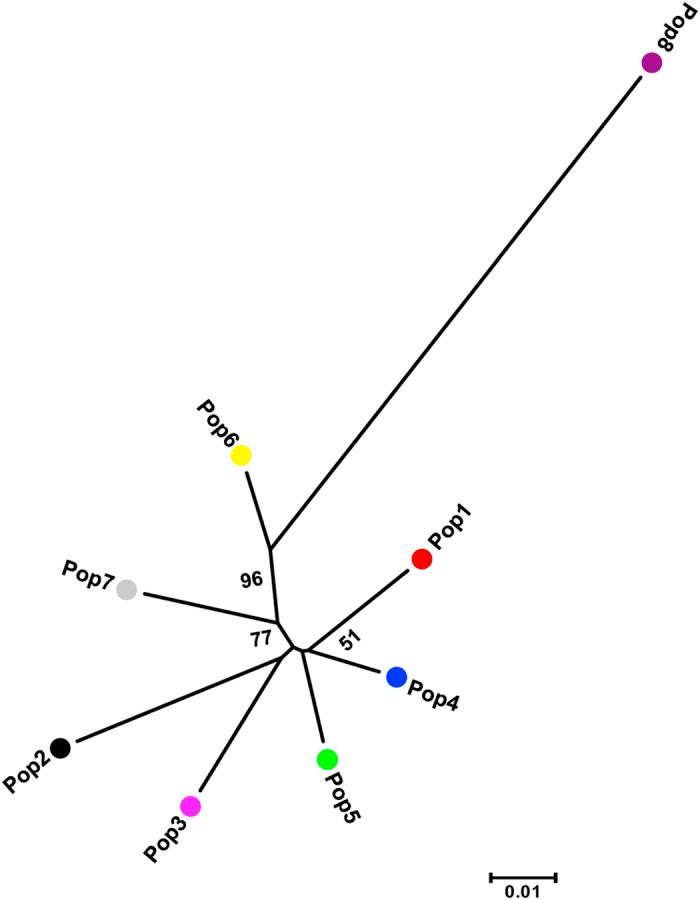
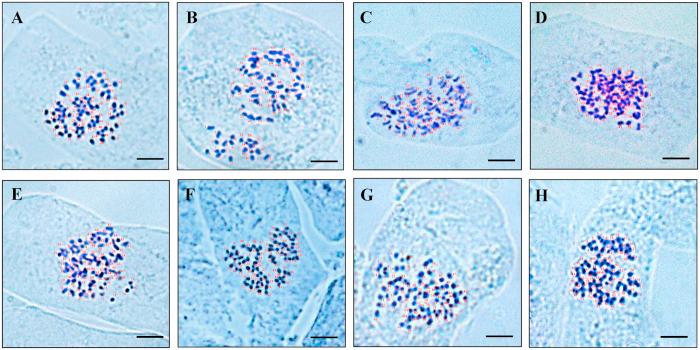
Salix psammophila, a sandy shrub known as desert willow, is regarded as a potential biomass feedstock and plays an important role in maintaining local ecosystems. However, a lack of genomic data and efficient molecular markers limit the study of its population evolution and genetic breeding. In this study, chromosome counts, flow cytometry and SSR analyses indicated that S. psammophila is tetraploid. A total of 6,346 EST-SSRs were detected based on 71,458 de novo assembled unigenes from transcriptome data. Twenty-seven EST-SSR markers were developed to evaluate the genetic diversity and population structure of S. psammophila from eight natural populations in Northern China. High levels of genetic diversity (mean 10.63 alleles per locus; mean H 0.689) were dectected in S. psammophila. The weak population structure and little genetic differentiation (pairwise F = 0.006-0.016) were found among Population 1-Population 7 (Pop1-Pop7; Inner Mongolia and Shaanxi), but Pop8 (Ningxia) was clearly separated from Pop1-Pop7 and moderate differentiation (pairwise F = 0.045-0.055) was detected between them, which may be influenced by local habitat conditions. Molecular variance analyses indicated that most of the genetic variation (94.27%) existed within populations. These results provide valuable genetic informations for natural resource conservation and breeding programme optimisation of S. psammophila.
沙柳,一种被称为沙漠柳树的沙生灌木,被认为是一种有潜力的生物质原料,在维持当地生态系统方面发挥着重要作用。然而,由于缺乏基因组数据和有效的分子标记,限制了对其种群进化和遗传育种的研究。在本研究中,染色体计数、流式细胞术和 SSR 分析表明沙柳是四倍体。基于转录组数据中 71458 个从头组装的 unigenes,共检测到 6346 个 EST-SSR。从中国北方 8 个自然种群中开发了 27 个 EST-SSR 标记,用于评估沙柳的遗传多样性和种群结构。在沙柳中检测到高水平的遗传多样性(平均每个位点 10.63 个等位基因;平均 H 0.689)。种群 1-种群 7(Pop1-Pop7;内蒙古和陕西)之间发现种群结构较弱,遗传分化较小(成对 F = 0.006-0.016),但种群 8(宁夏)与 Pop1-Pop7 明显分离,且分化程度中等(成对 F = 0.045-0.055),这可能受到当地生境条件的影响。分子方差分析表明,遗传变异的大部分(94.27%)存在于种群内部。这些结果为沙柳的自然资源保护和育种计划优化提供了有价值的遗传信息。



 Zotero 插件