
对于以经动脉化疗栓塞术(TACE)为主的肝细胞癌微创治疗,辅助性细胞免疫疗法必不可少吗?一项纳入1774例患者的研究的系统Meta分析
Is Adjuvant Cellular Immunotherapy Essential after TACE-Predominant Minimally-Invasive Treatment for Hepatocellular Carcinoma? A Systematic Meta-Analysis of Studies Including 1774 Patients.
作者信息
Ding Min, Wang Ying, Chi Jiachang, Wang Tao, Tang Xiaoyin, Cui Dan, Qian Qijun, Zhai Bo
机构信息
Department of Interventional Oncology, Renji Hospital, School of Medicine, Shanghai Jiaotong University, Shanghai, China.
Laboratory of Gene and Viral Therapy, Eastern Hepatobiliary Surgery Hospital, the Second Military Medical University of Chinese PLA, Shanghai, China.
出版信息
PLoS One. 2016 Dec 22;11(12):e0168798. doi: 10.1371/journal.pone.0168798. eCollection 2016.
PURPOSE
Cellular immunotherapy has appeared to be a promising modality for the treatment of malignant tumor. The objective of this study was to evaluate the efficacy of cellular immunotherapy combined with minimally invasive therapy.
METHODS
We searched PubMed, Web of Science and The Cochrane Library through March 2016 for relevant studies. Short-term efficacy (the disease control rate, the control rate of quality life and the AFP descent rate) and long-term efficacy (overall survival (OS) and progression-free survival (PFS) rate) were compared as the major outcome measures. The meta-analysis was performed using Review Manager 5.3.
RESULTS
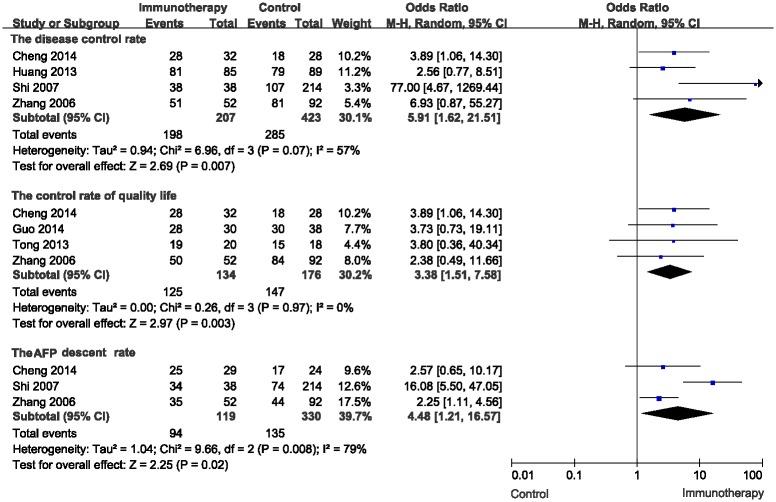
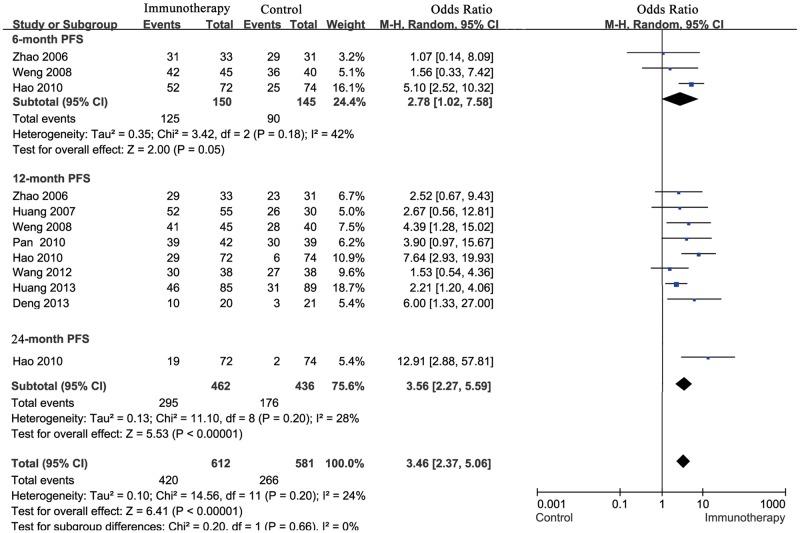
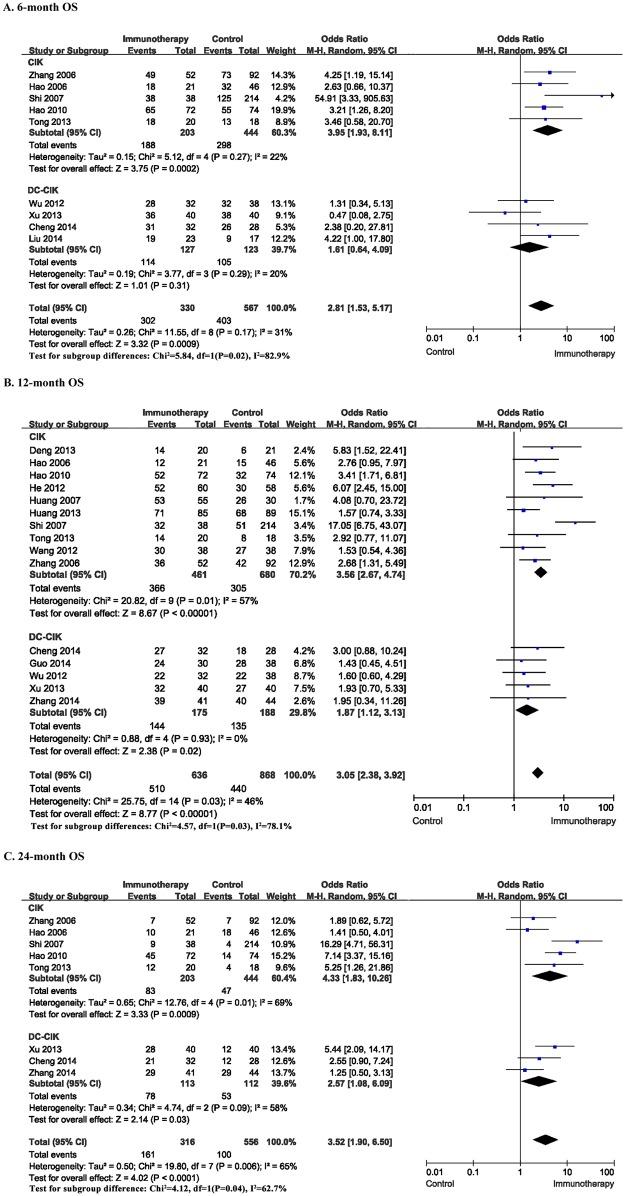
A total of 1174 references in 3 databases were found of which 19 individual studies with 1774 HCC patients enrolled in this meta-analysis. Meta-analysis results showed that cellular immunotherapy combined with minimally-invasive treatment significantly improved the measures of short-term response (the disease control rate (OR = 5.91, P = 0.007), the control rate of quality lift (OR = 3.38, P = 0.003) and the AFP descent rate (OR = 4.48, P = 0.02)). Also higher 6-month PFS (OR = 2.78, P = 0.05), ≥12-month PFS (OR = 3.56, P<0.00001) rate and 6-month OS (OR = 2.81, P = 0.0009), 12-month OS (OR = 3.05, P<0.00001) and 24-month OS (OR = 3.52, P<0.0001) rate were observed in patients undergoing cellular immunotherapy.
CONCLUSIONS
This meta-analysis suggested that cellular immunotherapy is a feasible adjuvant treatment that could be beneficial for the improvement of the clinical outcomes for hepatocellular carcinoma (HCC) patients after minimally invasive treatment, including short-term response and long-term survival.
目的
细胞免疫疗法似乎是一种治疗恶性肿瘤的有前景的方法。本研究的目的是评估细胞免疫疗法联合微创治疗的疗效。
方法
我们检索了截至2016年3月的PubMed、Web of Science和Cochrane图书馆中的相关研究。将短期疗效(疾病控制率、生活质量控制率和甲胎蛋白下降率)和长期疗效(总生存期(OS)和无进展生存期(PFS)率)作为主要结局指标进行比较。使用Review Manager 5.3进行荟萃分析。
结果
在3个数据库中总共找到了1174篇参考文献,其中19项个体研究纳入了1774例肝癌患者进行本荟萃分析。荟萃分析结果显示,细胞免疫疗法联合微创治疗显著改善了短期反应指标(疾病控制率(OR = 5.91,P = 0.007)、生活质量控制率(OR = 3.38,P = 0.003)和甲胎蛋白下降率(OR = 4.48,P = 0.02))。接受细胞免疫疗法的患者还观察到较高的6个月PFS率(OR = 2.78,P = 0.05)、≥12个月PFS率(OR = 3.56,P<0.00001)以及6个月OS率(OR = 2.81,P = 0.0009)、12个月OS率(OR = 3.05,P<0.00001)和24个月OS率(OR = 3.52,P<0.0001)。
结论
本荟萃分析表明,细胞免疫疗法是一种可行的辅助治疗方法,可能有利于改善肝细胞癌(HCC)患者微创治疗后的临床结局,包括短期反应和长期生存。


 Zotero 插件