
鲍曼不动杆菌毒力与抗生素耐药性的遗传调控
Genetic Regulation of Virulence and Antibiotic Resistance in Acinetobacter baumannii.
作者信息
Kröger Carsten, Kary Stefani C, Schauer Kristina, Cameron Andrew D S
机构信息
Department of Microbiology, School of Genetics and Microbiology, Moyne Institute of Preventive Medicine, Trinity College Dublin, Dublin 2, Ireland.
Department of Veterinary Science, Faculty of Veterinary Medicine, Ludwig-Maximilians-Universität München, Oberschleißheim 85764, Germany.
出版信息
Genes (Basel). 2016 Dec 28;8(1):12. doi: 10.3390/genes8010012.
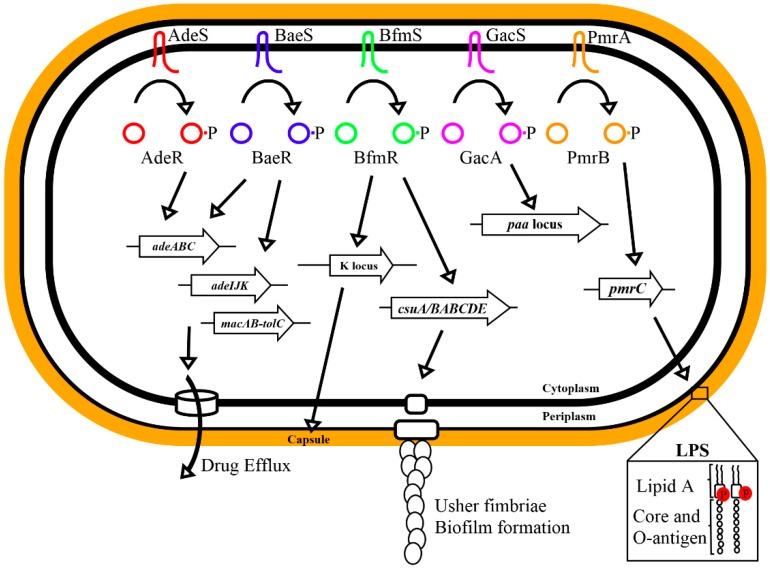
Multidrug resistant microorganisms are forecast to become the single biggest challenge to medical care in the 21st century. Over the last decades, members of the genus have emerged as bacterial opportunistic pathogens, in particular as challenging nosocomial pathogens because of the rapid evolution of antimicrobial resistances. Although we lack fundamental biological insight into virulence mechanisms, an increasing number of researchers are working to identify virulence factors and to study antibiotic resistance. Here, we review current knowledge regarding the regulation of virulence genes and antibiotic resistance in . A survey of the two-component systems AdeRS, BaeSR, GacSA and PmrAB explains how each contributes to antibiotic resistance and virulence gene expression, while BfmRS regulates cell envelope structures important for pathogen persistence. uses the transcription factors Fur and Zur to sense iron or zinc depletion and upregulate genes for metal scavenging as a critical survival tool in an animal host. Quorum sensing, nucleoid-associated proteins, and non-classical transcription factors such as AtfA and small regulatory RNAs are discussed in the context of virulence and antibiotic resistance.
多重耐药微生物预计将成为21世纪医疗保健面临的最大挑战。在过去几十年中,该属成员已成为细菌机会性病原体,尤其是作为具有挑战性的医院病原体,因为抗菌耐药性迅速演变。尽管我们对其毒力机制缺乏基本的生物学认识,但越来越多的研究人员致力于鉴定毒力因子并研究抗生素耐药性。在此,我们综述了关于该属中毒力基因调控和抗生素耐药性的现有知识。对双组分系统AdeRS、BaeSR、GacSA和PmrAB的研究表明了它们各自如何促进抗生素耐药性和毒力基因表达,而BfmRS调节对病原体持续存在至关重要的细胞包膜结构。该属利用转录因子Fur和Zur来感知铁或锌的消耗,并上调金属 scavenging 基因,作为在动物宿主中的关键生存工具。群体感应、类核相关蛋白以及非经典转录因子如AtfA和小调节RNA在毒力和抗生素耐药性背景下进行了讨论。
 Zotero 插件