
达拉非尼联合曲美替尼与维莫非尼联合考比替尼用于既往未治疗的转移性黑色素瘤患者的间接治疗比较
Indirect treatment comparison of dabrafenib plus trametinib versus vemurafenib plus cobimetinib in previously untreated metastatic melanoma patients.
作者信息
Daud Adil, Gill Japinder, Kamra Sheily, Chen Lei, Ahuja Amit
机构信息
Medicine and Dermatology, University of California, 1600 Divisadero Street Rm A 743, San Francisco, CA, 94143, USA.
PAREXEL International, Chandigarh, India.
出版信息
J Hematol Oncol. 2017 Jan 4;10(1):3. doi: 10.1186/s13045-016-0369-8.
BACKGROUND
Metastatic melanoma is an aggressive form of skin cancer with a high mortality rate and the fastest growing global incidence rate of all malignancies. The introduction of BRAF/MEK inhibitor combinations has yielded significant increases in PFS and OS for melanoma. However, at present, no direct comparisons between different BRAF/MEK combinations have been conducted. In light of this, an indirect treatment comparison was performed between two BRAF/MEK inhibitor combination therapies for metastatic melanoma, dabrafenib plus trametinib and vemurafenib plus cobimetinib, in order to understand the relative efficacy and toxicity profiles of these therapies.
METHODS
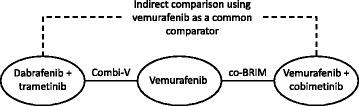
A systematic literature search identified two randomized trials as suitable for indirect comparison: the coBRIM trial of vemurafenib plus cobimetinib versus vemurafenib and the COMBI-v trial of dabrafenib plus trametinib versus vemurafenib. The comparison followed the method of Bucher et al. and analyzed both efficacy (overall survival [OS], progression-free survival [PFS], and overall response rate [ORR]) and safety outcomes (adverse events [AEs]).
RESULTS
The indirect comparison revealed similar efficacy outcomes between both therapies, with no statistically significant difference between therapies for OS (hazard ratio [HR] 0.94, 95% confidence interval [CI] 0.68 - 1.30), PFS (HR 1.05, 95% CI 0.79 - 1.40), or ORR (risk ratio [RR] 0.90, 95% CI 0.74 - 1.10). Dabrafenib plus trametinib differed significantly from vemurafenib plus cobimetinib with regard to the incidence of treatment-related AE (RR 0.92, 95% CI 0.87 - 0.97), any AE grade ≥3 (RR 0.71, 95% CI 0.60 - 0.85) or dose interruption/modification (RR 0.77, 95% CI 0.60 - 0.99). Several categories of AEs occurred significantly more frequently with vemurafenib plus cobimetinib, while some occurred significantly more frequently with dabrafenib plus trametinib. For severe AEs (grade 3 or above), four occurred significantly more frequently with vemurafenib plus cobimetinib and no severe AE occurred significantly more frequently with dabrafenib plus trametinib.
CONCLUSIONS
This indirect treatment comparison suggested that dabrafenib plus trametinib had comparable efficacy to vemurafenib plus cobimetinib but was associated with reduced adverse events.
背景
转移性黑色素瘤是一种侵袭性皮肤癌,死亡率高,是所有恶性肿瘤中全球发病率增长最快的。BRAF/MEK抑制剂联合使用已使黑色素瘤的无进展生存期(PFS)和总生存期(OS)显著延长。然而,目前尚未对不同的BRAF/MEK联合方案进行直接比较。鉴于此,对两种用于转移性黑色素瘤的BRAF/MEK抑制剂联合疗法——达拉非尼联合曲美替尼和维莫非尼联合考比替尼进行了间接治疗比较,以了解这些疗法的相对疗效和毒性特征。
方法
系统文献检索确定了两项适合间接比较的随机试验:维莫非尼联合考比替尼与维莫非尼的coBRIM试验,以及达拉非尼联合曲美替尼与维莫非尼的COMBI-v试验。比较采用Bucher等人的方法,分析了疗效(总生存期[OS]、无进展生存期[PFS]和总缓解率[ORR])和安全性结果(不良事件[AEs])。
结果
间接比较显示两种疗法的疗效结果相似,在OS(风险比[HR]0.94,95%置信区间[CI]0.68 - 1.30)、PFS(HR 1.05, 95% CI 0.79 - 1.40)或ORR(风险比[RR]0.90, 95% CI 0.74 - 1.10)方面,两种疗法之间无统计学显著差异。达拉非尼联合曲美替尼与维莫非尼联合考比替尼在治疗相关AE的发生率(RR 0.92, 95% CI 0.87 - 0.97)、任何≥3级AE(RR 0.71, 95% CI 0.60 - 0.85)或剂量中断/调整(RR 0.77, 95% CI 0.60 - 0.99)方面存在显著差异。维莫非尼联合考比替尼组中几类AE的发生频率显著更高,而达拉非尼联合曲美替尼组中某些AE的发生频率显著更高。对于严重AE(3级或以上),维莫非尼联合考比替尼组中有四种严重AE的发生频率显著更高,而达拉非尼联合曲美替尼组中没有严重AE的发生频率显著更高。
结论
这项间接治疗比较表明,达拉非尼联合曲美替尼与维莫非尼联合考比替尼疗效相当,但不良事件较少。
 Zotero 插件