
乳腺癌患者创伤后应激障碍的患病率:一项荟萃分析。
Prevalence of Posttraumatic Stress Disorder among Breast Cancer Patients: A Meta-analysis.
作者信息
Wu Xin, Wang Jieru, Cofie Reuben, Kaminga Atipatsa C, Liu Aizhong
机构信息
Dept. of Epidemiology and Health Statistics, School of Public Health, Central South University, Changsha, Hunan, China.
Dept. of Epidemiology and Health Statistics, School of Public Health, Central South University, Changsha, Hunan, China; Dept. of Pediatrics, School of Medicine, University of Pittsburgh, Pennsylvania, USA.
出版信息
Iran J Public Health. 2016 Dec;45(12):1533-1544.
BACKGROUND
Prevalence estimates of Posttraumatic Stress Disorder (PTSD) among breast cancer patients varied widely in existing studies. This study aimed to provide an overall prevalence estimate of PTSD among breast cancer patients, and the prevalence estimates related to specific PTSD diagnosis tools.
METHODS
Systematic search of relevant articles was made from seven databases. Freeman-Tukey Double Arcsine Transformation was used to estimate the overall prevalence of PTSD. Sub-group and meta-regression analyses were used to investigate the between-study sources of heterogeneity. Publication bias was examined using Egger's funnel plot and Begg test.
RESULTS
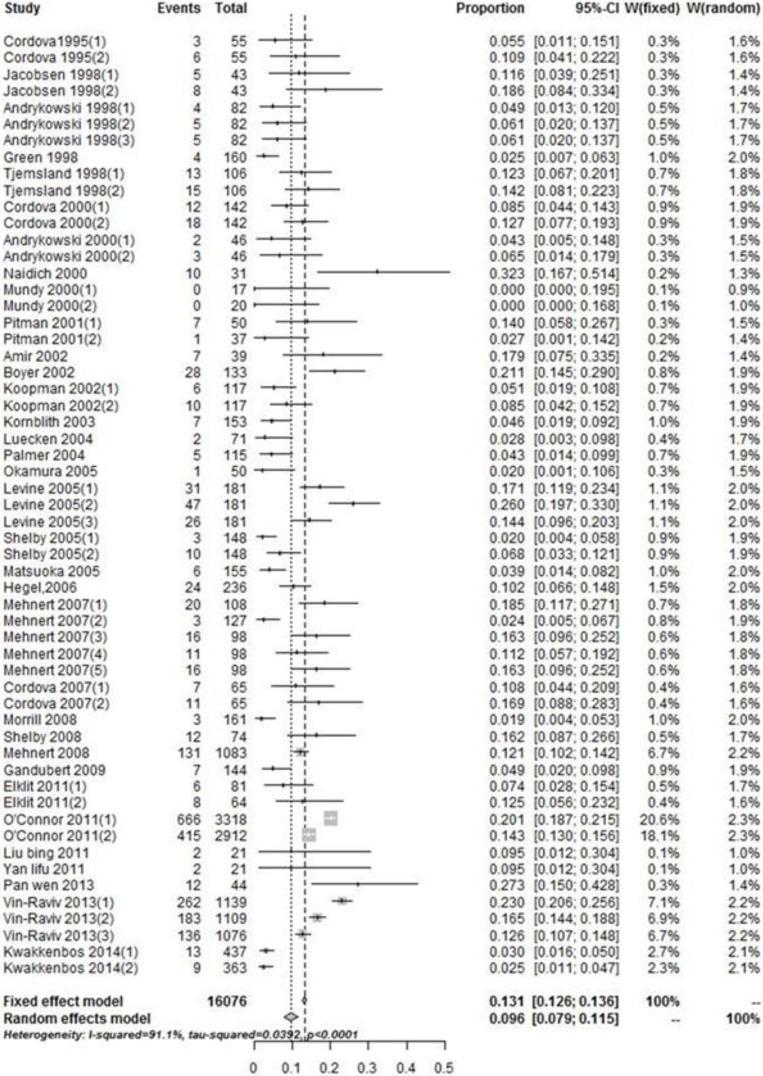
The pooled prevalence of PTSD among breast cancer patients was [9.6%, 95% confidence intervals (95%)=7.9-11.5%]. Studies that used Clinician Administered PTSD Scale-Form (CAPS) method alone yielded much higher prevalence (19.0%, 95%=13.1-25.5%, n=5) than three or fourth edition Structured Clinical Interview for Diagnostic and Statistical Manual (SCID) method alone (3.0%, 95%= 2.2-3.9%, n=11). Prevalence estimates for studies that used the methods: PTSD Checklist-Civilian Version (PCL-C) cut-off, PCL-C cluster, and Impact of Event Scale (IES) cut-off were (7.0%, 95%= 3.9-10.8%, n=10), (11.5%, 95%= 8.6-15.6%, n=11) and (15.1%, 95%= 12.3-18.2%, n=4), respectively. Heterogeneity between-study was substantial ( =44.9-92.3%).
CONCLUSION
About 9.6% of the breast cancer patients would develop the PTSD symptoms. Those who were younger, non-Caucasian and recently completed treatment would be at a greater risk of developing PTSD.
背景
在现有研究中,乳腺癌患者创伤后应激障碍(PTSD)的患病率估计差异很大。本研究旨在提供乳腺癌患者PTSD的总体患病率估计,以及与特定PTSD诊断工具相关的患病率估计。
方法
从七个数据库中系统检索相关文章。使用Freeman-Tukey双反正弦变换来估计PTSD的总体患病率。亚组分析和元回归分析用于研究研究间异质性的来源。使用Egger漏斗图和Begg检验检查发表偏倚。
结果
乳腺癌患者中PTSD的合并患病率为[9.6%,95%置信区间(95%)=7.9-11.5%]。仅使用临床医生管理的PTSD量表形式(CAPS)方法的研究得出的患病率(19.0%,95%=13.1-25.5%,n=5)远高于仅使用《诊断和统计手册》第三版或第四版结构化临床访谈(SCID)方法的研究(3.0%,95%=2.2-3.9%,n=11)。使用以下方法的研究的患病率估计:PTSD检查表-平民版(PCL-C)临界值、PCL-C聚类和事件影响量表(IES)临界值分别为(7.0%,95%=3.9-10.8%,n=10)、(11.5%,95%=8.6-15.6%,n=11)和(15.1%,95%=12.3-18.2%,n=4)。研究间的异质性很大(I²=44.9-92.3%)。
结论
约9.6%的乳腺癌患者会出现PTSD症状。年龄较小、非白种人和近期完成治疗的患者患PTSD的风险更大。
 Zotero 插件