
通过序列特异性核酸酶介导的基因靶向实现精确基因组修饰以改良作物
Precise Genome Modification via Sequence-Specific Nucleases-Mediated Gene Targeting for Crop Improvement.
作者信息
Sun Yongwei, Li Jingying, Xia Lanqin
机构信息
Institute of Crop Sciences (ICS), Chinese Academy of Agricultural Sciences (CAAS) Beijing, China.
出版信息
Front Plant Sci. 2016 Dec 20;7:1928. doi: 10.3389/fpls.2016.01928. eCollection 2016.
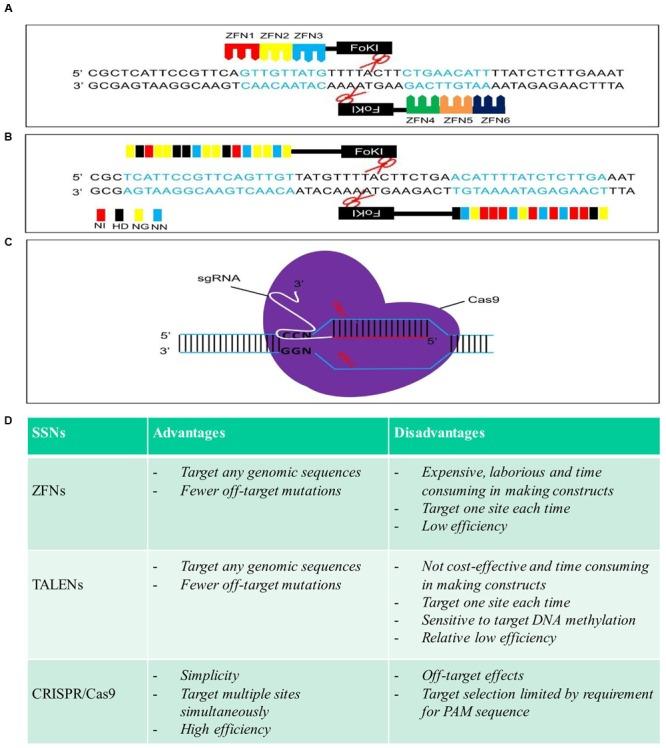
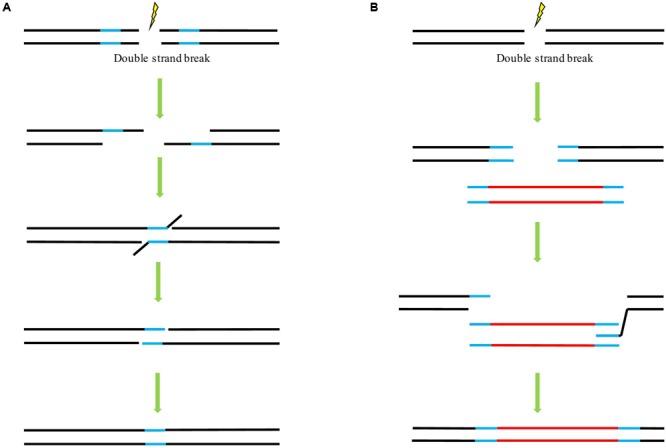
Genome editing technologies enable precise modifications of DNA sequences and offer a great promise for harnessing plant genes in crop improvement. The precise manipulation of plant genomes relies on the induction of DNA double-strand breaks by sequence-specific nucleases (SSNs) to initiate DNA repair reactions that are based on either non-homologous end joining (NHEJ) or homology-directed repair (HDR). While complete knock-outs and loss-of-function mutations generated by NHEJ are very valuable in defining gene functions, their applications in crop improvement are somewhat limited because many agriculturally important traits are conferred by random point mutations or indels at specific loci in either the genes' encoding or promoter regions. Therefore, genome modification through SSNs-mediated HDR for gene targeting (GT) that enables either gene replacement or knock-in will provide an unprecedented ability to facilitate plant breeding by allowing introduction of precise point mutations and new gene functions, or integration of foreign genes at specific and desired "safe" harbor in a predefined manner. The emergence of three programmable SSNs, such as zinc finger nucleases, transcriptional activator-like effector nucleases, and the clustered regularly interspaced short palindromic repeat (CRISPR)/CRISPR-associated protein 9 (Cas9) systems has revolutionized genome modification in plants in a more controlled manner. However, while targeted mutagenesis is becoming routine in plants, the potential of GT technology has not been well realized for traits improvement in crops, mainly due to the fact that NHEJ predominates DNA repair process in somatic cells and competes with the HDR pathway, and thus HDR-mediated GT is a relative rare event in plants. Here, we review recent research findings mainly focusing on development and applications of precise GT in plants using three SSNs systems described above, and the potential mechanisms underlying HDR events in plant cells. We then address the challenges and propose future perspectives in order to facilitate the implementation of precise genome modification through SSNs-mediated GT for crop improvement in a global context.
基因组编辑技术能够对DNA序列进行精确修饰,为利用植物基因改良作物带来了巨大希望。对植物基因组的精确操作依赖于序列特异性核酸酶(SSN)诱导DNA双链断裂,以启动基于非同源末端连接(NHEJ)或同源定向修复(HDR)的DNA修复反应。虽然由NHEJ产生的完全敲除和功能丧失突变在确定基因功能方面非常有价值,但它们在作物改良中的应用在一定程度上受到限制,因为许多重要的农业性状是由基因编码区或启动子区域特定位点的随机点突变或插入缺失赋予的。因此,通过SSN介导的HDR进行基因靶向(GT)的基因组修饰,能够实现基因替换或敲入,通过允许引入精确的点突变和新的基因功能,或以预定义的方式将外源基因整合到特定且理想的“安全”位点,将为促进植物育种提供前所未有的能力。三种可编程的SSN,如锌指核酸酶、转录激活因子样效应物核酸酶和成簇规律间隔短回文重复序列(CRISPR)/CRISPR相关蛋白9(Cas9)系统的出现,以更可控的方式彻底改变了植物基因组修饰。然而,虽然靶向诱变在植物中已成为常规操作,但GT技术在作物性状改良方面的潜力尚未得到充分发挥,主要是因为NHEJ在体细胞的DNA修复过程中占主导地位,并与HDR途径竞争,因此HDR介导的GT在植物中是相对罕见的事件。在这里,我们回顾了最近的研究结果,主要关注使用上述三种SSN系统在植物中进行精确GT的开发和应用,以及植物细胞中HDR事件的潜在机制。然后,我们讨论了挑战并提出了未来的展望,以便在全球范围内促进通过SSN介导的GT进行精确基因组修饰以改良作物的实施。

 Zotero 插件