
补充姜黄素可通过提高一氧化氮生物利用度和减轻氧化应激来改善健康中老年人的血管内皮功能。
Curcumin supplementation improves vascular endothelial function in healthy middle-aged and older adults by increasing nitric oxide bioavailability and reducing oxidative stress.
作者信息
Santos-Parker Jessica R, Strahler Talia R, Bassett Candace J, Bispham Nina Z, Chonchol Michel B, Seals Douglas R
机构信息
Integrative Physiology, University of Colorado Boulder, Boulder, CO 80309, USA.
Renal Diseases and Hypertension, University of Colorado Denver, Aurora, CO 80045, USA.
出版信息
Aging (Albany NY). 2017 Jan 3;9(1):187-208. doi: 10.18632/aging.101149.
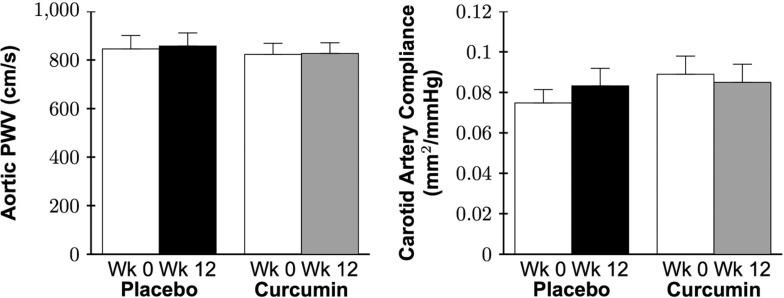
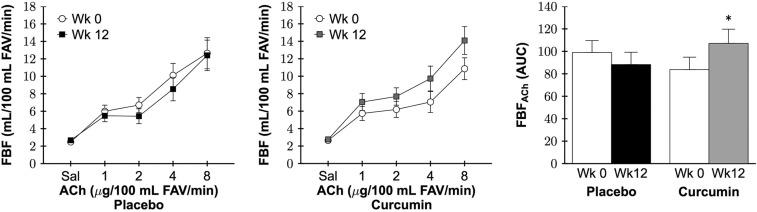
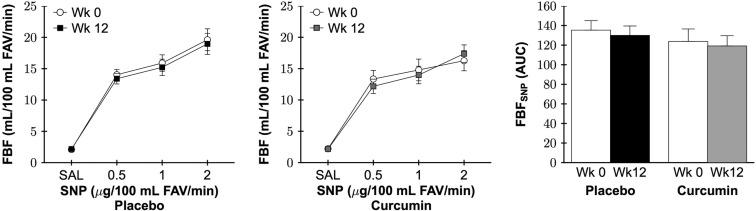
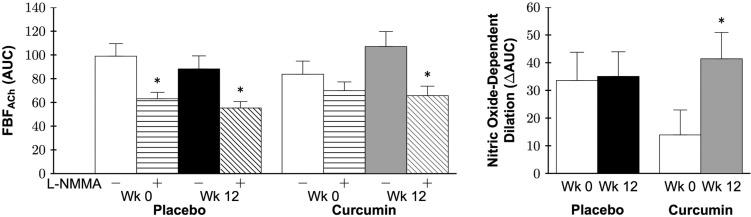
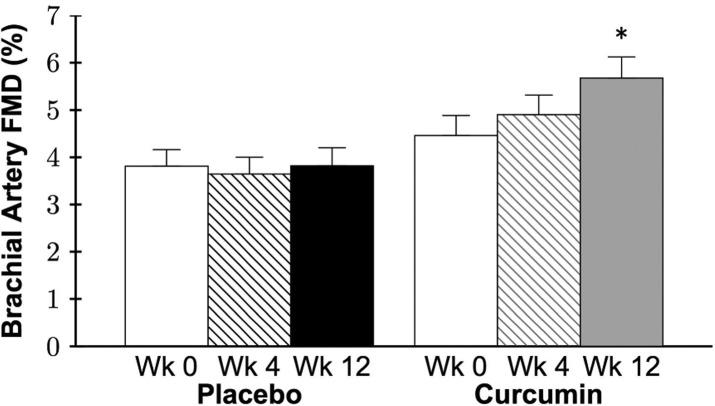
We hypothesized that curcumin would improve resistance and conduit artery endothelial function and large elastic artery stiffness in healthy middle-aged and older adults. Thirty-nine healthy men and postmenopausal women (45-74 yrs) were randomized to 12 weeks of curcumin (2000 mg/day Longvida®; n=20) or placebo (n=19) supplementation. Forearm blood flow response to acetylcholine infusions (FBF; resistance artery endothelial function) increased 37% following curcumin supplementation (107±13 vs. 84±11 AUC at baseline, P=0.03), but not placebo (P=0.2). Curcumin treatment augmented the acute reduction in FBF induced by the nitric oxide synthase inhibitor monomethyl-L-arginine (L-NMMA; P=0.03), and reduced the acute increase in FBF to the antioxidant vitamin C (P=0.02), whereas placebo had no effect (both P>0.6). Similarly, brachial artery flow-mediated dilation (conduit artery endothelial function) increased 36% in the curcumin group (5.7±0.4 vs. 4.4±0.4% at baseline, P=0.001), with no change in placebo (P=0.1). Neither curcumin nor placebo influenced large elastic artery stiffness (aortic pulse wave velocity or carotid artery compliance) or circulating biomarkers of oxidative stress and inflammation (all P>0.1). In healthy middle-aged and older adults, 12 weeks of curcumin supplementation improves resistance artery endothelial function by increasing vascular nitric oxide bioavailability and reducing oxidative stress, while also improving conduit artery endothelial function.
我们假设姜黄素可以改善健康的中老年人的血管阻力和 conduit 动脉内皮功能以及大弹性动脉僵硬度。39 名健康男性和绝经后女性(45 - 74 岁)被随机分为两组,一组补充姜黄素(2000 毫克/天的 Longvida®;n = 20),另一组补充安慰剂(n = 19),为期 12 周。补充姜黄素后,前臂对乙酰胆碱输注的血流反应(FBF;阻力动脉内皮功能)增加了 37%(基线时 AUC 为 107±13 与 84±11,P = 0.03),而补充安慰剂组无变化(P = 0.2)。姜黄素治疗增强了一氧化氮合酶抑制剂单甲基 - L - 精氨酸(L - NMMA)诱导的 FBF 的急性降低(P = 0.03),并降低了 FBF 对抗氧化维生素 C 的急性增加(P = 0.02),而安慰剂无影响(两者 P>0.6)。同样,姜黄素组肱动脉血流介导的扩张(conduit 动脉内皮功能)增加了 36%(基线时为 5.7±0.4 与 4.4±0.4%,P = 0.001),安慰剂组无变化(P = 0.1)。姜黄素和安慰剂均未影响大弹性动脉僵硬度(主动脉脉搏波速度或颈动脉顺应性)或氧化应激和炎症的循环生物标志物(所有 P>0.1)。在健康的中老年人中,补充 12 周姜黄素可通过增加血管一氧化氮生物利用度和降低氧化应激来改善阻力动脉内皮功能,同时还可改善 conduit 动脉内皮功能。


 Zotero 插件