
2009年甲型H1N1流感及中东呼吸综合征冠状病毒感染合并糖尿病的患病率:一项系统评价和荟萃分析
Prevalence of Diabetes in the 2009 Influenza A (H1N1) and the Middle East Respiratory Syndrome Coronavirus: A Systematic Review and Meta-Analysis.
作者信息
Badawi Alaa, Ryoo Seung Gwan
机构信息
Public Health Risk Sciences Division, Public Health Agency of Canada , Toronto, ON.
Faculty of Arts and Science, University of Toronto , Toronto, ON, Canada.
出版信息
J Public Health Res. 2016 Dec 21;5(3):733. doi: 10.4081/jphr.2016.733. eCollection 2016 Dec 9.
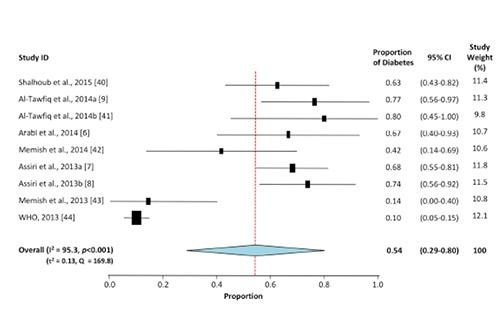
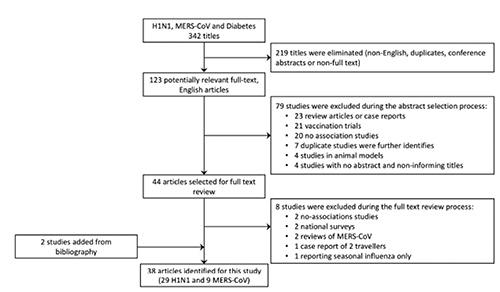
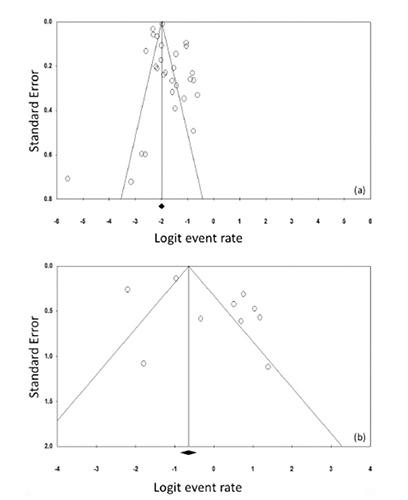
Over the past two decades a number of severe acute respiratory infection outbreaks such as the 2009 influenza A (H1N1) and the Middle East respiratory syndrome coronavirus (MERS-CoV) have emerged and presented a considerable global public health threat. Epidemiologic evidence suggests that diabetic subjects are more susceptible to these conditions. However, the prevalence of diabetes in H1N1 and MERS-CoV has not been systematically described. The aim of this study is to conduct a systematic review and meta-analysis of published reports documenting the prevalence of diabetes in H1N1 and MERS-CoV and compare its frequency in the two viral conditions. Meta-analysis for the proportions of subjects with diabetes was carried out in 29 studies for H1N1 (=92,948) and 9 for MERS-CoV (=308). Average age of H1N1 patients (36.2±6.0 years) was significantly younger than that of subjects with MERS-CoV (54.3±7.4 years, P<0.05). Compared to MERS-CoV patients, subjects with H1N1 exhibited 3-fold lower frequency of cardiovascular diseases and 2- and 4-fold higher prevalence of obesity and immunosuppression, respectively. The overall prevalence of diabetes in H1N1 was 14.6% (95% CI: 12.3-17.0%; P<0.001), a 3.6-fold lower than in MERS-CoV (54.4%; 95% CI: 29.4-79.5; P<0.001). The prevalence of diabetes among H1N1 cases from Asia and North America was ~two-fold higher than those from South America and Europe. The prevalence of diabetes in MERS-CoV cases is higher than in H1N1. Regional comparisons suggest that an etiologic role of diabetes in MERS-CoV may exist distinctive from that in H1N1.
在过去二十年中,出现了一些严重急性呼吸道感染疫情,如2009年甲型H1N1流感和中东呼吸综合征冠状病毒(MERS-CoV),对全球公共卫生构成了重大威胁。流行病学证据表明,糖尿病患者更容易感染这些疾病。然而,甲型H1N1流感和MERS-CoV患者中糖尿病的患病率尚未得到系统描述。本研究的目的是对已发表的关于甲型H1N1流感和MERS-CoV患者中糖尿病患病率的报告进行系统评价和荟萃分析,并比较这两种病毒感染情况下糖尿病的发生频率。对29项关于甲型H1N1流感(n = 92,948)和9项关于MERS-CoV(n = 308)的研究进行了糖尿病患者比例的荟萃分析。甲型H1N1流感患者的平均年龄(36.2±6.0岁)显著低于MERS-CoV患者(54.3±7.4岁,P<0.05)。与MERS-CoV患者相比,甲型H1N1流感患者患心血管疾病的频率低3倍,肥胖和免疫抑制的患病率分别高2倍和4倍。甲型H(1N1)流感患者中糖尿病的总体患病率为14.6%(95%CI:12.3-17.0%;P<0.001),比MERS-CoV患者低3.6倍(54.4%;95%CI:29.4-79.5;P<0.001)。来自亚洲和北美的甲型H1N1流感病例中糖尿病的患病率比来自南美和欧洲的病例高约两倍。MERS-CoV病例中糖尿病的患病率高于甲型H1N1流感。区域比较表明,糖尿病在MERS-CoV中的病因作用可能与在甲型H1N1流感中的不同。

 Zotero 插件