
MscS的电压依赖性失活独立于跨膜结构域中的带正电残基发生。
Voltage-Dependent Inactivation of MscS Occurs Independently of the Positively Charged Residues in the Transmembrane Domain.
作者信息
Nomura Takeshi, Sokabe Masahiro, Yoshimura Kenjiro
机构信息
International Cooperative Research Project (ICORP)/Solution Oriented Research for Science and Technology (SORST), Cell-Mechanosensing Project, Japan Science and Technology Agency, Nagoya 466-8550, Japan; Department of Rehabilitation, Kyushu Nutrition Welfare University, Kitakyushu 800-029, Japan.
International Cooperative Research Project (ICORP)/Solution Oriented Research for Science and Technology (SORST), Cell-Mechanosensing Project, Japan Science and Technology Agency, Nagoya 466-8550, Japan; Mechanobiology Laboratory, Nagoya University Graduate School of Medicine, Nagoya 466-8550, Japan.
出版信息
Biomed Res Int. 2016;2016:2401657. doi: 10.1155/2016/2401657. Epub 2016 Dec 22.
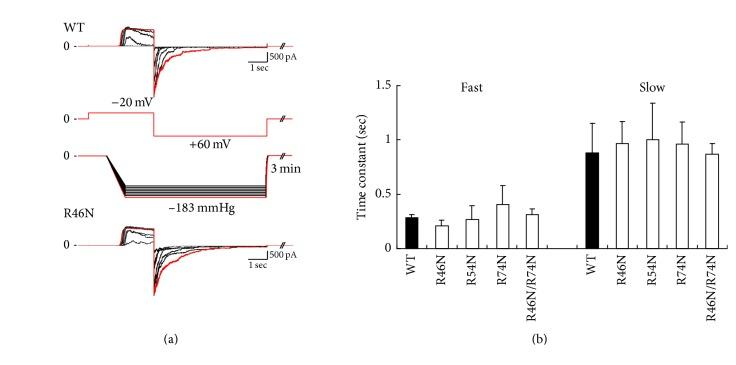
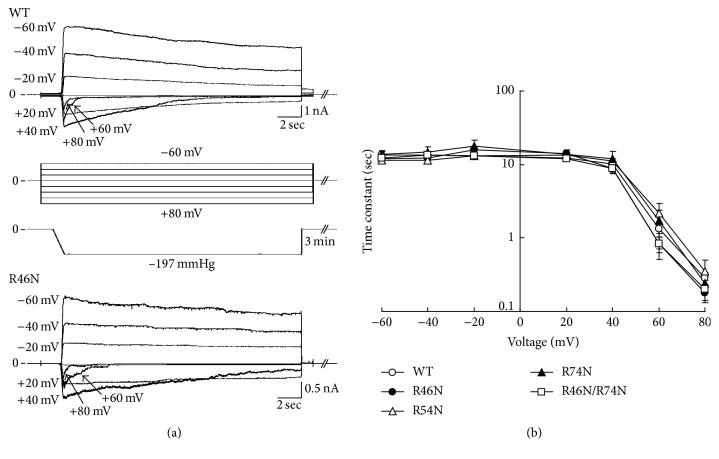
MscS (mechanosensitive channel of small conductance) is ubiquitously found among bacteria and plays a major role in avoiding cell lysis upon rapid osmotic downshock. The gating of MscS is modulated by voltage, but little is known about how MscS senses membrane potential. Three arginine residues (Arg-46, Arg-54, and Arg-74) in the transmembrane (TM) domain are possible to respond to voltage judging from the MscS structure. To examine whether these residues are involved in the voltage dependence of MscS, we neutralized the charge of each residue by substituting with asparagine (R46N, R54N, and R74N). Mechanical threshold for the opening of the expressed wild-type MscS and asparagine mutants did not change with voltage in the range from -40 to +100 mV. By contrast, inactivation process of wild-type MscS was strongly affected by voltage. The wild-type MscS inactivated at +60 to +80 mV but not at -60 to +40 mV. The voltage dependence of the inactivation rate of all mutants tested, that is, R46N, R54N, R74N, and R46N/R74N MscS, was almost indistinguishable from that of the wild-type MscS. These findings indicate that the voltage dependence of the inactivation occurs independently of the positive charges of R46, R54, and R74.
小电导机械敏感通道(MscS)在细菌中广泛存在,在快速渗透压下降时避免细胞裂解中起主要作用。MscS的门控受电压调节,但关于MscS如何感知膜电位知之甚少。从MscS结构判断,跨膜(TM)结构域中的三个精氨酸残基(Arg-46、Arg-54和Arg-74)可能对电压作出反应。为了研究这些残基是否参与MscS的电压依赖性,我们通过用天冬酰胺替代(R46N、R54N和R74N)来中和每个残基的电荷。在-40至+100 mV范围内,表达的野生型MscS和天冬酰胺突变体开放的机械阈值不随电压变化。相比之下,野生型MscS的失活过程受电压强烈影响。野生型MscS在+60至+80 mV时失活,但在-60至+40 mV时不失活。所有测试突变体(即R46N、R54N、R74N和R46N/R74N MscS)失活速率的电压依赖性与野生型MscS几乎没有区别。这些发现表明,失活的电压依赖性独立于R46、R54和R74的正电荷而发生。


 Zotero 插件