
撒哈拉以南非洲地区患者报告的抗逆转录病毒治疗依从性的障碍和促进因素。
Patient-reported barriers and facilitators to antiretroviral adherence in sub-Saharan Africa.
作者信息
Croome Natasha, Ahluwalia Monisha, Hughes Lyndsay D, Abas Melanie
机构信息
aCentre for Global Mental Health, Health Service and Population Research bHealth Psychology, Institute of Psychiatry, Psychology and Neuroscience, King's College London, UK.
出版信息
AIDS. 2017 Apr 24;31(7):995-1007. doi: 10.1097/QAD.0000000000001416.
OBJECTIVE
The aim of this study was to identify the range and frequency of patient-reported barriers and facilitators to antiretroviral treatment (ART) adherence in sub-Saharan Africa (SSA).
DESIGN
Studies from 2005 to 2016 were identified by searching 10 electronic databases and through additional hand and web-searching.
METHODS
Inclusion criteria were HIV-positive adults taking ART based in any SSA country, qualitative study or quantitative survey and included at least one patient-reported barrier or facilitator to ART adherence. Exclusion criteria were only including data from treatment-naive patients initiating ART, only single-dose treatment, participants residing outside of SSA and reviews.
RESULTS
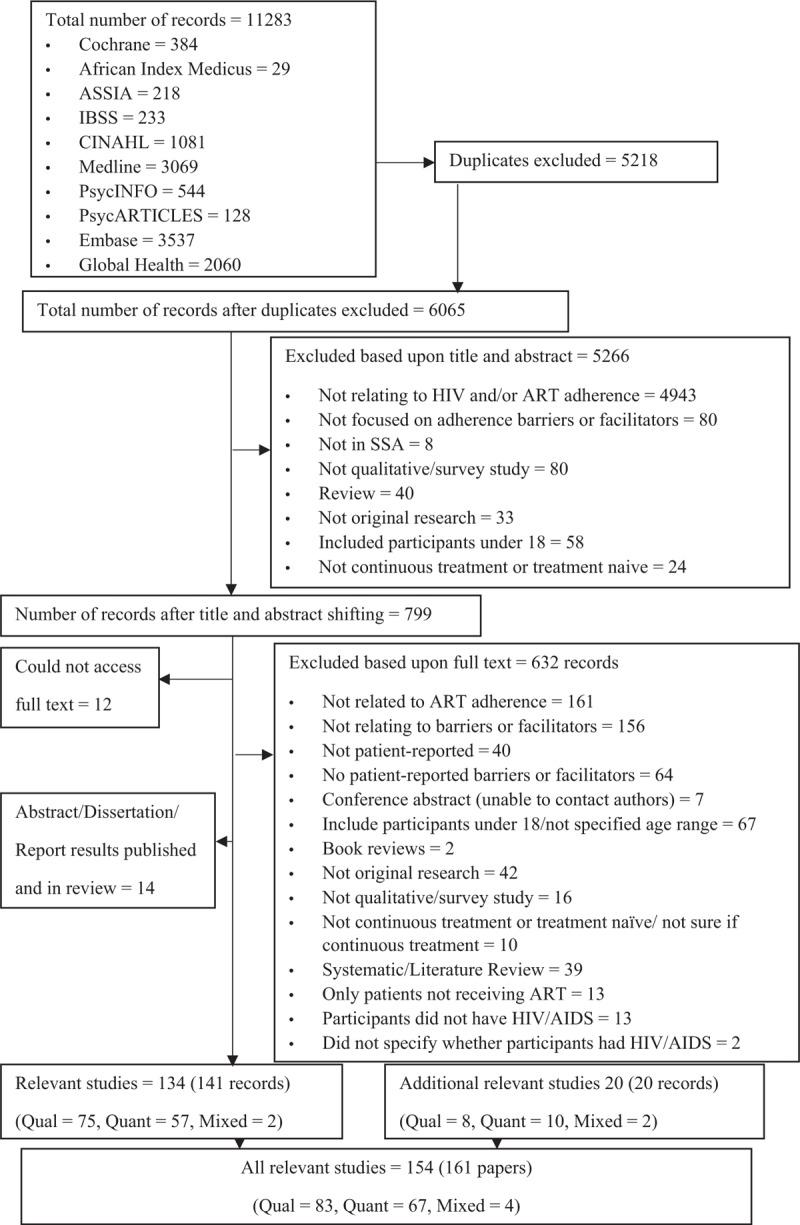
After screening 11 283 records, 154 studies (161 papers) were included in this review. Forty-three barriers and 30 facilitators were reported across 24 SSA countries. The most frequently identified barriers across studies were forgetting (n = 76), lack of access to adequate food (n = 72), stigma and discrimination (n = 68), side effects (n = 67) and being outside the house or travelling (n = 60). The most frequently identified facilitators across studies were social support (n = 60), reminders (n = 55), feeling better or healthier after taking ART (n = 35), disclosing their HIV status (n = 26) and having a good relationship with a health provider (n = 22).
CONCLUSION
This review addresses the gap in knowledge by collating all the patient-reported barriers and facilitators to ART adherence in SSA. Current barriers measures need to be adapted or new tools developed to include the wide variety of factors identified. The factors that have the greatest impact need to be isolated so interventions are developed that reduce the barriers and enhance the facilitators.
目的
本研究旨在确定撒哈拉以南非洲地区(SSA)患者报告的抗逆转录病毒治疗(ART)依从性的障碍和促进因素的范围及频率。
设计
通过检索10个电子数据库以及额外的手工和网络搜索,确定了2005年至2016年的研究。
方法
纳入标准为在任何SSA国家接受ART治疗的HIV阳性成年人、定性研究或定量调查,且至少包括一项患者报告的ART依从性障碍或促进因素。排除标准为仅包括初治患者开始ART的数据、仅单剂量治疗、居住在SSA以外的参与者以及综述。
结果
在筛选了11283条记录后,本综述纳入了154项研究(161篇论文)。在24个SSA国家共报告了43个障碍和30个促进因素。各研究中最常确定的障碍是忘记服药(n = 76)、无法获得足够食物(n = 72)、耻辱和歧视(n = 68)、副作用(n = 67)以及外出或旅行(n = 60)。各研究中最常确定的促进因素是社会支持(n = 60)、提醒(n = 55)、服用ART后感觉更好或更健康(n = 35)、披露其HIV感染状况(n = 26)以及与医疗服务提供者关系良好(n = 22)。
结论
本综述通过整理SSA地区所有患者报告的ART依从性障碍和促进因素,填补了知识空白。当前的障碍测量方法需要调整或开发新工具,以纳入所确定的各种因素。需要分离出影响最大的因素,以便制定减少障碍和增强促进因素的干预措施。
 Zotero 插件