
急性髓系白血病异基因造血细胞移植前的微小残留病:一项荟萃分析
Minimal residual disease prior to allogeneic hematopoietic cell transplantation in acute myeloid leukemia: a meta-analysis.
作者信息
Buckley Sarah A, Wood Brent L, Othus Megan, Hourigan Christopher S, Ustun Celalettin, Linden Michael A, DeFor Todd E, Malagola Michele, Anthias Chloe, Valkova Veronika, Kanakry Christopher G, Gruhn Bernd, Buccisano Francesco, Devine Beth, Walter Roland B
机构信息
Hematology/Oncology Fellowship Program, University of Washington, Seattle, WA, USA
Division of Hematopathology, Department of Laboratory Medicine, University of Washington, Seattle, WA, USA.
出版信息
Haematologica. 2017 May;102(5):865-873. doi: 10.3324/haematol.2016.159343. Epub 2017 Jan 25.
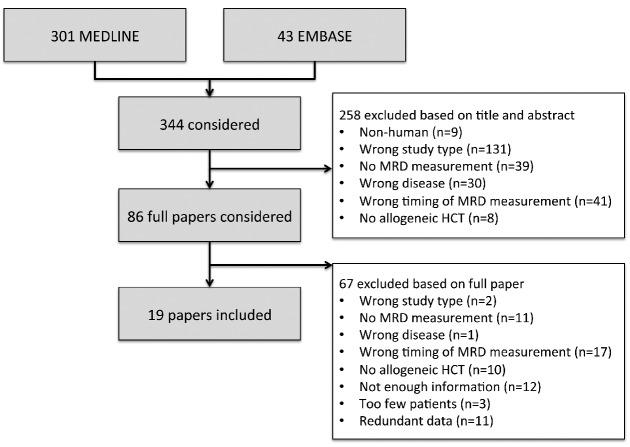
Minimal residual disease prior to allogeneic hematopoietic cell transplantation has been associated with increased risk of relapse and death in patients with acute myeloid leukemia, but detection methodologies and results vary widely. We performed a systematic review and meta-analysis evaluating the prognostic role of minimal residual disease detected by polymerase chain reaction or multiparametric flow cytometry before transplant. We identified 19 articles published between January 2005 and June 2016 and extracted hazard ratios for leukemia-free survival, overall survival, and cumulative incidences of relapse and non-relapse mortality. Pre-transplant minimal residual disease was associated with worse leukemia-free survival (hazard ratio=2.76 [1.90-4.00]), overall survival (hazard ratio=2.36 [1.73-3.22]), and cumulative incidence of relapse (hazard ratio=3.65 [2.53-5.27]), but not non-relapse mortality (hazard ratio=1.12 [0.81-1.55]). These associations held regardless of detection method, conditioning intensity, and patient age. Adverse cytogenetics was not an independent risk factor for death or relapse. There was more heterogeneity among studies using flow cytometry-based than polymerase chain reaction-based detection (I=75.1% <0.1% for leukemia-free survival, 67.8% <0.1% for overall survival, and 22.1% <0.1% for cumulative incidence of relapse). These results demonstrate a strong relationship between pre-transplant minimal residual disease and post-transplant relapse and survival. Outcome heterogeneity among studies using flow-based methods may underscore site-specific methodological differences or differences in test performance and interpretation.
异基因造血细胞移植前的微小残留病与急性髓系白血病患者复发和死亡风险增加相关,但检测方法和结果差异很大。我们进行了一项系统评价和荟萃分析,评估移植前通过聚合酶链反应或多参数流式细胞术检测的微小残留病的预后作用。我们检索了2005年1月至2016年6月发表的19篇文章,并提取了无白血病生存、总生存以及复发和非复发死亡率的累积发生率的风险比。移植前微小残留病与较差的无白血病生存(风险比=2.76[1.90-4.00])、总生存(风险比=2.36[1.73-3.22])和复发累积发生率(风险比=3.65[2.53-5.27])相关,但与非复发死亡率无关(风险比=1.12[0.81-1.55])。无论检测方法、预处理强度和患者年龄如何,这些关联均成立。不良细胞遗传学不是死亡或复发的独立危险因素。基于流式细胞术的研究之间的异质性比基于聚合酶链反应的研究更多(无白血病生存的I²=75.1%对<0.1%,总生存的I²=67.8%对<0.1%,复发累积发生率的I²=22.1%对<0.1%)。这些结果表明移植前微小残留病与移植后复发和生存之间存在密切关系。使用基于流式方法的研究结果异质性可能突出了特定部位的方法学差异或检测性能及解释方面的差异。



 Zotero 插件