
迈向更可持续的电子垃圾政策轨迹:加纳阿克拉十年电子垃圾研究综述
Toward a More Sustainable Trajectory for E-Waste Policy: A Review of a Decade of E-Waste Research in Accra, Ghana.
作者信息
Daum Kurt, Stoler Justin, Grant Richard J
机构信息
Department of Geography and Regional Studies, University of Miami, Coral Gables, FL 33146, USA.
Department of Public Health Sciences, Miller School of Medicine, University of Miami, Miami, Florida, FL 33136, USA.
出版信息
Int J Environ Res Public Health. 2017 Jan 29;14(2):135. doi: 10.3390/ijerph14020135.
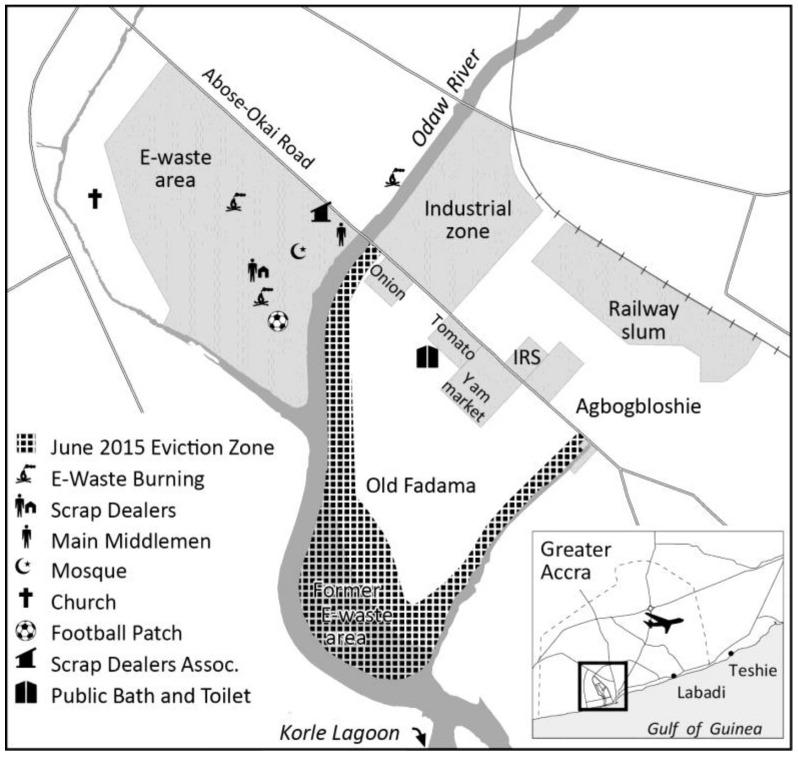
Global flows of e-waste from the Global North to the Global South continue to damage local environments and harm human health. Weak e-waste regulations and limited use of safety measures for e-waste workers in Accra, Ghana, foster an exploitative environment within the industry, and pose health risks for those working and living near e-waste processing sites. This paper presents an integrated review of over 40 e-waste studies specific to Accra, with particular emphasis on the well-studied e-waste processing site in Agbogbloshie, and synthesizes the existing research base across interdisciplinary themes of human health, environmental health, globalization, trade and informalization, and public policy. Despite significant international attention to Accra's e-waste problem, loopholes within international environmental regulations and treaties provide few incentives and resources for Ghana to strengthen protections for human and environmental health. After a decade of e-waste research in Accra, the crisis continues to intensify; we present a renewed vision for sustainable e-waste policy reform in Ghana and beyond.
从全球北方流向全球南方的电子垃圾全球流动,持续破坏当地环境并损害人类健康。加纳阿克拉的电子垃圾法规薄弱,电子垃圾处理工人的安全措施使用有限,这助长了该行业内的剥削环境,并给在电子垃圾处理场附近工作和生活的人带来健康风险。本文对40多项针对阿克拉的电子垃圾研究进行了综合综述,特别强调了阿博布罗西研究充分的电子垃圾处理场,并综合了人类健康、环境卫生、全球化、贸易与非正规化以及公共政策等跨学科主题的现有研究基础。尽管国际社会对阿克拉的电子垃圾问题给予了高度关注,但国际环境法规和条约中的漏洞几乎没有为加纳提供加强对人类和环境健康保护的激励措施和资源。在对阿克拉进行了十年的电子垃圾研究之后,这场危机仍在加剧;我们提出了加纳及其他地区可持续电子垃圾政策改革的新愿景。
 Zotero 插件