
脂肪组织巨噬细胞会损害人类前脂肪细胞的分化。
Adipose tissue macrophages impair preadipocyte differentiation in humans.
作者信息
Liu Li Fen, Craig Colleen M, Tolentino Lorna L, Choi Okmi, Morton John, Rivas Homero, Cushman Samuel W, Engleman Edgar G, McLaughlin Tracey
机构信息
Division of Endocrinology, Department of Medicine, Stanford University, Palo Alto, California, United States of America.
Stanford Blood Center, Palo Alto, California, United States of America.
出版信息
PLoS One. 2017 Feb 2;12(2):e0170728. doi: 10.1371/journal.pone.0170728. eCollection 2017.
AIM
The physiologic mechanisms underlying the relationship between obesity and insulin resistance are not fully understood. Impaired adipocyte differentiation and localized inflammation characterize adipose tissue from obese, insulin-resistant humans. The directionality of this relationship is not known, however. The aim of the current study was to investigate whether adipose tissue inflammation is causally-related to impaired adipocyte differentiation.
METHODS
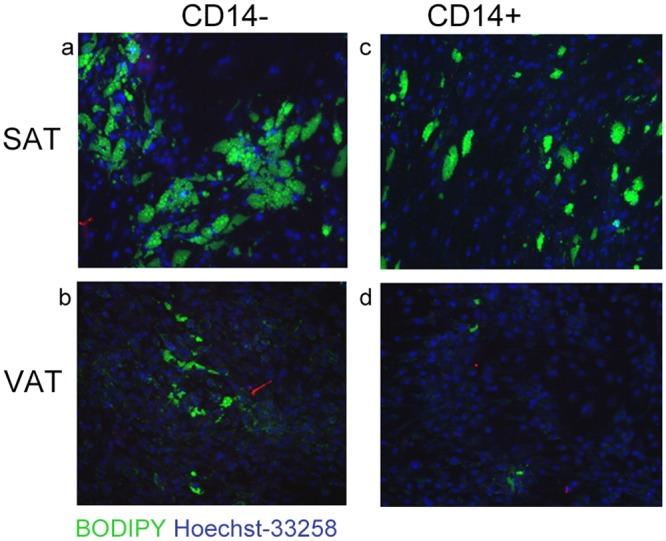
Abdominal subcutaneous(SAT) and visceral(VAT) adipose tissue was obtained from 20 human participants undergoing bariatric surgery. Preadipocytes were isolated, and cultured in the presence or absence of CD14+ macrophages obtained from the same adipose tissue sample. Adipocyte differentiation was quantified after 14 days via immunofluorescence, Oil-Red O, and adipogenic gene expression. Cytokine secretion by mature adipocytes cultured with or without CD14+macrophages was quantified.
RESULTS
Adipocyte differentiation was significantly lower in VAT than SAT by all measures (p<0.001). With macrophage removal, SAT preadipocyte differentiation increased significantly as measured by immunofluorescence and gene expression, whereas VAT preadipocyte differentiation was unchanged. Adipocyte-secreted proinflammatory cytokines were higher and adiponectin lower in media from VAT vs SAT: macrophage removal reduced inflammatory cytokine and increased adiponectin secretion from both SAT and VAT adipocytes. Differentiation of preadipocytes from SAT but not VAT correlated inversely with systemic insulin resistance.
CONCLUSIONS
The current results reveal that proinflammatory immune cells in human SAT are causally-related to impaired preadipocyte differentiation, which in turn is associated with systemic insulin resistance. In VAT, preadipocyte differentiation is poor even in the absence of tissue macrophages, pointing to inherent differences in fat storage potential between the two depots.
目的
肥胖与胰岛素抵抗之间关系的生理机制尚未完全明确。肥胖且存在胰岛素抵抗的人体脂肪组织具有脂肪细胞分化受损和局部炎症的特征。然而,这种关系的方向性尚不清楚。本研究的目的是调查脂肪组织炎症是否与脂肪细胞分化受损存在因果关系。
方法
从20名接受减肥手术的人类参与者身上获取腹部皮下(SAT)和内脏(VAT)脂肪组织。分离前脂肪细胞,并在存在或不存在从同一脂肪组织样本中获得的CD14 +巨噬细胞的情况下进行培养。14天后,通过免疫荧光、油红O和脂肪生成基因表达对脂肪细胞分化进行量化。对在有或没有CD14 +巨噬细胞的情况下培养的成熟脂肪细胞的细胞因子分泌进行量化。
结果
通过所有测量方法,VAT中的脂肪细胞分化均显著低于SAT(p < 0.001)。去除巨噬细胞后,通过免疫荧光和基因表达测量,SAT前脂肪细胞分化显著增加,而VAT前脂肪细胞分化未改变。与SAT相比,VAT培养基中脂肪细胞分泌的促炎细胞因子更高,脂联素更低:去除巨噬细胞可减少炎症细胞因子,并增加SAT和VAT脂肪细胞的脂联素分泌。SAT而非VAT的前脂肪细胞分化与全身胰岛素抵抗呈负相关。
结论
目前的结果表明,人类SAT中的促炎免疫细胞与前脂肪细胞分化受损存在因果关系,而前脂肪细胞分化受损又与全身胰岛素抵抗相关。在VAT中,即使没有组织巨噬细胞,前脂肪细胞分化也很差,这表明两个脂肪库之间的脂肪储存潜力存在固有差异。


 Zotero 插件