
基因拷贝数的种间差异在拟南芥适应进化的关键功能中富集。
Between-species differences in gene copy number are enriched among functions critical for adaptive evolution in Arabidopsis halleri.
作者信息
Suryawanshi Vasantika, Talke Ina N, Weber Michael, Eils Roland, Brors Benedikt, Clemens Stephan, Krämer Ute
机构信息
Department of Plant Physiology, Ruhr University Bochum, Universitätsstrasse 150, Bochum, 44801, Germany.
BioQuant, University of Heidelberg, Im Neuenheimer Feld 267, Heidelberg, 69120, Germany.
出版信息
BMC Genomics. 2016 Dec 22;17(Suppl 13):1034. doi: 10.1186/s12864-016-3319-5.
BACKGROUND
Gene copy number divergence between species is a form of genetic polymorphism that contributes significantly to both genome size and phenotypic variation. In plants, copy number expansions of single genes were implicated in cultivar- or species-specific tolerance of high levels of soil boron, aluminium or calamine-type heavy metals, respectively. Arabidopsis halleri is a zinc- and cadmium-hyperaccumulating extremophile species capable of growing on heavy-metal contaminated, toxic soils. In contrast, its non-accumulating sister species A. lyrata and the closely related reference model species A. thaliana exhibit merely basal metal tolerance.
RESULTS
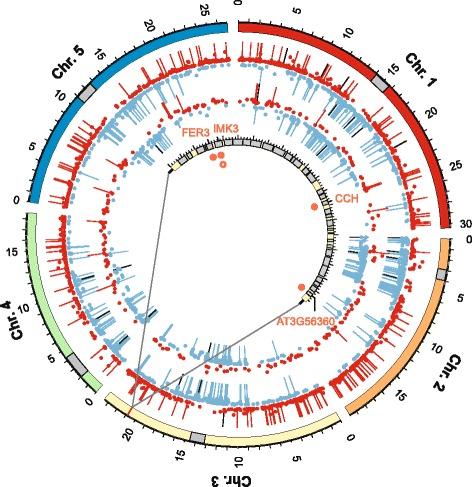
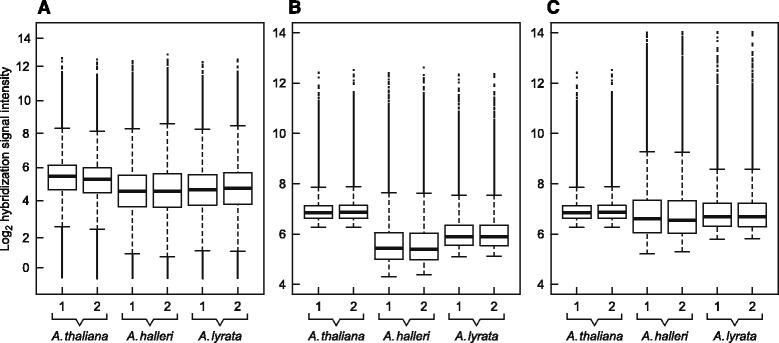
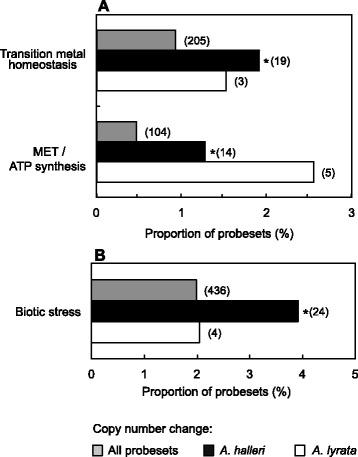
For a genome-wide assessment of the role of copy number divergence (CND) in lineage-specific environmental adaptation, we conducted cross-species array comparative genome hybridizations of three plant species and developed a global signal scaling procedure to adjust for sequence divergence. In A. halleri, transition metal homeostasis functions are enriched twofold among the genes detected as copy number expanded. Moreover, biotic stress functions including mostly disease Resistance (R) gene-related genes are enriched twofold among genes detected as copy number reduced, when compared to the abundance of these functions among all genes.
CONCLUSIONS
Our results provide genome-wide support for a link between evolutionary adaptation and CND in A. halleri as shown previously for Heavy metal ATPase4. Moreover our results support the hypothesis that elemental defences, which result from the hyperaccumulation of toxic metals, allow the reduction of classical defences against biotic stress as a trade-off.
背景
物种间基因拷贝数差异是一种遗传多态性形式,对基因组大小和表型变异均有显著贡献。在植物中,单个基因的拷贝数扩增分别与品种或物种对高土壤硼、铝或炉甘石型重金属的特异性耐受性有关。拟南芥是一种锌和镉超积累极端嗜性物种,能够在重金属污染的有毒土壤上生长。相比之下,其非积累性姊妹物种琴叶拟南芥以及密切相关的参考模式物种拟南芥仅表现出基本的金属耐受性。
结果
为了在全基因组范围内评估拷贝数差异(CND)在特定谱系环境适应中的作用,我们对三种植物物种进行了跨物种阵列比较基因组杂交,并开发了一种全局信号缩放程序来校正序列差异。在南芥中,检测到拷贝数增加的基因中,过渡金属稳态功能富集了两倍。此外,与所有基因中这些功能的丰度相比,在检测到拷贝数减少的基因中,主要包括抗病(R)基因相关基因的生物胁迫功能富集了两倍。
结论
我们的结果为南芥中进化适应与CND之间的联系提供了全基因组支持,如之前对重金属ATP酶4的研究所示。此外,我们的结果支持这样一种假设,即有毒金属的超积累导致的元素防御允许减少对生物胁迫的经典防御作为一种权衡。


 Zotero 插件