
通过与蜡样芽孢杆菌磷脂酶C共表达提高大肠杆菌中重组蛋白的胞外产量。
Enhanced extracellular production of recombinant proteins in Escherichia coli by co-expression with Bacillus cereus phospholipase C.
作者信息
Su Lingqia, Jiang Qi, Yu Lingang, Wu Jing
机构信息
State Key Laboratory of Food Science and Technology, Jiangnan University, 1800 Lihu Avenue, Wuxi, 214122, China.
School of Biotechnology and Key Laboratory of Industrial Biotechnology Ministry of Education, Jiangnan University, 1800 Lihu Avenue, Wuxi, 214122, China.
出版信息
Microb Cell Fact. 2017 Feb 8;16(1):24. doi: 10.1186/s12934-017-0639-3.
BACKGROUND
Our laboratory has reported a strategy for improving the extracellular production of recombinant proteins through co-expression with Thermobifida fusca cutinase, which increases membrane permeability via its phospholipid hydrolysis activity. However, the foam generated by the lysophospholipid product makes the fermentation process difficult to control in a fermentor. Phospholipase C (PLC) catalyzes the hydrolysis of phospholipids to produce sn1,2-diacylglycerides and organic phosphate, which do not induce foam formation. Therefore, co-expression with Bacillus cereus PLC was investigated as a method to improve the extracellular production of recombinant proteins.
RESULTS
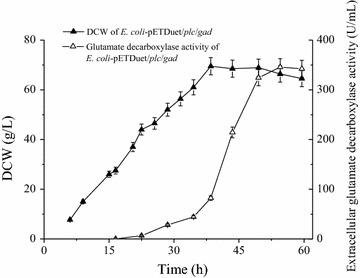
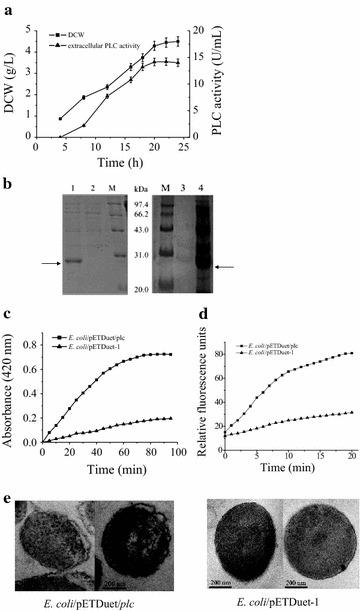
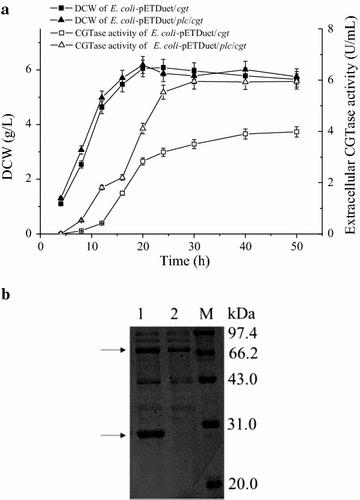
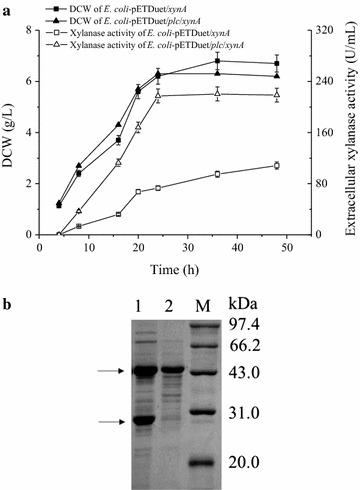
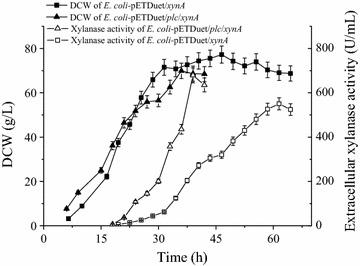
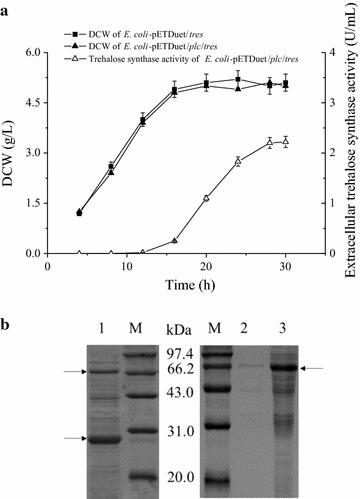
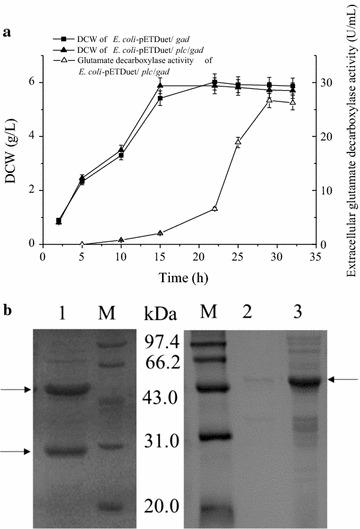
When B. cereus PLC was expressed in Escherichia coli without its signal peptide, 95.3% of the total PLC activity was detected in the culture supernatant. PLC expression enhanced membrane permeability without obvious cell lysis. Then, six test enzymes, three secretory and three cytosolic, were co-expressed with B. cereus PLC. The enhancement of extracellular production correlated strongly with the molecular mass of the test enzyme. Extracellular production of Streptomyces sp. FA1 xylanase (43 kDa), which had the lowest molecular mass among the secretory enzymes, was 4.0-fold that of its individual expression control. Extracellular production of glutamate decarboxylase (51 kDa), which had the lowest molecular mass among the cytosolic enzymes, reached 26.7 U/mL; 88.3% of the total activity produced. This strategy was effectively scaled up using a 3-L fermentor. No obvious foam was generated during this fermentation process.
CONCLUSIONS
This is the first study to detail the enhanced extracellular production of recombinant proteins through co-expression with PLC. This new strategy, which is especially appropriate for lower molecular mass proteins, allows large-scale protein production in an easily controlled fermentation process.
背景
我们实验室报道了一种通过与嗜热栖热放线菌角质酶共表达来提高重组蛋白胞外产量的策略,该角质酶通过其磷脂水解活性增加膜通透性。然而,溶血磷脂产物产生的泡沫使得在发酵罐中难以控制发酵过程。磷脂酶C(PLC)催化磷脂水解生成sn1,2 - 二酰甘油和有机磷酸盐,不会诱导泡沫形成。因此,研究了与蜡样芽孢杆菌PLC共表达作为提高重组蛋白胞外产量的一种方法。
结果
当蜡样芽孢杆菌PLC在没有信号肽的情况下在大肠杆菌中表达时,95.3%的总PLC活性在培养上清液中检测到。PLC表达增强了膜通透性且没有明显的细胞裂解。然后,六种测试酶,三种分泌型和三种胞质型,与蜡样芽孢杆菌PLC共表达。胞外产量的提高与测试酶的分子量密切相关。分泌型酶中分子量最低的链霉菌FA1木聚糖酶(43 kDa)的胞外产量是其单独表达对照的4.0倍。胞质型酶中分子量最低的谷氨酸脱羧酶(51 kDa)的胞外产量达到26.7 U/mL;占总活性的88.3%。使用3-L发酵罐有效地扩大了该策略的规模。在此发酵过程中没有产生明显的泡沫。
结论
这是第一项详细阐述通过与PLC共表达增强重组蛋白胞外产量的研究。这种新策略特别适用于较低分子量的蛋白质,能够在易于控制的发酵过程中进行大规模蛋白质生产。
 Zotero 插件