
运动强度对骨骼肌应激激酶和胰岛素蛋白信号传导的影响。
The effect of exercise-intensity on skeletal muscle stress kinase and insulin protein signaling.
作者信息
Parker Lewan, Trewin Adam, Levinger Itamar, Shaw Christopher S, Stepto Nigel K
机构信息
Institute of Sport, Exercise and Active Living (ISEAL), College of Sport and Exercise Science, Victoria University, Melbourne, Australia.
Institute for Physical Activity and Nutrition, School of Exercise and Nutrition Sciences, Deakin University, Geelong, Australia.
出版信息
PLoS One. 2017 Feb 9;12(2):e0171613. doi: 10.1371/journal.pone.0171613. eCollection 2017.
BACKGROUND
Stress and mitogen activated protein kinase (SAPK) signaling play an important role in glucose homeostasis and the physiological adaptation to exercise. However, the effects of acute high-intensity interval exercise (HIIE) and sprint interval exercise (SIE) on activation of these signaling pathways are unclear.
METHODS
Eight young and recreationally active adults performed a single cycling session of HIIE (5 x 4 minutes at 75% Wmax), SIE (4 x 30 second Wingate sprints), and continuous moderate-intensity exercise work-matched to HIIE (CMIE; 30 minutes at 50% of Wmax), separated by a minimum of 1 week. Skeletal muscle SAPK and insulin protein signaling were measured immediately, and 3 hours after exercise.
RESULTS
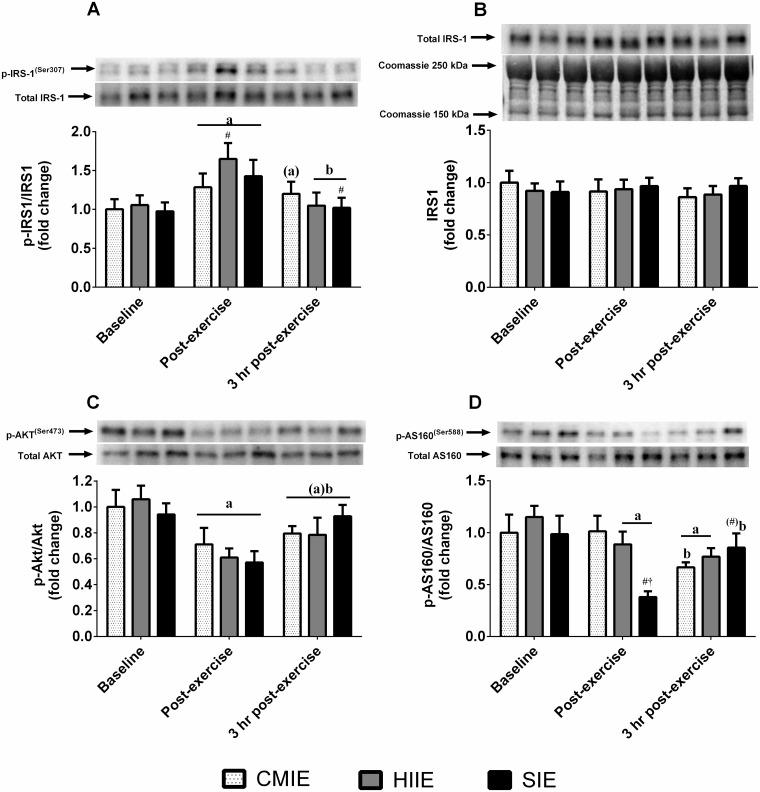
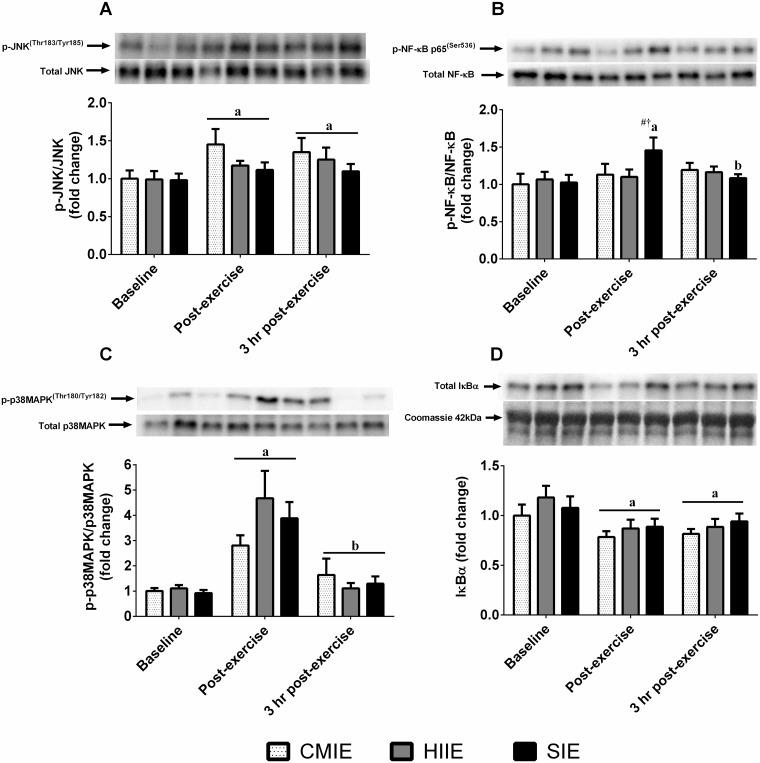
SIE elicited greater skeletal muscle NF-κB p65 phosphorylation immediately after exercise (SIE: 40%; HIIE: ~4%; CMIE; ~13%; p < 0.05) compared to HIIE and CMIE. AS160Ser588 phosphorylation decreased immediately after HIIE (-27%; p < 0.05), and decreased to the greatest extent immediately after SIE (-60%; p < 0.05). Skeletal muscle JNK (42%; p < 0.05) and p38 MAPK (171%; p < 0.05) phosphorylation increased, and skeletal muscle AktSer473 phosphorylation (-32%; p < 0.05) decreased, to a similar extent immediately after all exercise protocols. AS160Ser588 phosphorylation was similar to baseline three hours after SIE (-12%; p > 0.05), remained lower 3 hours after HIIE (-34%; p < 0.05), and decreased 3 hours after CMIE (~-33%; p < 0.05).
CONCLUSION
Despite consisting of less total work than CMIE and HIIE, SIE proved to be an effective stimulus for the activation of stress protein kinase signaling pathways linked to exercise-mediated adaptation of skeletal muscle. Furthermore, post-exercise AS160Ser588 phosphorylation decreased in an exercise-intensity and post-exercise time-course dependent manner.
背景
应激和丝裂原活化蛋白激酶(SAPK)信号传导在葡萄糖稳态及对运动的生理适应中发挥重要作用。然而,急性高强度间歇运动(HIIE)和冲刺间歇运动(SIE)对这些信号通路激活的影响尚不清楚。
方法
八名年轻且有休闲运动习惯的成年人进行了单次骑行训练,包括HIIE(75%最大功率下5组,每组4分钟)、SIE(4组,每组30秒温盖特冲刺)以及与HIIE工作量匹配的持续中等强度运动(CMIE;50%最大功率下30分钟),训练间隔至少1周。在运动后即刻及3小时后测量骨骼肌SAPK和胰岛素蛋白信号。
结果
与HIIE和CMIE相比,SIE在运动后即刻引起更大程度的骨骼肌NF-κB p65磷酸化(SIE:约40%;HIIE:约4%;CMIE:约13%;p<0.05)。HIIE后即刻AS160Ser588磷酸化降低(约-27%;p<0.05),SIE后即刻降低幅度最大(约-60%;p<0.05)。在所有运动方案后即刻,骨骼肌JNK(约42%;p<0.05)和p38 MAPK(约171%;p<0.05)磷酸化增加,骨骼肌AktSer473磷酸化(约-32%;p<0.05)降低,且降低幅度相似。SIE后3小时AS160Ser588磷酸化与基线相似(约-12%;p>0.05),HIIE后3小时仍较低(约-34%;p<0.05),CMIE后3小时降低(约-33%;p<0.05)。
结论
尽管SIE的总运动量低于CMIE和HIIE,但它被证明是激活与运动介导的骨骼肌适应相关的应激蛋白激酶信号通路的有效刺激。此外,运动后AS160Ser588磷酸化以运动强度和运动后时间进程依赖性方式降低。


 Zotero 插件