
三种市售泪膜渗透压计的随机、盲法体外比较
Randomized, masked, in vitro comparison of three commercially available tear film osmometers.
作者信息
Rocha Guillermo, Gulliver Eric, Borovik Armand, Chan Clara C
机构信息
Department of Ophthalmology, University of Manitoba, Winnipeg.
Department of Ophthalmology and Vision Sciences, University of Toronto, Toronto, Ontario, Canada.
出版信息
Clin Ophthalmol. 2017 Jan 27;11:243-248. doi: 10.2147/OPTH.S127035. eCollection 2017.
PURPOSE
The purpose of this study was to compare the precision and accuracy of commercially available tear film osmometers.
METHODS
Contrived tear solution target values representing the physiological range of tear osmolarity (normal eyes 297 mOsm/L, moderately dry eyes 342 mOsm/L, and severe dry eyes 383 mOsm/L) were constructed using a mix of mono- and divalent electrolytes, metabolites, serum albumin, and pH balanced to 7.4. Solution values were randomized and masked from the investigators during testing. Osmometers (Wescor 5520 Vapro Pressure Osmometer: device A, TearLab Osmolarity System: device B, and i-Med Pharma i-Pen: device C) were calibrated according to manufacturer instructions. Each level was tested 64× on each osmometer across two sites. Accuracy was reported as a correlation coefficient against expected linear dilutions, precision was calculated as percent coefficient of variation.
RESULTS
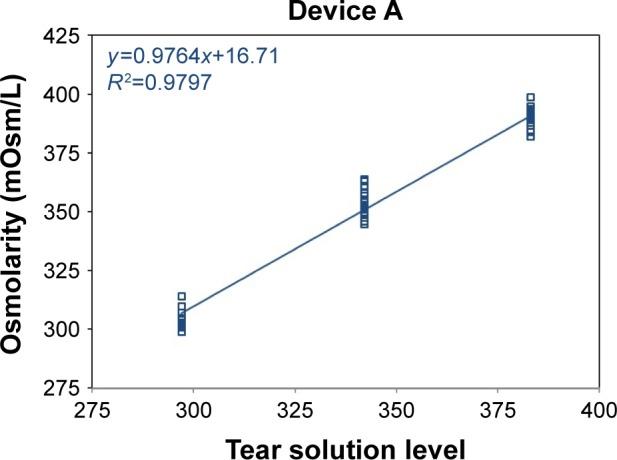
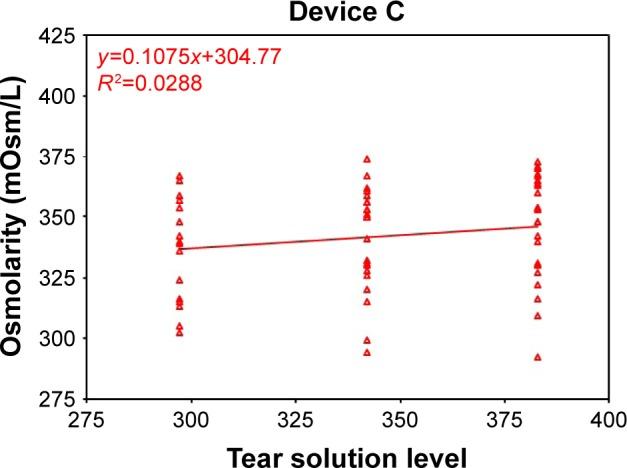
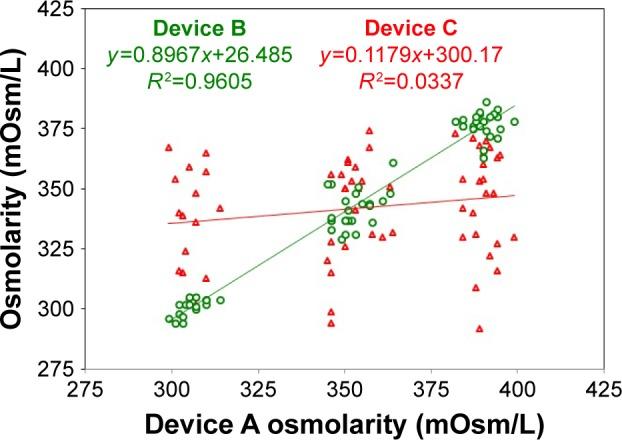
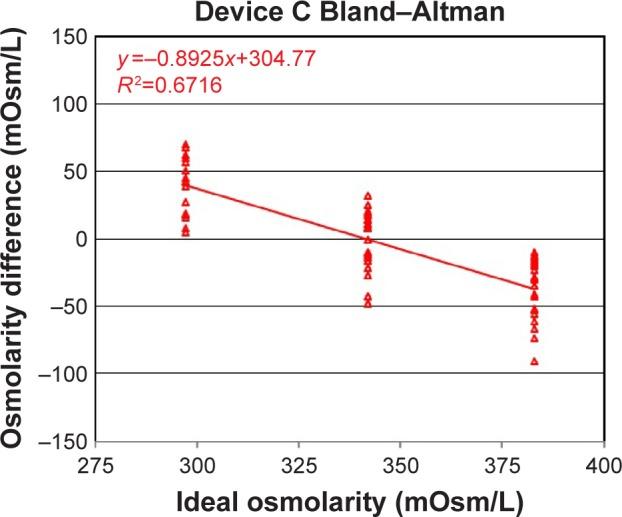
Device A reported a correlation with known solutions of =0.98, with averages of 305.6±4.0, 352.2±5.5, and 389.8±4.0 mOsm/L, and coefficient of variations (CVs) of 1.3%, 1.6%, and 1.0%, respectively. Device B reported an =0.96, with averages of 300.6±3.7, 341.4±7.9, and 376.8±5.1 mOsm/L, and CVs of 1.2%, 2.3%, and 1.4%, respectively. Device C reported an =0.03, with averages of 336.4±21.5, 342.0±20.7, and 345.7±22.0 mOsm/L, and CVs of 6.4%, 6.1%, and 6.4%, respectively.
CONCLUSION
In this randomized, masked, in vitro study, device A and device B had significantly better accuracy and precision in measuring osmolarity of contrived tear solutions of known target values compared to device C. Device C showed insufficient performance to accurately and precisely delineate osmolarity levels in the physiological range. Furthermore, in vivo studies would be required to compare performance in human subjects.
目的
本研究旨在比较市售泪膜渗透压计的精密度和准确性。
方法
使用单价和二价电解质、代谢物、血清白蛋白的混合物以及pH值调至7.4的溶液,配制出代表泪液渗透压生理范围的人工泪液目标值(正常眼297 mOsm/L、中度干眼342 mOsm/L、重度干眼383 mOsm/L)。在测试过程中,溶液值随机化且对研究人员设盲。渗透压计(Wescor 5520 Vapro压力渗透压计:设备A、TearLab渗透压系统:设备B、i-Med Pharma i-Pen:设备C)按照制造商说明进行校准。每个水平在两个地点的每个渗透压计上测试64次。准确性以与预期线性稀释的相关系数报告,精密度以变异系数百分比计算。
结果
设备A报告与已知溶液的相关性r = 0.98,平均值分别为305.6±4.0、352.2±5.5和389.8±4.0 mOsm/L,变异系数(CV)分别为1.3%、1.6%和1.0%。设备B报告r = 0.96,平均值分别为300.6±3.7、341.4±7.9和376.8±5.1 mOsm/L,CV分别为1.2%、2.3%和1.4%。设备C报告r = 0.03,平均值分别为336.4±21.5、342.0±20.7和345.7±22.0 mOsm/L,CV分别为6.4%、6.1%和6.4%。
结论
在这项随机、设盲的体外研究中,与设备C相比,设备A和设备B在测量已知目标值的人工泪液渗透压方面具有显著更好的准确性和精密度。设备C的性能不足以准确精确地描绘生理范围内的渗透压水平。此外,需要进行体内研究以比较在人类受试者中的性能。



 Zotero 插件