
利用工程化Cas9-胞苷脱氨酶融合蛋白扩大碱基编辑的基因组靶向范围并提高其精度。
Increasing the genome-targeting scope and precision of base editing with engineered Cas9-cytidine deaminase fusions.
作者信息
Kim Y Bill, Komor Alexis C, Levy Jonathan M, Packer Michael S, Zhao Kevin T, Liu David R
机构信息
Department of Chemistry and Chemical Biology, Harvard University, Cambridge, Massachusetts, USA.
Howard Hughes Medical Institute, Harvard University, Cambridge, Massachusetts, USA.
出版信息
Nat Biotechnol. 2017 Apr;35(4):371-376. doi: 10.1038/nbt.3803. Epub 2017 Feb 13.
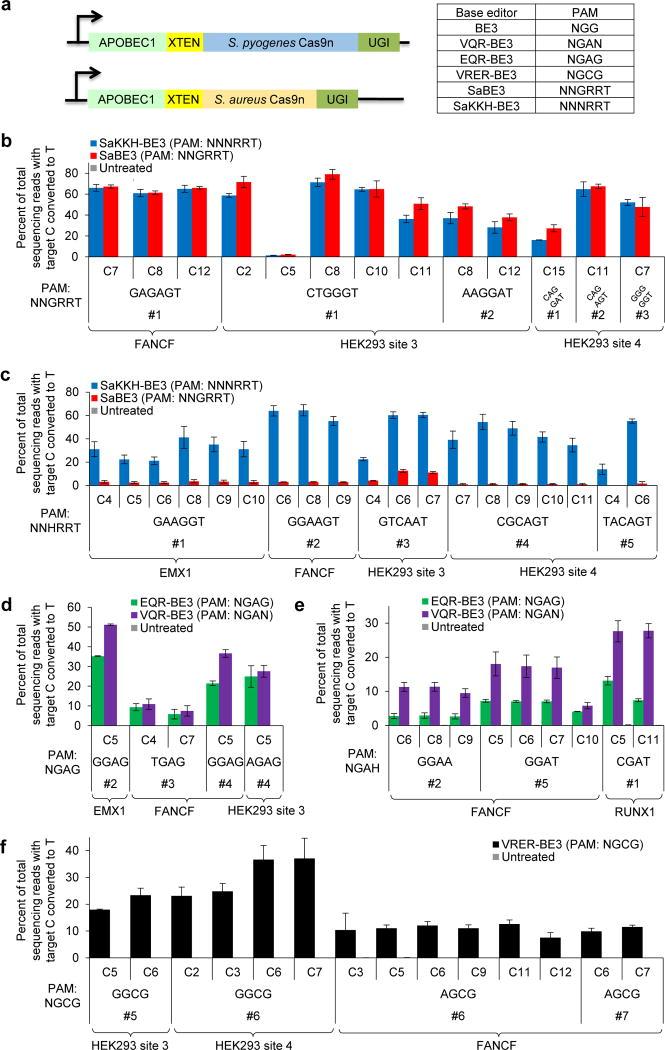
Base editing induces single-nucleotide changes in the DNA of living cells using a fusion protein containing a catalytically defective Streptococcus pyogenes Cas9, a cytidine deaminase, and an inhibitor of base excision repair. This genome editing approach has the advantage that it does not require formation of double-stranded DNA breaks or provision of a donor DNA template. Here we report the development of five C to T (or G to A) base editors that use natural and engineered Cas9 variants with different protospacer-adjacent motif (PAM) specificities to expand the number of sites that can be targeted by base editing 2.5-fold. Additionally, we engineered base editors containing mutated cytidine deaminase domains that narrow the width of the editing window from ∼5 nucleotides to as little as 1-2 nucleotides. We thereby enabled discrimination of neighboring C nucleotides, which would otherwise be edited with similar efficiency, and doubled the number of disease-associated target Cs able to be corrected preferentially over nearby non-target Cs.
碱基编辑利用一种融合蛋白在活细胞的DNA中诱导单核苷酸变化,该融合蛋白包含催化缺陷型化脓性链球菌Cas9、一种胞嘧啶脱氨酶和一种碱基切除修复抑制剂。这种基因组编辑方法的优点是不需要形成双链DNA断裂或提供供体DNA模板。在此,我们报告了五种C到T(或G到A)碱基编辑器的开发,这些编辑器使用具有不同原间隔相邻基序(PAM)特异性的天然和工程化Cas9变体,将碱基编辑可靶向的位点数量增加了2.5倍。此外,我们设计了包含突变胞嘧啶脱氨酶结构域的碱基编辑器,将编辑窗口的宽度从约5个核苷酸缩小至仅1 - 2个核苷酸。由此,我们能够区分相邻的C核苷酸,否则它们会以相似的效率被编辑,并且将能够优先于附近非靶标C进行校正的疾病相关靶标C的数量增加了一倍。


 Zotero 插件