
具有不同UAG和UAA密码子含义的核遗传密码。
Nuclear genetic codes with a different meaning of the UAG and the UAA codon.
作者信息
Pánek Tomáš, Žihala David, Sokol Martin, Derelle Romain, Klimeš Vladimír, Hradilová Miluše, Zadrobílková Eliška, Susko Edward, Roger Andrew J, Čepička Ivan, Eliáš Marek
机构信息
Department of Biology and Ecology, Faculty of Science, University of Ostrava, Chittussiho 10, 710 00, Ostrava, Czech Republic.
Unité d'Ecologie, Systématique et Evolution, Centre National de la Recherche Scientifique (CNRS), Université Paris-Sud/Paris-Saclay, AgroParisTech, Orsay, France.
出版信息
BMC Biol. 2017 Feb 13;15(1):8. doi: 10.1186/s12915-017-0353-y.
BACKGROUND
Departures from the standard genetic code in eukaryotic nuclear genomes are known for only a handful of lineages and only a few genetic code variants seem to exist outside the ciliates, the most creative group in this regard. Most frequent code modifications entail reassignment of the UAG and UAA codons, with evidence for at least 13 independent cases of a coordinated change in the meaning of both codons. However, no change affecting each of the two codons separately has been documented, suggesting the existence of underlying evolutionary or mechanistic constraints.
RESULTS
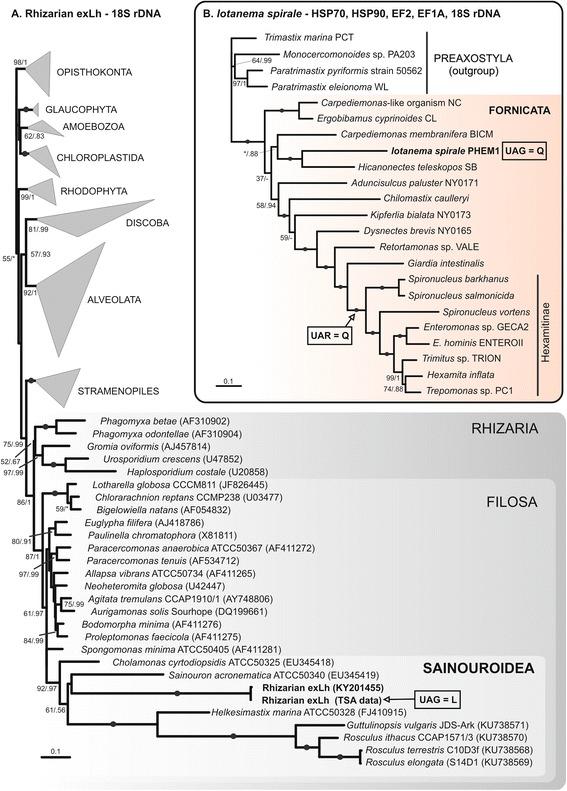
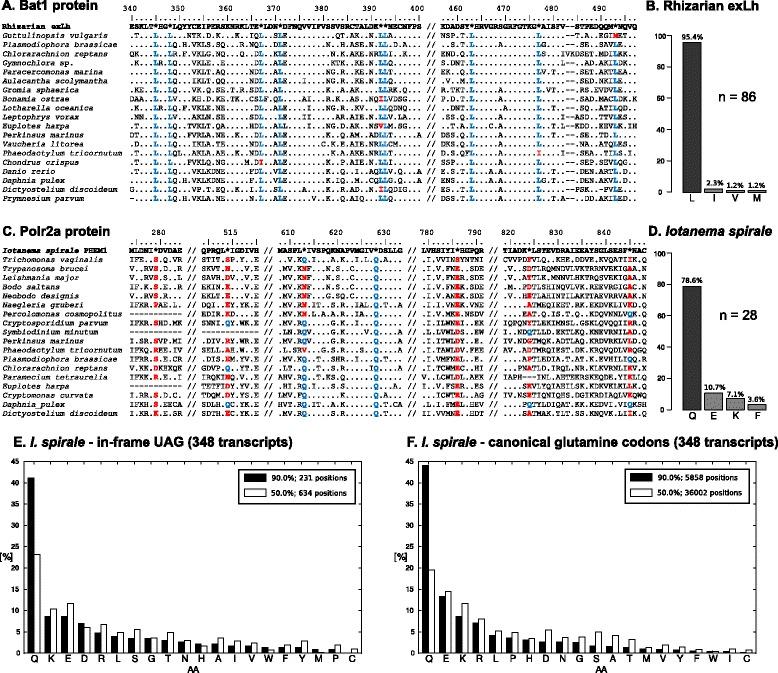
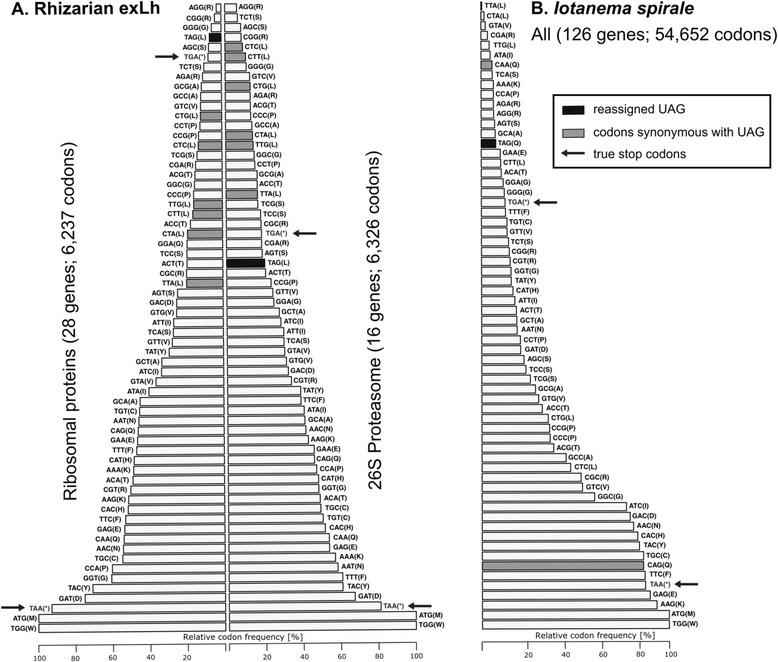
Here, we present the discovery of two new variants of the nuclear genetic code, in which UAG is translated as an amino acid while UAA is kept as a termination codon (along with UGA). The first variant occurs in an organism noticed in a (meta)transcriptome from the heteropteran Lygus hesperus and demonstrated to be a novel insect-dwelling member of Rhizaria (specifically Sainouroidea). This first documented case of a rhizarian with a non-canonical genetic code employs UAG to encode leucine and represents an unprecedented change among nuclear codon reassignments. The second code variant was found in the recently described anaerobic flagellate Iotanema spirale (Metamonada: Fornicata). Analyses of transcriptomic data revealed that I. spirale uses UAG to encode glutamine, similarly to the most common variant of a non-canonical code known from several unrelated eukaryotic groups, including hexamitin diplomonads (also a lineage of fornicates). However, in these organisms, UAA also encodes glutamine, whereas it is the primary termination codon in I. spirale. Along with phylogenetic evidence for distant relationship of I. spirale and hexamitins, this indicates two independent genetic code changes in fornicates.
CONCLUSIONS
Our study documents, for the first time, that evolutionary changes of the meaning of UAG and UAA codons in nuclear genomes can be decoupled and that the interpretation of the two codons by the cytoplasmic translation apparatus is mechanistically separable. The latter conclusion has interesting implications for possibilities of genetic code engineering in eukaryotes. We also present a newly developed generally applicable phylogeny-informed method for inferring the meaning of reassigned codons.
背景
真核细胞核基因组中偏离标准遗传密码的情况仅在少数谱系中被知晓,并且似乎只有少数遗传密码变体存在于纤毛虫之外,纤毛虫是这方面最具创新性的类群。最常见的密码子修饰涉及UAG和UAA密码子的重新分配,有证据表明至少有13个独立案例显示这两个密码子的含义发生了协同变化。然而,尚未有文献记载影响这两个密码子各自单独变化的情况,这表明存在潜在的进化或机制限制。
结果
在此,我们展示了核遗传密码的两个新变体的发现,其中UAG被翻译为一种氨基酸,而UAA(与UGA一起)仍作为终止密码子。第一个变体出现在从异翅目牧草盲蝽的(元)转录组中发现的一种生物中,并被证明是根足虫(特别是赛诺虫纲)的一种新型寄生于昆虫的成员。这是首次记录到具有非规范遗传密码的根足虫案例,它使用UAG编码亮氨酸,代表了核密码子重新分配中前所未有的变化。第二个密码变体在最近描述的厌氧鞭毛虫旋回艾奥塔虫(变形虫门:双滴虫目)中被发现。转录组数据分析表明,旋回艾奥塔虫使用UAG编码谷氨酰胺,这与从几个不相关的真核生物类群(包括六鞭虫双滴虫,也是双滴虫目的一个谱系)中已知的最常见的非规范密码变体类似。然而,在这些生物中,UAA也编码谷氨酰胺,而在旋回艾奥塔虫中它是主要的终止密码子。连同旋回艾奥塔虫和六鞭虫之间远缘关系的系统发育证据,这表明双滴虫目中发生了两次独立的遗传密码变化。
结论
我们的研究首次证明,核基因组中UAG和UAA密码子含义的进化变化可以解耦,并且细胞质翻译装置对这两个密码子的解读在机制上是可分离的。后一个结论对真核生物中遗传密码工程的可能性具有有趣的启示。我们还提出了一种新开发的普遍适用的基于系统发育信息的方法,用于推断重新分配密码子的含义。

 Zotero 插件