
女性网球运动员和非运动员大学生中用于估计能量需求的膳食参考摄入量预测方程的准确性:与双标水法的比较。
Accuracy of dietary reference intake predictive equation for estimated energy requirements in female tennis athletes and non-athlete college students: comparison with the doubly labeled water method.
作者信息
Ndahimana Didace, Lee Sun-Hee, Kim Ye-Jin, Son Hee-Ryoung, Ishikawa-Takata Kazuko, Park Jonghoon, Kim Eun-Kyung
机构信息
Department of Food and Nutrition, Gangneung-Wonju National University, 120 Gangneungdaehangno, Gangneung, Gangwon 25457, Korea.
Department of Nutritional Education, National Institute of Health and Nutrition, Tokyo 162-8636, Japan.
出版信息
Nutr Res Pract. 2017 Feb;11(1):51-56. doi: 10.4162/nrp.2017.11.1.51. Epub 2016 Dec 19.
BACKGROUND/OBJECTIVES: The purpose of this study was to assess the accuracy of a dietary reference intake (DRI) predictive equation for estimated energy requirements (EER) in female college tennis athletes and non-athlete students using doubly labeled water (DLW) as a reference method.
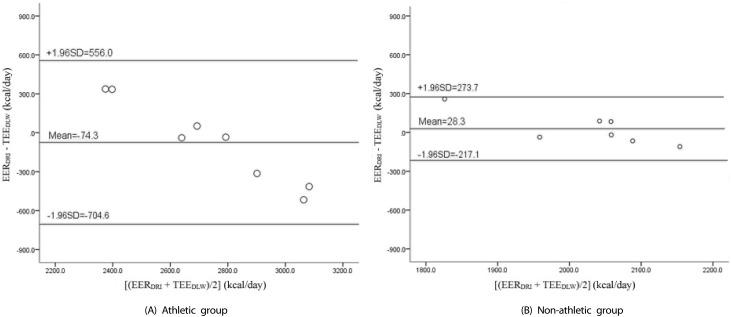
MATERIALS/METHODS: Fifteen female college students, including eight tennis athletes and seven non-athlete subjects (aged between 19 to 24 years), were involved in the study. Subjects' total energy expenditure (TEE) was measured by the DLW method, and EER were calculated using the DRI predictive equation. The accuracy of this equation was assessed by comparing the EER calculated using the DRI predictive equation (EER) and TEE measured by the DLW method (TEE) based on calculation of percentage difference mean and percentage of accurate prediction. The agreement between the two methods was assessed by the Bland-Altman method.
RESULTS
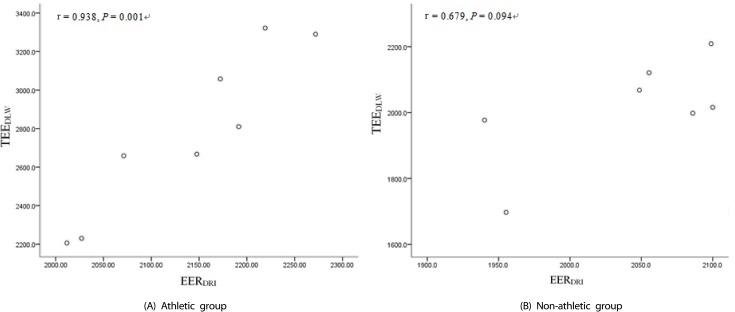
The percentage difference mean between the methods was -1.1% in athletes and 1.8% in non-athlete subjects, whereas the percentage of accurate prediction was 37.5% and 85.7%, respectively. In the case of athletic subjects, the DRI predictive equation showed a clear bias negatively proportional to the subjects' TEE.
CONCLUSIONS
The results from this study suggest that the DRI predictive equation could be used to obtain EER in non-athlete female college students at a group level. However, this equation would be difficult to use in the case of athletes at the group and individual levels. The development of a new and more appropriate equation for the prediction of energy expenditure in athletes is proposed.
背景/目的:本研究旨在以双标水(DLW)法作为参考方法,评估膳食参考摄入量(DRI)预测方程对估计女大学生网球运动员和非运动员学生能量需求(EER)的准确性。
材料/方法:15名女大学生参与了本研究,其中包括8名网球运动员和7名非运动员受试者(年龄在19至24岁之间)。通过DLW法测量受试者的总能量消耗(TEE),并使用DRI预测方程计算EER。基于计算差异百分比均值和准确预测百分比,通过比较使用DRI预测方程计算的EER(EER)和通过DLW法测量的TEE来评估该方程的准确性。采用Bland-Altman法评估两种方法之间的一致性。
结果
两种方法之间的差异百分比均值在运动员中为-1.1%,在非运动员受试者中为1.8%,而准确预测百分比分别为37.5%和85.7%。对于运动员受试者,DRI预测方程显示出与受试者TEE呈负相关的明显偏差。
结论
本研究结果表明,DRI预测方程可用于在群体水平上获取非运动员女大学生的EER。然而,该方程在运动员群体和个体水平上难以使用。建议开发一种新的、更合适的方程来预测运动员的能量消耗。
 Zotero 插件