
系统生物学解释复杂心脏疾病的概念基础
Conceptual Foundations of Systems Biology Explaining Complex Cardiac Diseases.
作者信息
Louridas George E, Lourida Katerina G
机构信息
Department of Cardiology, Aristotle University, Thessaloniki 54124, Greece.
出版信息
Healthcare (Basel). 2017 Feb 21;5(1):10. doi: 10.3390/healthcare5010010.
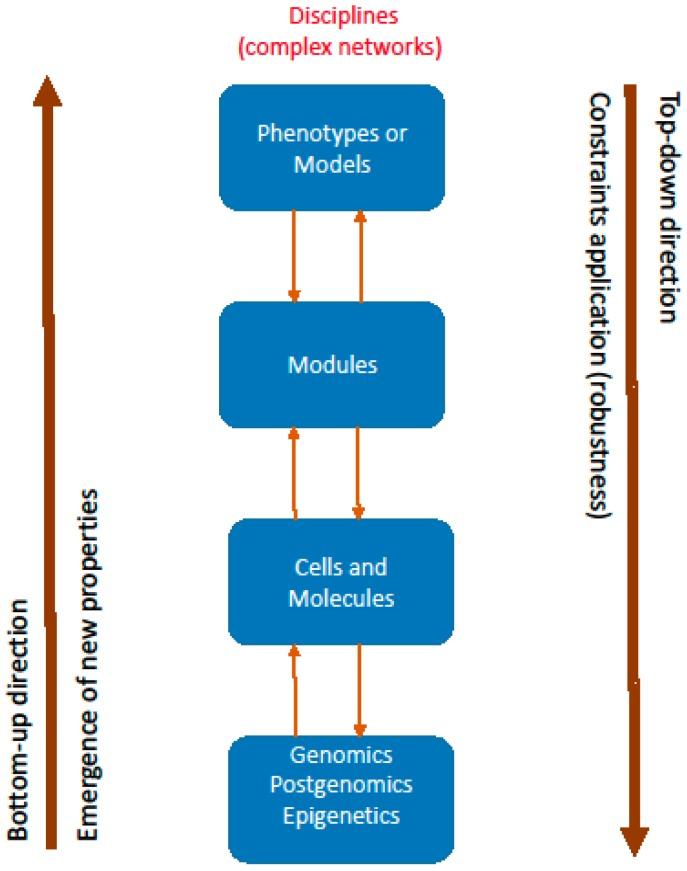
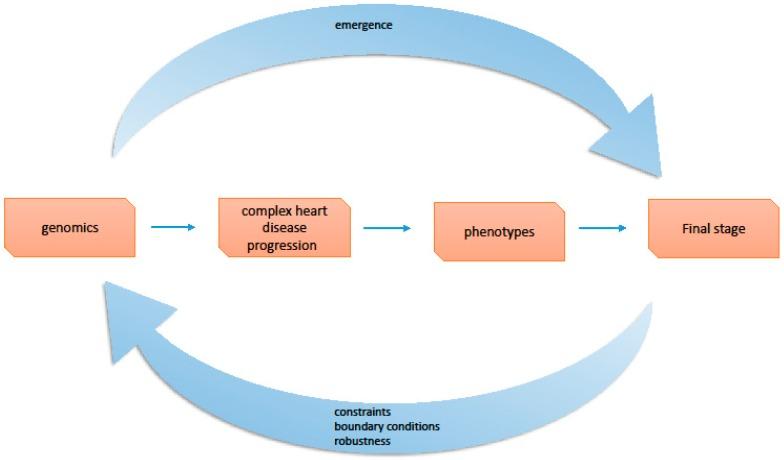
Systems biology is an important concept that connects molecular biology and genomics with computing science, mathematics and engineering. An endeavor is made in this paper to associate basic conceptual ideas of systems biology with clinical medicine. Complex cardiac diseases are clinical phenotypes generated by integration of genetic, molecular and environmental factors. Basic concepts of systems biology like network construction, modular thinking, biological constraints (downward biological direction) and emergence (upward biological direction) could be applied to clinical medicine. Especially, in the field of cardiology, these concepts can be used to explain complex clinical cardiac phenotypes like chronic heart failure and coronary artery disease. Cardiac diseases are biological complex entities which like other biological phenomena can be explained by a systems biology approach. The above powerful biological tools of systems biology can explain robustness growth and stability during disease process from modulation to phenotype. The purpose of the present review paper is to implement systems biology strategy and incorporate some conceptual issues raised by this approach into the clinical field of complex cardiac diseases. Cardiac disease process and progression can be addressed by the holistic realistic approach of systems biology in order to define in better terms earlier diagnosis and more effective therapy.
系统生物学是一个将分子生物学、基因组学与计算机科学、数学和工程学联系起来的重要概念。本文致力于将系统生物学的基本概念与临床医学联系起来。复杂的心脏疾病是由遗传、分子和环境因素整合产生的临床表型。系统生物学的基本概念,如网络构建、模块化思维、生物约束(向下的生物学方向)和涌现(向上的生物学方向),可以应用于临床医学。特别是在心脏病学领域,这些概念可用于解释诸如慢性心力衰竭和冠状动脉疾病等复杂的临床心脏表型。心脏疾病是生物学上的复杂实体,与其他生物现象一样,可以用系统生物学方法来解释。系统生物学上述强大的生物学工具可以从调节到表型解释疾病过程中的稳健性增长和稳定性。本综述文章的目的是实施系统生物学策略,并将这种方法提出的一些概念问题纳入复杂心脏疾病的临床领域。系统生物学的整体现实方法可以解决心脏疾病的过程和进展问题,以便更好地定义早期诊断和更有效的治疗方法。

 Zotero 插件