
γδ T细胞介导的巨细胞病毒感染免疫
γδ T Cell-Mediated Immunity to Cytomegalovirus Infection.
作者信息
Khairallah Camille, Déchanet-Merville Julie, Capone Myriam
机构信息
Immunoconcept, CNRS UMR 5164, Bordeaux University , Bordeaux , France.
出版信息
Front Immunol. 2017 Feb 9;8:105. doi: 10.3389/fimmu.2017.00105. eCollection 2017.
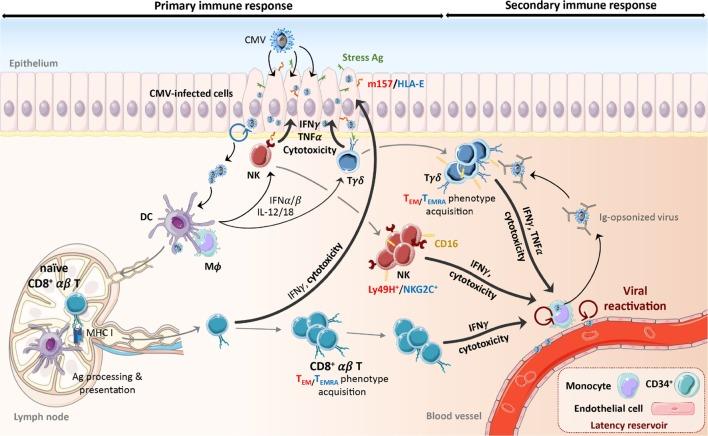
γδ T lymphocytes are unconventional immune cells, which have both innate- and adaptive-like features allowing them to respond to a wide spectrum of pathogens. For many years, we and others have reported on the role of these cells in the immune response to human cytomegalovirus in transplant patients, pregnant women, neonates, immunodeficient children, and healthy people. Indeed, and as described for CD8 T cells, CMV infection leaves a specific imprint on the γδ T cell compartment: (i) driving a long-lasting expansion of oligoclonal γδ T cells in the blood of seropositive individuals, (ii) inducing their differentiation into effector/memory cells expressing a T phenotype, and (iii) enhancing their antiviral effector functions (i.e., cytotoxicity and IFNγ production). Recently, two studies using murine CMV (MCMV) have corroborated and extended these observations. In particular, they have illustrated the ability of adoptively transferred MCMV-induced γδ T cells to protect immune-deficient mice against virus-induced death. , expansion of γδ T cells is associated with the clearance of CMV infection as well as with reduced cancer occurrence or leukemia relapse risk in kidney transplant patients and allogeneic stem cell recipients, respectively. Taken together, all these studies show that γδ T cells are important immune effectors against CMV and cancer, which are life-threatening diseases affecting transplant recipients. The ability of CMV-induced γδ T cells to act independently of other immune cells opens the door to the development of novel cellular immunotherapies that could be particularly beneficial for immunocompromised transplant recipients.
γδ T淋巴细胞是非常规免疫细胞,具有先天和适应性样特征,使其能够对多种病原体作出反应。多年来,我们和其他人都报道了这些细胞在移植患者、孕妇、新生儿、免疫缺陷儿童和健康人中对人巨细胞病毒免疫反应中的作用。事实上,正如对CD8 T细胞的描述一样,巨细胞病毒感染在γδ T细胞区室留下了特定印记:(i)驱动血清阳性个体血液中寡克隆γδ T细胞的长期扩增,(ii)诱导它们分化为表达T表型的效应/记忆细胞,以及(iii)增强它们的抗病毒效应功能(即细胞毒性和IFNγ产生)。最近,两项使用鼠巨细胞病毒(MCMV)的研究证实并扩展了这些观察结果。特别是,它们阐明了过继转移的MCMV诱导的γδ T细胞保护免疫缺陷小鼠免受病毒诱导死亡的能力。此外,γδ T细胞的扩增分别与肾移植患者和异基因干细胞接受者中巨细胞病毒感染的清除以及癌症发生或白血病复发风险的降低相关。综上所述,所有这些研究表明,γδ T细胞是对抗巨细胞病毒和癌症的重要免疫效应器,而巨细胞病毒和癌症是影响移植受者的危及生命的疾病。巨细胞病毒诱导的γδ T细胞独立于其他免疫细胞发挥作用的能力为新型细胞免疫疗法的开发打开了大门,这可能对免疫受损的移植受者特别有益。

 Zotero 插件