
2015年从台湾中南部腹泻仔猪粪便样本中分离出的产超广谱β-内酰胺酶大肠杆菌的特征
Characteristics of extended-spectrum β-lactamase-producing Escherichia coli isolated from fecal samples of piglets with diarrhea in central and southern Taiwan in 2015.
作者信息
Lee Wan-Chen, Yeh Kuang-Sheng
机构信息
Department of Veterinary Medicine, School of Veterinary Medicine, College of Bio-Resources and Agriculture, National Taiwan University, Taipei, 106, Taiwan.
National Taiwan University Veterinary Hospital, Taipei, 106, Taiwan.
出版信息
BMC Vet Res. 2017 Mar 1;13(1):66. doi: 10.1186/s12917-017-0986-7.
BACKGROUND
The production of extended-spectrum β-lactamases (ESBLs) confer resistance to the commonly used beta-lactam antimicrobials and ESBL-producing bacteria render treatment difficulty in human and veterinary medicine. ESBL-producing bacteria have emerged in livestock in recent years, which may raise concerns regarding possible transfer of such bacteria through the food chain. The swine industry is important in Taiwan, but investigations regarding the status of ESBL in swine are limited.
RESULTS
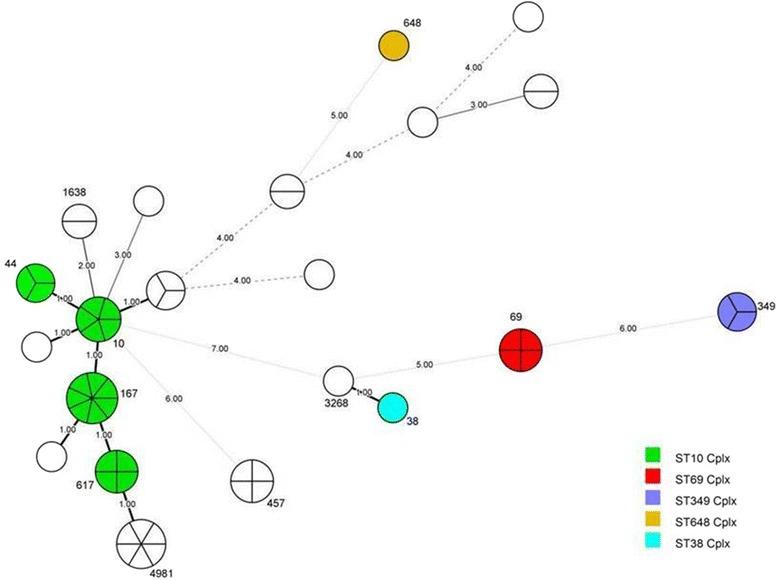
We collected 275 fecal swab samples from piglets with diarrhea in 16 swine farms located in central and southern Taiwan from January to December 2015 and screened them for ESBL-producing Escherichia coli. ESBL producers were confirmed phenotypically by combination disc test and genotypically by polymerase chain reaction and DNA sequencing. The occurrence rate of ESBL-producing E. coli was 19.7% (54 of 275), and all were obtained in swine farms located in southern Taiwan. bla and bla were the two bla groups found. bla (34 of 54; 63.0%) and bla (16 of 54; 29.6%), which belong to the bla , were the two major bla gene types, whereas bla was the only type found in the bla . Twenty-seven strains contained bla , and the other 27 strains contained bla . One strain found in Pingtung harbored three bla genes: bla , bla , and bla . ESBL-producing E. coli exhibited a multidrug-resistant phenotype, and multilocus sequence typing revealed that the ST10 clonal complexes, including ST10, 167, 44, and 617 accounted for 35% (19 of 54) of these strains.
CONCLUSIONS
ESBL-producing E. coli from piglets with diarrhea were isolated from swine farms located in southern Taiwan. The most commonly detected bla were bla and bla . The ST10 clonal complexes comprised most of our ESBL-producing E. coli strains. Fecal shedding from swine may contaminate the environment, resulting in public health concerns; thus, continued surveillance of ESBL is essential in swine and in other food animals.
背景
超广谱β-内酰胺酶(ESBLs)的产生使细菌对常用的β-内酰胺类抗菌药物产生耐药性,产ESBLs细菌给人类和兽医学的治疗带来困难。近年来,产ESBLs细菌已在牲畜中出现,这可能引发人们对这类细菌通过食物链传播的担忧。养猪业在台湾很重要,但关于猪中ESBLs状况的调查有限。
结果
我们于2015年1月至12月从台湾中部和南部16个养猪场的腹泻仔猪中收集了275份粪便拭子样本,筛查其中产ESBLs的大肠杆菌。通过组合纸片试验对产ESBLs细菌进行表型确认,通过聚合酶链反应和DNA测序进行基因型确认。产ESBLs大肠杆菌的发生率为19.7%(275份样本中有54份),且均来自台湾南部的养猪场。发现了bla 和bla 这两个bla 组。属于bla 的bla (54份样本中有34份;63.0%)和bla (54份样本中有16份;29.6%)是两种主要的bla 基因类型,而bla 是bla 组中唯一发现的类型。27株菌株含有bla ,另外27株含有bla 。在屏东发现的一株菌株携带三个bla 基因:bla 、bla 和bla 。产ESBLs大肠杆菌表现出多重耐药表型,多位点序列分型显示,ST10克隆复合体,包括ST10、167、44和617,占这些菌株的35%(54份样本中有19份)。
结论
腹泻仔猪中产ESBLs大肠杆菌分离自台湾南部养猪场。最常检测到的bla 是bla 和bla 。我们分离的产ESBLs大肠杆菌菌株大多属于ST10克隆复合体。猪的粪便排放可能污染环境,引发公共卫生问题;因此,持续监测猪及其他食用动物中的ESBLs至关重要。

 Zotero 插件