
使用可穿戴传感器检测帕金森病中的冻结步态和跌倒:一项系统综述。
Freezing of gait and fall detection in Parkinson's disease using wearable sensors: a systematic review.
作者信息
Silva de Lima Ana Lígia, Evers Luc J W, Hahn Tim, Bataille Lauren, Hamilton Jamie L, Little Max A, Okuma Yasuyuki, Bloem Bastiaan R, Faber Marjan J
机构信息
Radboud university medical center, Donders Institute for Brain, Cognition and Behavior, Nijmegen, The Netherlands.
Department of Neurology, Radboud university medical center, Nijmegen, The Netherlands.
出版信息
J Neurol. 2017 Aug;264(8):1642-1654. doi: 10.1007/s00415-017-8424-0. Epub 2017 Mar 1.
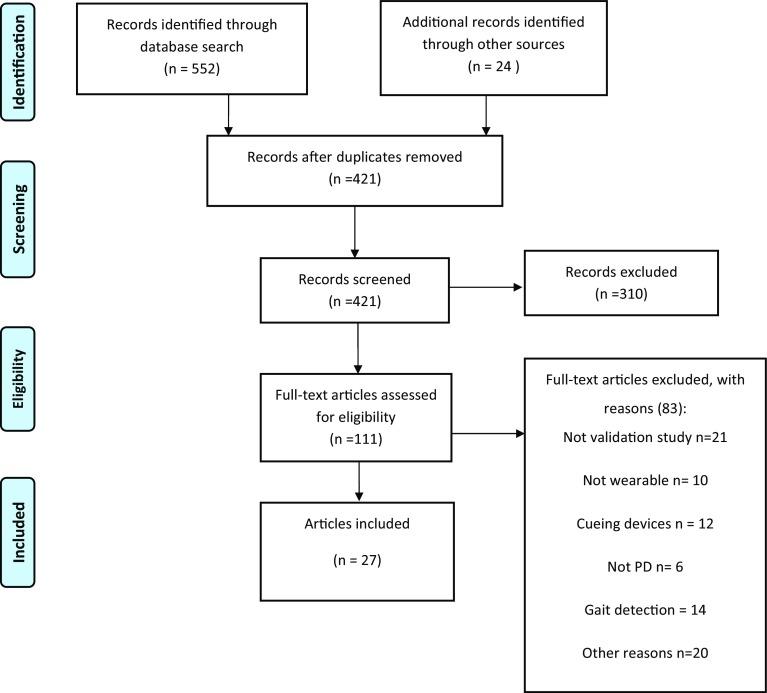
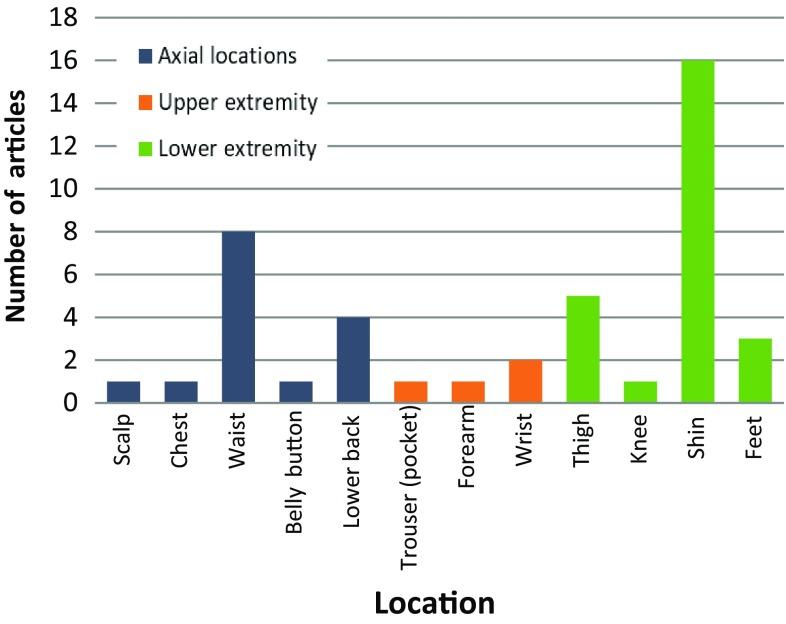
Despite the large number of studies that have investigated the use of wearable sensors to detect gait disturbances such as Freezing of gait (FOG) and falls, there is little consensus regarding appropriate methodologies for how to optimally apply such devices. Here, an overview of the use of wearable systems to assess FOG and falls in Parkinson's disease (PD) and validation performance is presented. A systematic search in the PubMed and Web of Science databases was performed using a group of concept key words. The final search was performed in January 2017, and articles were selected based upon a set of eligibility criteria. In total, 27 articles were selected. Of those, 23 related to FOG and 4 to falls. FOG studies were performed in either laboratory or home settings, with sample sizes ranging from 1 PD up to 48 PD presenting Hoehn and Yahr stage from 2 to 4. The shin was the most common sensor location and accelerometer was the most frequently used sensor type. Validity measures ranged from 73-100% for sensitivity and 67-100% for specificity. Falls and fall risk studies were all home-based, including samples sizes of 1 PD up to 107 PD, mostly using one sensor containing accelerometers, worn at various body locations. Despite the promising validation initiatives reported in these studies, they were all performed in relatively small sample sizes, and there was a significant variability in outcomes measured and results reported. Given these limitations, the validation of sensor-derived assessments of PD features would benefit from more focused research efforts, increased collaboration among researchers, aligning data collection protocols, and sharing data sets.
尽管已有大量研究探讨了可穿戴传感器在检测步态障碍(如冻结步态(FOG))和跌倒方面的应用,但对于如何最佳应用此类设备的适当方法,目前尚未达成共识。在此,本文对可穿戴系统在评估帕金森病(PD)中的FOG和跌倒情况及验证性能进行了综述。使用一组概念关键词在PubMed和Web of Science数据库中进行了系统检索。最终检索于2017年1月进行,并根据一组纳入标准选择文章。总共选择了27篇文章。其中,23篇与FOG相关,4篇与跌倒相关。FOG研究在实验室或家庭环境中进行,样本量从1名帕金森病患者到48名患者不等,Hoehn和Yahr分期为2至4期。小腿是最常见的传感器放置位置,加速度计是最常用的传感器类型。有效性测量的灵敏度范围为73%-100%,特异性范围为67%-100%。跌倒及跌倒风险研究均在家庭环境中进行,样本量从1名帕金森病患者到107名患者不等,大多使用一个包含加速度计的传感器,佩戴在身体的不同部位。尽管这些研究报告了有前景的验证举措,但它们都是在相对较小的样本量下进行的,并且所测量的结果和报告的结果存在显著差异。鉴于这些局限性,对基于传感器的帕金森病特征评估进行验证将受益于更有针对性的研究工作、研究人员之间加强合作、统一数据收集协议以及共享数据集。


 Zotero 插件