
初级传入神经中降钙素基因相关肽的不同表达模式导致大鼠坐骨神经慢性缩窄或挤压损伤后出现不同的神经病理性症状。
Distinct calcitonin gene-related peptide expression pattern in primary afferents contribute to different neuropathic symptoms following chronic constriction or crush injuries to the rat sciatic nerve.
作者信息
Zou Yu, Xu Fangting, Tang Zhaohui, Zhong Tao, Cao Jiawei, Guo Qulian, Huang Changsheng
机构信息
1 Department of Anesthesiology, Xiangya Hospital of Central South University, Changsha, China.
出版信息
Mol Pain. 2016 Jan-Dec;12:1744806916681566. doi: 10.1177/1744806916681566.
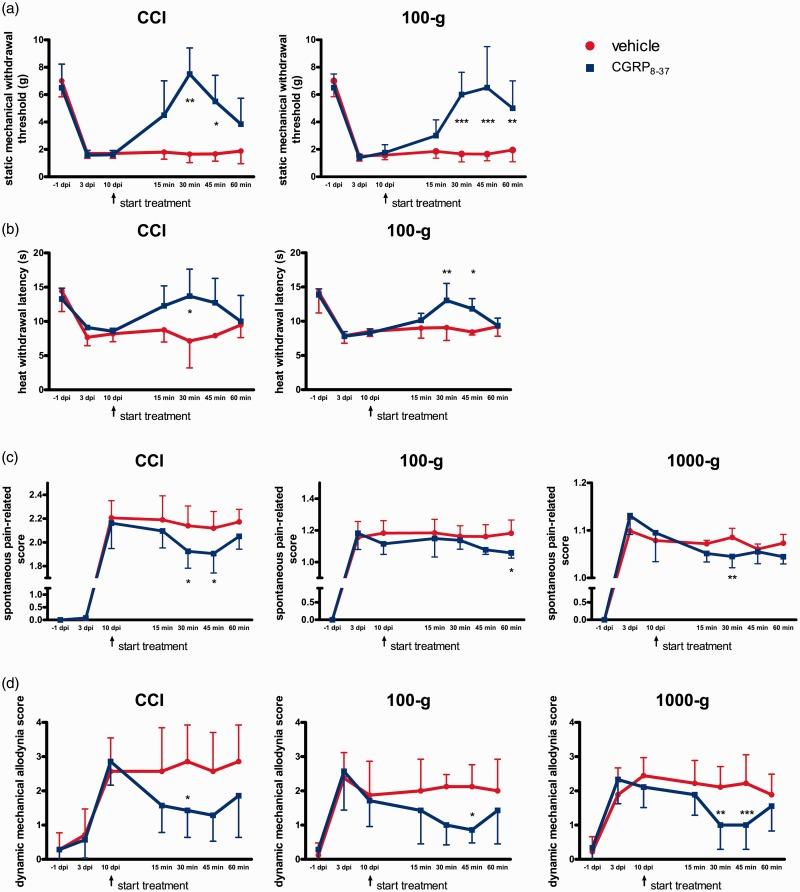
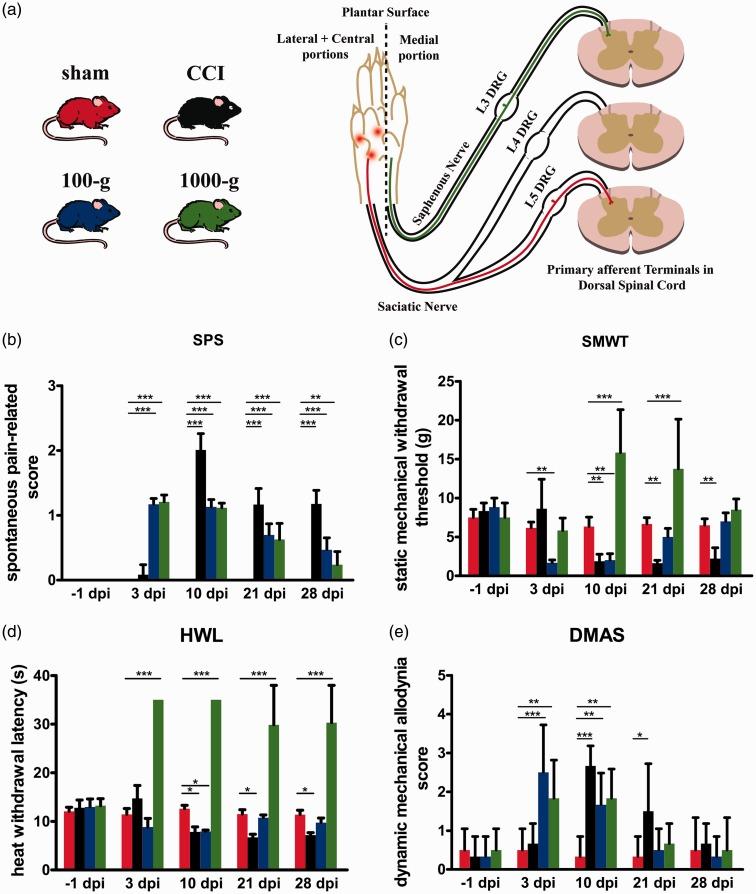
Although calcitonin gene-related peptide is a recognized pain transducer, the expression of calcitonin gene-related peptide in primary afferents may be differentially affected following different types of nerve injury. Here, we examined whether different calcitonin gene-related peptide expression patterns in primary afferents contributes to distinct sensory disturbances in three animal models of sciatic nerve injury: chronic constriction injury, mild (100 g force) or strong (1000 g force) transient crush in rats. Assessments of withdrawal reflexes and spontaneous behavior indicated that chronic constriction injury and mild crush resulted in positive neuropathic symptoms (static/dynamic mechanical allodynia, heat hyperalgesia, cold allodynia, spontaneous pain). However, strong crush led to both positive (dynamic mechanical allodynia, cold allodynia, spontaneous pain) and negative symptoms (static mechanical hypoesthesia, heat hypoalgesia). Calcitonin gene-related peptide immunoreactivity in dorsal root ganglia and corresponding spinal cord segments, and calcitonin gene-related peptide mRNA levels in dorsal root ganglia, indicated that the primary afferent calcitonin gene-related peptide supply was markedly reduced only after strong crush. This reduction paralleled the development of negative symptoms (static mechanical hypoesthesia and heat hypoalgesia). Administration of exogenous calcitonin gene-related peptide intrathecally after strong crush did not alter heat hypoalgesia but ameliorated static mechanical hypoesthesia, an effect blocked by a calcitonin gene-related peptide receptor antagonist. Thus, reducing the primary afferent calcitonin gene-related peptide supply contributed to subsequent negative neuropathic symptoms, especially to static mechanical stimuli. Moreover, nerve injury caused a subcellular redistribution of calcitonin gene-related peptide from small- and medium-size dorsal root ganglia neurons to large-size dorsal root ganglia neurons, which paralleled the development of positive neuropathic symptoms. Intrathecal administration of the calcitonin gene-related peptide receptor antagonist ameliorated these positive symptoms, indicating that the expression of calcitonin gene-related peptide in large-size dorsal root ganglia neurons is important for the positive neuropathic symptoms in all three models. Taken together, these results suggest that distinct calcitonin gene-related peptide expression pattern in primary afferents contribute to different neuropathic symptoms following chronic constriction or crush injuries to the rat sciatic nerve.
尽管降钙素基因相关肽是一种公认的疼痛传导分子,但在不同类型的神经损伤后,初级传入神经元中降钙素基因相关肽的表达可能会受到不同的影响。在此,我们研究了在三种坐骨神经损伤动物模型(慢性压迫损伤、大鼠轻度(100克力)或重度(1000克力)短暂挤压)中,初级传入神经元中不同的降钙素基因相关肽表达模式是否会导致不同的感觉障碍。对退缩反射和自发行为的评估表明,慢性压迫损伤和轻度挤压导致阳性神经病理性症状(静态/动态机械性异常性疼痛、热痛觉过敏、冷异常性疼痛、自发痛)。然而,重度挤压导致了阳性症状(动态机械性异常性疼痛、冷异常性疼痛、自发痛)和阴性症状(静态机械性感觉减退、热痛觉减退)。背根神经节和相应脊髓节段中的降钙素基因相关肽免疫反应性,以及背根神经节中的降钙素基因相关肽mRNA水平,表明仅在重度挤压后初级传入神经元的降钙素基因相关肽供应明显减少。这种减少与阴性症状(静态机械性感觉减退和热痛觉减退)的发展平行。重度挤压后鞘内注射外源性降钙素基因相关肽并未改变热痛觉减退,但改善了静态机械性感觉减退,这一效应被降钙素基因相关肽受体拮抗剂阻断。因此,减少初级传入神经元的降钙素基因相关肽供应会导致随后的阴性神经病理性症状,尤其是对静态机械性刺激。此外,神经损伤导致降钙素基因相关肽在中小型背根神经节神经元向大型背根神经节神经元发生亚细胞重新分布,这与阳性神经病理性症状的发展平行。鞘内注射降钙素基因相关肽受体拮抗剂改善了这些阳性症状,表明大型背根神经节神经元中降钙素基因相关肽的表达对所有三种模型中的阳性神经病理性症状都很重要。综上所述,这些结果表明,初级传入神经元中不同的降钙素基因相关肽表达模式导致大鼠坐骨神经慢性压迫或挤压损伤后出现不同的神经病理性症状。


 Zotero 插件