
黄素腺嘌呤二核苷酸依赖性赖氨酸去甲基化酶抑制剂的结构洞察
Structural insight into inhibitors of flavin adenine dinucleotide-dependent lysine demethylases.
作者信息
Niwa Hideaki, Umehara Takashi
机构信息
a Epigenetics Drug Discovery Unit , RIKEN Center for Life Science Technologies , Suehiro-cho, Tsurumi, Yokohama , Kanagawa , Japan.
b PRESTO, Japan Science and Technology Agency (JST) , Honcho, Kawaguchi , Saitama , Japan.
出版信息
Epigenetics. 2017 May 4;12(5):340-352. doi: 10.1080/15592294.2017.1290032. Epub 2017 Feb 10.
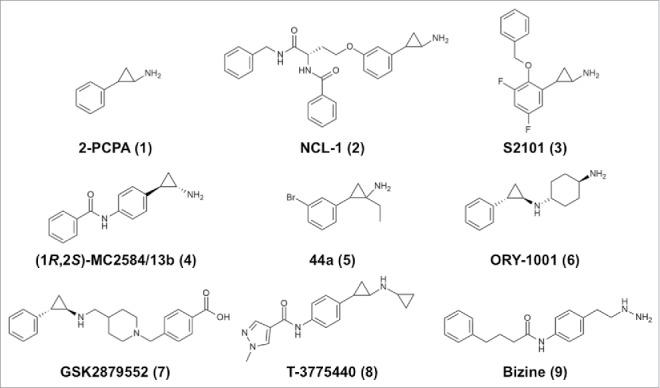
Until 2004, many researchers believed that protein methylation in eukaryotic cells was an irreversible reaction. However, the discovery of lysine-specific demethylase 1 in 2004 drastically changed this view and the concept of chromatin regulation. Since then, the enzymes responsible for lysine demethylation and their cellular substrates, biological significance, and selective regulation have become major research topics in epigenetics and chromatin biology. Many cell-permeable inhibitors for lysine demethylases have been developed, including both target-specific and nonspecific inhibitors. Structural understanding of how these inhibitors bind to lysine demethylases is crucial both for validation of the inhibitors as chemical probes and for the rational design of more potent, target-specific inhibitors. This review focuses on published small-molecule inhibitors targeted at the two flavin adenine dinucleotide-dependent lysine demethylases, lysine-specific demethylases 1 and 2, and how the inhibitors interact with the tertiary structures of the enzymes.
直到2004年,许多研究人员都认为真核细胞中的蛋白质甲基化是一种不可逆反应。然而,2004年赖氨酸特异性去甲基化酶1的发现彻底改变了这一观点以及染色质调控的概念。从那时起,负责赖氨酸去甲基化的酶及其细胞底物、生物学意义和选择性调控就成为了表观遗传学和染色质生物学的主要研究课题。已经开发出了许多用于赖氨酸去甲基化酶的细胞渗透性抑制剂,包括靶向特异性和非特异性抑制剂。了解这些抑制剂如何与赖氨酸去甲基化酶结合的结构,对于将抑制剂验证为化学探针以及合理设计更有效、靶向特异性的抑制剂都至关重要。本综述重点关注已发表的针对两种黄素腺嘌呤二核苷酸依赖性赖氨酸去甲基化酶,即赖氨酸特异性去甲基化酶1和2的小分子抑制剂,以及这些抑制剂如何与酶的三级结构相互作用。



 Zotero 插件