
一种新的转基因水稻品系表现出增强的三价铁还原和植物铁载体生产能力,从而赋予其在石灰性土壤中低铁可用性条件下的耐受性。
A new transgenic rice line exhibiting enhanced ferric iron reduction and phytosiderophore production confers tolerance to low iron availability in calcareous soil.
机构信息
Research Institute for Bioresources and Biotechnology, Ishikawa Prefectural University, Nonoichi, Ishikawa, Japan.
Graduate School of Science, Tohoku University, Aoba, Sendai, Miyagi, Japan.
出版信息
PLoS One. 2017 Mar 9;12(3):e0173441. doi: 10.1371/journal.pone.0173441. eCollection 2017.
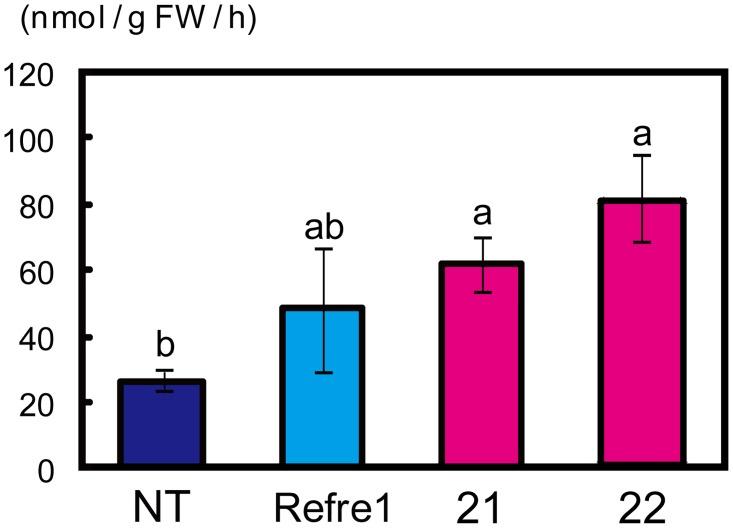
Iron (Fe) deficiency is a critical agricultural problem, especially in calcareous soil, which is distributed worldwide. Rice plants take up Fe(II) from soil through a OsIRT1 transporter (Strategy I-related system) and also take up Fe(III) via a phytosiderophore-based system (Strategy II system). However, rice plants are susceptible to low-Fe conditions because they have low Fe(III) reduction activity and low-level phytosiderophore secretion. Previously, we produced transgenic rice plants expressing a mutationally reconstructed yeast ferric chelate reductase, refre1/372, under the control of the OsIRT1 promoter. This transgenic rice line exhibited higher Fe(III) chelate reductase activity and tolerance to Fe deficiency. In addition, we produced transgenic rice overexpressing the Fe deficiency-inducible transcription factor, OsIRO2, which regulates the expression of various genes involved in the strategy II Fe(III) uptake system, including OsNAS1, OsNAAT1, OsDMAS1, OsYSL15, and TOM1. This transgenic rice exhibited improved phytosiderophore secretion ability and tolerance to Fe deficiency. In the present research, transgenic rice plants that possess both the OsIRT1 promoter-refre1/372 and the 35S promoter-OsIRO2 (RI lines) were produced to enhance both Strategy I Fe(II) reductase ability and Strategy II phytosiderophore productivity. RI lines exhibited enhanced tolerance to Fe-deficient conditions at the early and middle-late stages of growth in calcareous soil, compared to both the non-transgenic line and lines harboring either OsIRT1 promoter-refre1/372 or 35S promoter-OsIRO2 alone. RI lines also exhibited a 9-fold higher yield than the non-transgenic line. Moreover, we successfully produced Fe-deficiency-tolerant Tachisugata rice, which is a high-biomass variety used as fodder. Collectively, our results demonstrate that combined enhancement of two Fe uptake systems in rice is highly effective in conferring tolerance to low Fe availability in calcareous soil.
缺铁(Fe)是一个严重的农业问题,特别是在全球分布的石灰性土壤中。水稻通过 OsIRT1 转运蛋白(I 型相关系统)从土壤中吸收 Fe(II),还通过植物络合素基系统(II 型系统)吸收 Fe(III)。然而,水稻对低铁条件敏感,因为它们的 Fe(III)还原活性低,植物络合素分泌水平低。此前,我们在 OsIRT1 启动子的控制下,表达酵母亚铁螯合还原酶突变重构体 refre1/372 的转基因水稻植株。该转基因水稻品系表现出更高的 Fe(III)螯合还原酶活性和对缺铁的耐受性。此外,我们还生产了过量表达缺铁诱导转录因子 OsIRO2 的转基因水稻,该基因调控参与 II 型 Fe(III)摄取系统的各种基因的表达,包括 OsNAS1、OsNAAT1、OsDMAS1、OsYSL15 和 TOM1。该转基因水稻表现出改善的植物络合素分泌能力和对缺铁的耐受性。在本研究中,我们生产了同时具有 OsIRT1 启动子-refre1/372 和 35S 启动子-OsIRO2 的转基因水稻植株(RI 系),以增强 I 型 Fe(II)还原酶能力和 II 型植物络合素生产力。与非转基因系和仅含有 OsIRT1 启动子-refre1/372 或 35S 启动子-OsIRO2 的系相比,RI 系在石灰性土壤中生长的早期和中晚期对缺铁条件的耐受性更强。RI 系的产量也比非转基因系高出 9 倍。此外,我们成功生产了耐缺铁的 Tachisugata 水稻,这是一种用作饲料的高生物量品种。总的来说,我们的研究结果表明,在水稻中同时增强两种铁摄取系统对提高其在石灰性土壤中对低铁有效性的耐受性非常有效。




 Zotero 插件