
严重急性加重的长期未来风险:问题性哮喘的不同5年轨迹。
Long-term future risk of severe exacerbations: Distinct 5-year trajectories of problematic asthma.
作者信息
Yii A C A, Tan J H Y, Lapperre T S, Chan A K W, Low S Y, Ong T H, Tan K L, Chotirmall S H, Sterk P J, Koh M S
机构信息
Department of Respiratory and Critical Care Medicine, Singapore General Hospital, Singapore, Singapore.
Duke-National University Singapore Graduate Medical School, Singapore, Singapore.
出版信息
Allergy. 2017 Sep;72(9):1398-1405. doi: 10.1111/all.13159. Epub 2017 Apr 25.
BACKGROUND
Assessing future risk of exacerbations is an important component of asthma management. Existing studies have investigated short- but not long-term risk. Problematic asthma patients with unfavorable long-term disease trajectory and persistently frequent severe exacerbations need to be identified early to guide treatment.
AIM
To identify distinct trajectories of severe exacerbation rates among "problematic asthma" patients and develop a risk score to predict the most unfavorable trajectory.
METHODS
Severe exacerbation rates over five years for 177 "problematic asthma" patients presenting to a specialist asthma clinic were tracked. Distinct trajectories of severe exacerbation rates were identified using group-based trajectory modeling. Baseline predictors of trajectory were identified and used to develop a clinical risk score for predicting the most unfavorable trajectory.
RESULTS
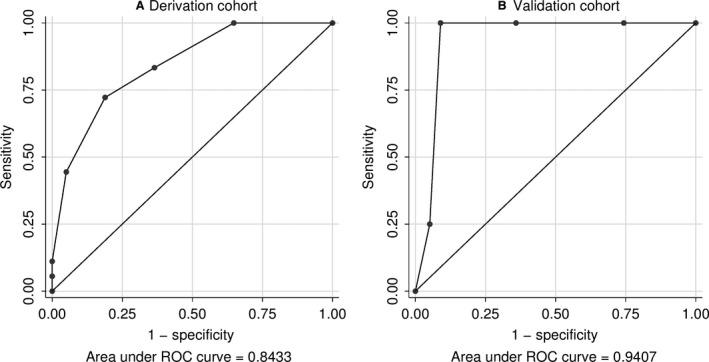
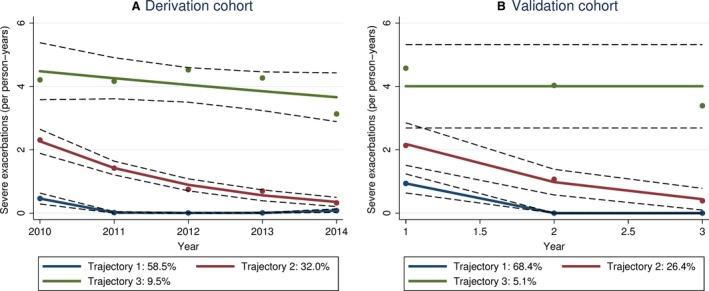
Three distinct trajectories were found: 58.5% had rare intermittent severe exacerbations ("infrequent"), 32.0% had frequent severe exacerbations at baseline but improved subsequently ("nonpersistently frequent"), and 9.5% exhibited persistently frequent severe exacerbations, with the highest incidence of near-fatal asthma ("persistently frequent"). A clinical risk score composed of ≥2 severe exacerbations in the past year (+2 points), history of near-fatal asthma (+1 point), body mass index ≥25kg/m (+1 point), obstructive sleep apnea (+1 point), gastroesophageal reflux (+1 point), and depression (+1 point) was predictive of the "persistently frequent" trajectory (area under the receiver operating characteristic curve: 0.84, sensitivity 72.2%, specificity 81.1% using cutoff ≥3 points). The trajectories and clinical risk score had excellent performance in an independent validation cohort.
CONCLUSIONS
Patients with problematic asthma follow distinct illness trajectories over a period of five years. We have derived and validated a clinical risk score that accurately identifies patients who will have persistently frequent severe exacerbations in the future.
背景
评估未来加重风险是哮喘管理的重要组成部分。现有研究调查的是短期而非长期风险。需要尽早识别出具有不良长期疾病轨迹且严重加重频繁发作的难治性哮喘患者,以指导治疗。
目的
识别“难治性哮喘”患者中严重加重率的不同轨迹,并开发一种风险评分来预测最不利的轨迹。
方法
对前往一家专科哮喘诊所就诊的177例“难治性哮喘”患者的五年严重加重率进行跟踪。使用基于组的轨迹模型识别严重加重率的不同轨迹。确定轨迹的基线预测因素,并用于开发预测最不利轨迹的临床风险评分。
结果
发现了三种不同的轨迹:58.5%的患者有罕见的间歇性严重加重(“不频繁”),32.0%的患者在基线时有频繁的严重加重但随后有所改善(“非持续性频繁”),9.5%的患者表现出持续性频繁严重加重,且近致命性哮喘的发生率最高(“持续性频繁”)。由过去一年中≥2次严重加重(+2分)、近致命性哮喘病史(+1分)、体重指数≥25kg/m(+1分)、阻塞性睡眠呼吸暂停(+1分)、胃食管反流(+1分)和抑郁症(+1分)组成的临床风险评分可预测“持续性频繁”轨迹(受试者工作特征曲线下面积:0.84,使用截断值≥3分时敏感性为72.2%,特异性为81.1%)。这些轨迹和临床风险评分在独立验证队列中表现出色。
结论
难治性哮喘患者在五年期间遵循不同的疾病轨迹。我们已经推导并验证了一种临床风险评分,该评分能准确识别出未来将持续频繁发生严重加重的患者。
 Zotero 插件