
PBMDA:一种用于miRNA-疾病关联预测的新型有效基于路径的计算模型。
PBMDA: A novel and effective path-based computational model for miRNA-disease association prediction.
作者信息
You Zhu-Hong, Huang Zhi-An, Zhu Zexuan, Yan Gui-Ying, Li Zheng-Wei, Wen Zhenkun, Chen Xing
机构信息
Xinjiang Technical Institute of Physics and Chemistry, Chinese Academy of Science, ürümqi, China.
College of Computer Science and Software Engineering, Shenzhen University, Shenzhen, China.
出版信息
PLoS Comput Biol. 2017 Mar 24;13(3):e1005455. doi: 10.1371/journal.pcbi.1005455. eCollection 2017 Mar.
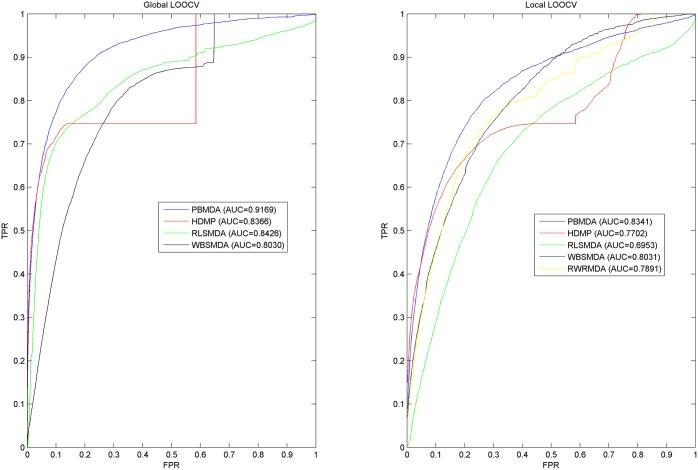
In the recent few years, an increasing number of studies have shown that microRNAs (miRNAs) play critical roles in many fundamental and important biological processes. As one of pathogenetic factors, the molecular mechanisms underlying human complex diseases still have not been completely understood from the perspective of miRNA. Predicting potential miRNA-disease associations makes important contributions to understanding the pathogenesis of diseases, developing new drugs, and formulating individualized diagnosis and treatment for diverse human complex diseases. Instead of only depending on expensive and time-consuming biological experiments, computational prediction models are effective by predicting potential miRNA-disease associations, prioritizing candidate miRNAs for the investigated diseases, and selecting those miRNAs with higher association probabilities for further experimental validation. In this study, Path-Based MiRNA-Disease Association (PBMDA) prediction model was proposed by integrating known human miRNA-disease associations, miRNA functional similarity, disease semantic similarity, and Gaussian interaction profile kernel similarity for miRNAs and diseases. This model constructed a heterogeneous graph consisting of three interlinked sub-graphs and further adopted depth-first search algorithm to infer potential miRNA-disease associations. As a result, PBMDA achieved reliable performance in the frameworks of both local and global LOOCV (AUCs of 0.8341 and 0.9169, respectively) and 5-fold cross validation (average AUC of 0.9172). In the cases studies of three important human diseases, 88% (Esophageal Neoplasms), 88% (Kidney Neoplasms) and 90% (Colon Neoplasms) of top-50 predicted miRNAs have been manually confirmed by previous experimental reports from literatures. Through the comparison performance between PBMDA and other previous models in case studies, the reliable performance also demonstrates that PBMDA could serve as a powerful computational tool to accelerate the identification of disease-miRNA associations.
近年来,越来越多的研究表明,微小RNA(miRNA)在许多基本且重要的生物学过程中发挥着关键作用。作为致病因素之一,从miRNA的角度来看,人类复杂疾病背后的分子机制仍未完全明晰。预测潜在的miRNA与疾病的关联对于理解疾病的发病机制、开发新药以及为各种人类复杂疾病制定个性化的诊断和治疗方案具有重要意义。计算预测模型并非仅依赖昂贵且耗时的生物学实验,通过预测潜在的miRNA与疾病的关联、为所研究的疾病对候选miRNA进行优先级排序以及选择具有更高关联概率的miRNA进行进一步的实验验证,其具有有效性。在本研究中,基于通路的miRNA与疾病关联(PBMDA)预测模型通过整合已知的人类miRNA与疾病关联、miRNA功能相似性、疾病语义相似性以及miRNA和疾病的高斯相互作用谱核相似性而被提出。该模型构建了一个由三个相互关联的子图组成的异构图,并进一步采用深度优先搜索算法来推断潜在的miRNA与疾病的关联。结果,PBMDA在局部和全局留一法交叉验证框架(AUC分别为0.8341和0.9169)以及五折交叉验证(平均AUC为0.9172)中均取得了可靠的性能。在三种重要人类疾病的案例研究中,预测的前50个miRNA中有88%(食管癌)、88%(肾肿瘤)和90%(结肠肿瘤)已被文献中先前的实验报告手动证实。通过在案例研究中比较PBMDA与其他先前模型的性能,其可靠的性能也表明PBMDA可作为一种强大的计算工具来加速疾病与miRNA关联的识别。

 Zotero 插件