
中性粒细胞与淋巴细胞比值与依匹单抗治疗期间的结局相关。
Neutrophil to Lymphocyte Ratio is Associated With Outcome During Ipilimumab Treatment.
机构信息
Department of Surgery, Memorial Sloan Kettering Cancer Center, New York, NY, United States.
Department of Surgery, Memorial Sloan Kettering Cancer Center, New York, NY, United States.
出版信息
EBioMedicine. 2017 Apr;18:56-61. doi: 10.1016/j.ebiom.2017.03.029. Epub 2017 Mar 24.
BACKGROUND
Ipilimumab (IPI) and BRAF inhibitors (BRAFi) improve survival in melanoma, but not all patients will benefit and toxicity can be significant. Pretreatment neutrophil to lymphocyte ratio (NLR) has been associated with outcome in IPI-treated patients, but has not been studied during treatment or in BRAFi-treated patients.
METHODS
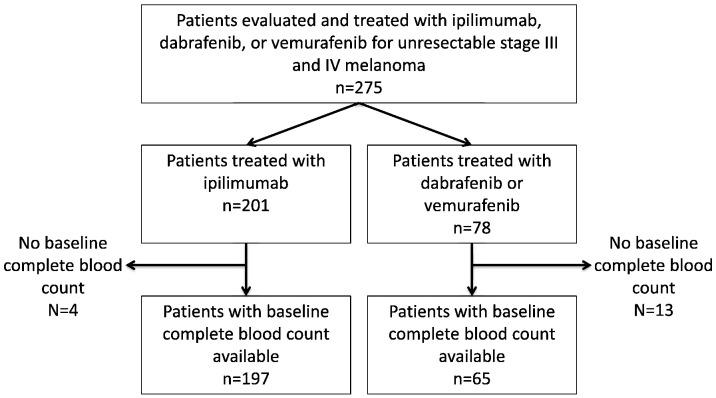
Using a prospectively maintained database, patients with unresectable stage III or IV melanoma treated with IPI or a BRAFi (vemurafenib or dabrafenib as monotherapy) from 2006 to 2011 were identified. NLR was calculated before treatment and at 3-week intervals after treatment initiation until 9weeks. Baseline NLR was tested for association with overall survival (OS), progression free survival (PFS), and clinical response to treatment. On-treatment NLRs were tested for association with the same outcomes using landmark survival analyses and time-dependent Cox regression models. The association of relative change of NLR from baseline with outcomes was also examined. A multivariate model tested the association of NLR and OS/PFS with additional clinical factors.
RESULTS
There were 197 IPI patients and 65 BRAFi patients. In multivariable analysis adjusting for M stage, and disease type (in OS)/gender (in PFS), an NLR value of 5 or above at every timepoint was associated with worse OS (HR 2.03-3.37, p<0.001), PFS (HR 1.81-2.51, p<0.001), and response to therapy (OR 3.92-9.18, p<0.007), in the IPI cohort. In addition, a >30% increase in NLR above baseline at any timepoint was associated with a worse OS and PFS (HR 1.81 and 1.66, p<0.004). In BRAFi patients, NLR was not consistently associated with outcomes.
CONCLUSIONS
A high NLR, whether measured prior to or during treatment with IPI, is associated with worse OS, PFS, and clinical response in patients with advanced melanoma. An increasing NLR from baseline during treatment was correlated with worse OS and PFS in IPI-treated patients. In comparison, as NLR was not associated with outcomes in BRAFi patients, NLR may have a uniquely predictive value in patients treated with immunotherapy.
背景
伊匹单抗(IPI)和 BRAF 抑制剂(BRAFi)可改善黑色素瘤患者的生存,但并非所有患者均能从中获益,且毒性作用显著。治疗前中性粒细胞与淋巴细胞比值(NLR)与 IPI 治疗患者的预后相关,但尚未在治疗期间或 BRAFi 治疗患者中进行研究。
方法
本研究使用前瞻性维护的数据库,对 2006 年至 2011 年间接受 IPI 或 BRAFi(vemurafenib 或 dabrafenib 单药治疗)治疗的不可切除 III 期或 IV 期黑色素瘤患者进行了识别。在治疗前和治疗开始后 3 周的间隔内计算 NLR,直至 9 周。对基线 NLR 与总生存期(OS)、无进展生存期(PFS)和治疗临床反应进行相关性检验。采用 landmark 生存分析和时间依赖性 Cox 回归模型,对治疗期间 NLR 与相同结局的相关性进行检验。还对 NLR 基线相对变化与结局的相关性进行了检验。多变量模型检验了 NLR 和 OS/PFS 与其他临床因素的相关性。
结果
共纳入 197 例 IPI 患者和 65 例 BRAFi 患者。在多变量分析中,调整 M 分期和疾病类型(OS)/性别(PFS)后,各时间点 NLR 值等于或大于 5 与较差的 OS(HR 2.03-3.37,p<0.001)、PFS(HR 1.81-2.51,p<0.001)和治疗反应(OR 3.92-9.18,p<0.007)相关,在 IPI 队列中。此外,在任何时间点 NLR 较基线增加 30%以上与较差的 OS 和 PFS 相关(HR 1.81 和 1.66,p<0.004)。在 BRAFi 患者中,NLR 与结局并不一致相关。
结论
在晚期黑色素瘤患者中,无论是在接受 IPI 治疗前还是治疗期间测量,高 NLR 均与 OS、PFS 和临床反应较差相关。治疗期间 NLR 自基线的持续升高与 IPI 治疗患者的 OS 和 PFS 较差相关。相比之下,由于 NLR 与 BRAFi 患者的结局无关,因此 NLR 在接受免疫治疗的患者中可能具有独特的预测价值。
 Zotero 插件