
免耕对有机草-三叶草轮作-冬小麦种植序列中温室气体排放和土壤碳储量的影响。
Impact of reduced tillage on greenhouse gas emissions and soil carbon stocks in an organic grass-clover ley - winter wheat cropping sequence.
作者信息
Krauss Maike, Ruser Reiner, Müller Torsten, Hansen Sissel, Mäder Paul, Gattinger Andreas
机构信息
Department of Soil Sciences, Research Institute of Organic Agriculture (FiBL), 5070, Frick, Switzerland; University of Hohenheim (340i), Institute of Crop Science, Fertilisation and Soil Matter Dynamics, 70593, Stuttgart, Germany.
University of Hohenheim (340i), Institute of Crop Science, Fertilisation and Soil Matter Dynamics, 70593, Stuttgart, Germany.
出版信息
Agric Ecosyst Environ. 2017 Feb 15;239:324-333. doi: 10.1016/j.agee.2017.01.029.
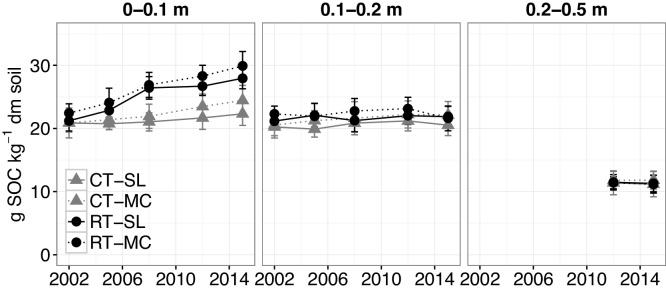
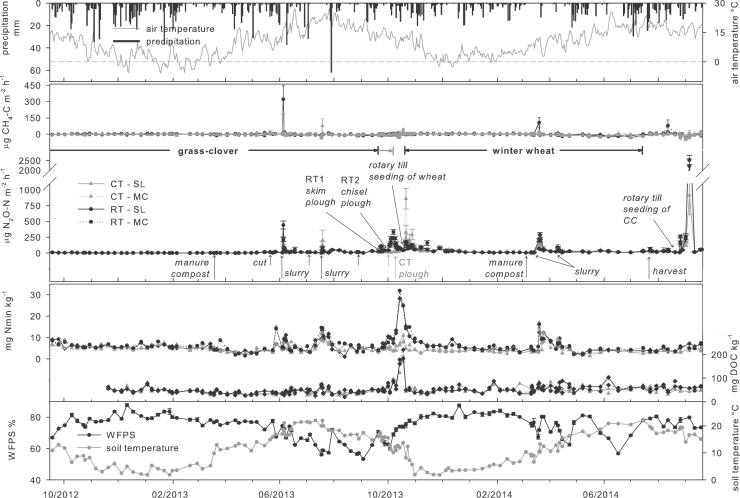
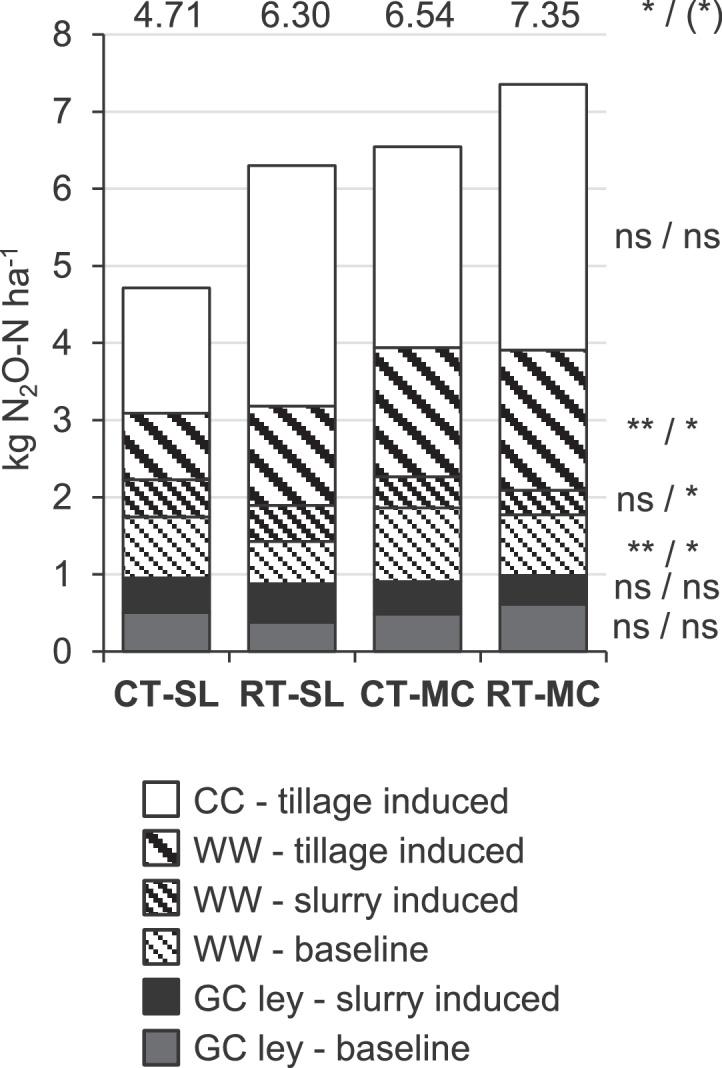
Organic reduced tillage aims to combine the environmental benefits of organic farming and conservation tillage to increase sustainability and soil quality. In temperate climates, there is currently no knowledge about its impact on greenhouse gas emissions and only little information about soil organic carbon (SOC) stocks in these management systems. We therefore monitored nitrous oxide (NO) and methane (CH) fluxes besides SOC stocks for two years in a grass-clover ley - winter wheat - cover crop sequence. The monitoring was undertaken in an organically managed long-term tillage trial on a clay rich soil in Switzerland. Reduced tillage (RT) was compared with ploughing (conventional tillage, CT) in interaction with two fertilisation systems, cattle slurry alone (SL) versus cattle manure compost and slurry (MC). Median NO and CH flux rates were 13 μg NO-N m h and -2 μg CHC m h, respectively, with no treatment effects. NO fluxes correlated positively with nitrate contents, soil temperature, water filled pore space and dissolved organic carbon and negatively with ammonium contents in soil. Pulse emissions after tillage operations and slurry application dominated cumulative gas emissions. NO emissions after tillage operations correlated with SOC contents and collinearly to microbial biomass. There was no tillage system impact on cumulative NO emissions in the grass-clover (0.8-0.9 kg NO-N ha, 369 days) and winter wheat (2.1-3.0 kg NO-N ha, 296 days) cropping seasons, with a tendency towards higher emissions in MC than SL in winter wheat. Including a tillage induced peak after wheat harvest, a full two year data set showed increased cumulative NO emissions in RT than CT and in MC than SL. There was no clear treatment influence on cumulative CH uptake. Topsoil SOC accumulation (0-0.1 m) was still ongoing. SOC stocks were more stratified in RT than CT and in MC than SL. Total SOC stocks (0-0.5 m) were higher in RT than CT in SL and similar in MC. Maximum relative SOC stock difference accounted for +8.1 Mg C ha in RT-MC compared to CT-SL after 13 years which dominated over the relative increase in greenhouse gas emissions. Under these site conditions, organic reduced tillage and manure compost application seems to be a viable greenhouse gas mitigation strategy as long as SOC is sequestered.
有机少耕旨在结合有机农业和保护性耕作的环境效益,以提高可持续性和土壤质量。在温带气候条件下,目前对于其对温室气体排放的影响尚无了解,且关于这些管理系统中土壤有机碳(SOC)储量的信息也很少。因此,我们在一个三叶草草地 - 冬小麦 - 覆盖作物轮作序列中,对一氧化二氮(N₂O)和甲烷(CH₄)通量以及SOC储量进行了为期两年的监测。监测工作在瑞士一个富粘土土壤上的有机管理长期耕作试验中进行。将少耕(RT)与翻耕(传统耕作,CT)进行比较,并与两种施肥系统相互作用,即单独施用牛粪(SL)与牛粪堆肥和粪水(MC)。N₂O和CH₄通量的中位数分别为13 μg N-N m⁻² h⁻¹和 -2 μg CH₄-C m⁻² h⁻¹,没有处理效应。N₂O通量与硝酸盐含量、土壤温度、土壤孔隙含水量和溶解有机碳呈正相关,与土壤中的铵含量呈负相关。耕作操作和粪水施用后的脉冲排放主导了累积气体排放。耕作操作后的N₂O排放与SOC含量相关,并且与微生物生物量共线。在三叶草草地(0.8 - 0.9 kg N-N ha⁻¹,369天)和冬小麦(2.1 - 3.0 kg N-N ha⁻¹,296天)种植季节,耕作系统对累积N₂O排放没有影响,冬小麦中MC处理的排放有高于SL处理的趋势。包括小麦收获后因耕作引起的峰值,完整的两年数据集显示RT处理的累积N₂O排放高于CT处理,MC处理的高于SL处理。对于累积CH₄吸收没有明显的处理影响。表层土壤(0 - 0.1 m)的SOC积累仍在进行。RT处理的SOC储量比CT处理更分层,MC处理的比SL处理更分层。在SL处理中,RT处理的总SOC储量(0 - 0.5 m)高于CT处理,在MC处理中两者相似。13年后,与CT - SL相比,RT - MC处理的最大相对SOC储量差异为 +8.1 Mg C ha⁻¹,这在温室气体排放的相对增加中占主导地位。在这些场地条件下,只要SOC被固存,有机少耕和粪肥堆肥施用似乎是一种可行的温室气体减排策略。
 Zotero 插件