
蛋白质组学分析以鉴定和表征非衰弱与衰弱老年人的生物标志物及身体活动情况。
Proteomics Analysis to Identify and Characterize the Biomarkers and Physical Activities of Non-Frail and Frail Older Adults.
作者信息
Lin Ching-Hung, Liao Chen-Chung, Huang Chi-Huang, Tung Yu-Tang, Chang Huan-Cheng, Hsu Mei-Chich, Huang Chi-Chang
机构信息
Physical Education Office, Yuan Ze University, Taoyuan 32003, Taiwan.
Proteomics Research Center, National Yang-Ming University, Taipei 11221, Taiwan.
出版信息
Int J Med Sci. 2017 Feb 23;14(3):231-239. doi: 10.7150/ijms.17627. eCollection 2017.
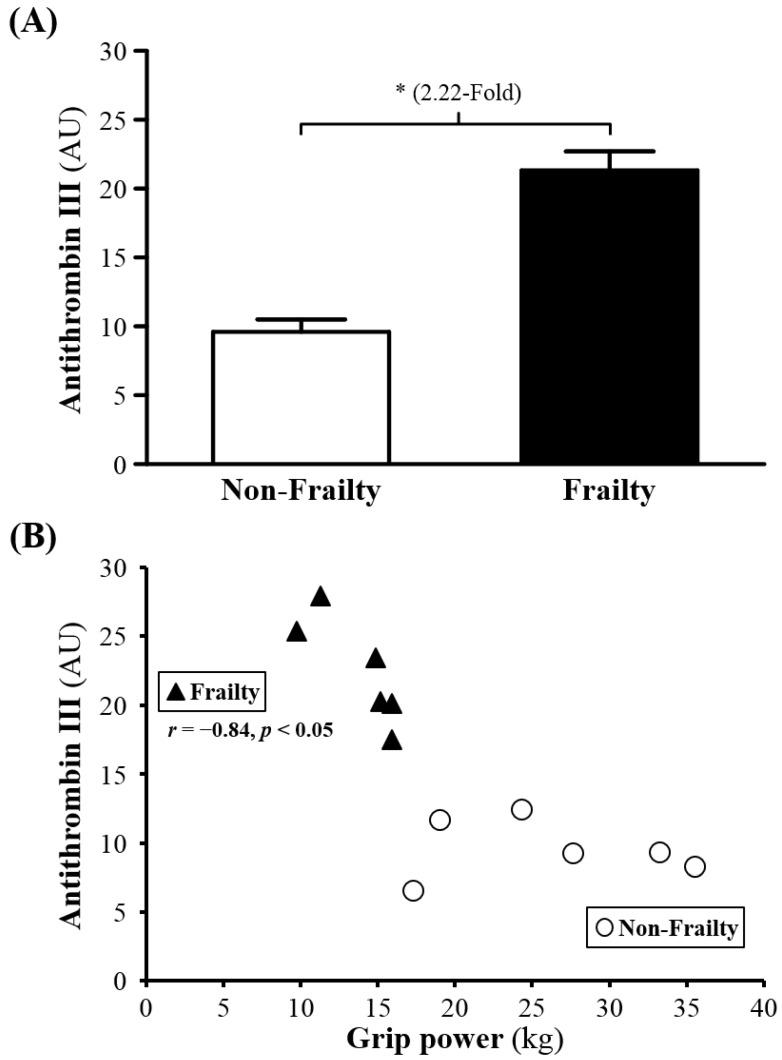
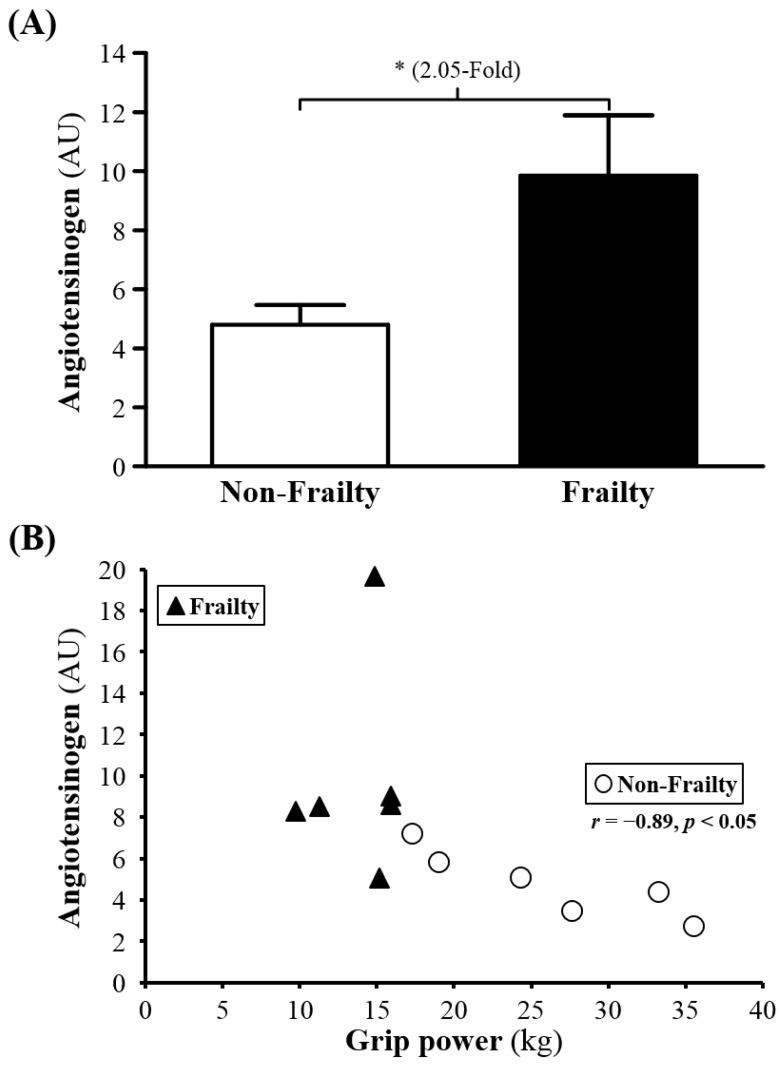
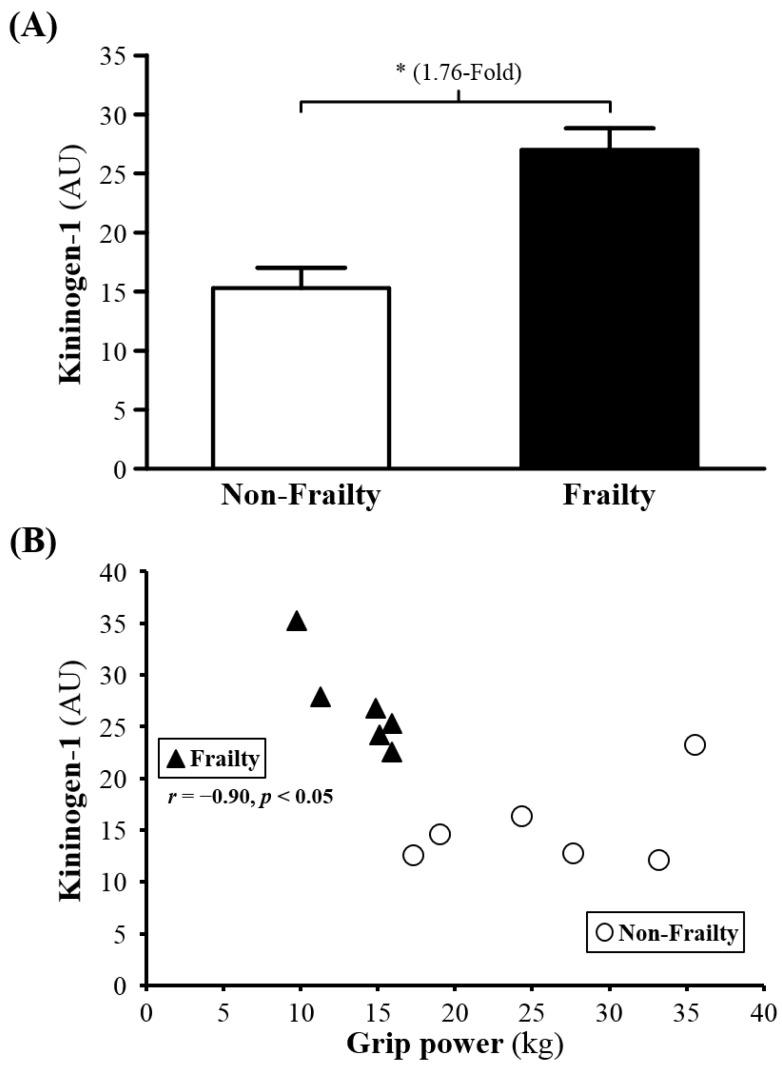
Globally, the proportion of older adults is increasing. Older people face chronic conditions such as sarcopenia and functional decline, which are often associated with disability and frailty. Proteomics assay of potential serum biomarkers of frailty in older adults. Older adults were divided into non-frail and frail groups ( = 6 each; 3 males in each group) in accordance with the Chinese-Canadian Study of Health and Aging Clinical Frailty Scale. Adults were measured for grip power and the 6-min walk test for physical activity, and venous blood was sampled after adults fasted for 8 h. Ultra-high-performance liquid chromatography-tandem mass spectrometry was used for proteomics assay. The groups were compared for levels of biomarkers by test and Pearson correlation analysis. Non-frail and frail subjects had mean age 77.5±0.4 and 77.7±1.6 years, mean height 160.5±1.3 and 156.6±2.9 cm and mean weight 62.5±1.2 and 62.8±2.9 kg, respectively. Physical activity level was lower for frail than non-frail subjects (grip power: 13.8±0.4 26.1±1.2 kg; 6-min walk test: 215.2±17.2 438.3±17.2 m). Among 226 proteins detected, for 31, serum levels were significantly higher for frail than non-frail subjects; serum levels of Ig kappa chain V-III region WOL, COX7A2, and albumin were lower. The serum levels of ANGT, KG and AT were 2.05-, 1.76- and 2.22-fold lower (all < 0.05; Figure 1A, 2A and 3A) for non-frail than frail subjects and were highly correlated with grip power (Figure 1B, 2B and 3B). Our study found that ANGT, KG and AT levels are known to increase with aging, so degenerated vascular function might be associated with frailty. In total, 226 proteins were revealed proteomics assay; levels of angiotensinogen (ANGT), kininogen-1 (KG) and antithrombin III (AT) were higher in frail than non-frail subjects (11.26±2.21 5.09±0.74; 18.42±1.36 11.64±1.36; 22.23±1.64 9.52±0.95, respectively, < 0.05). These 3 factors were highly correlated with grip power ( < 0.05), with higher correlations between grip power and serum levels of ANGT (r = -0.89), KG (r = -0.90), and AT (r = -0.84). In conclusion, this is the first study to demonstrate a serum proteomic profile characteristic of frailty in older adults. Serum ANGT, KG and AT levels could be potential biomarkers for monitoring the development and progression of frailty in older adults.
在全球范围内,老年人的比例正在增加。老年人面临肌肉减少症和功能衰退等慢性疾病,这些疾病通常与残疾和虚弱相关。对老年人虚弱的潜在血清生物标志物进行蛋白质组学分析。根据中加健康与衰老临床虚弱量表,将老年人分为非虚弱组和虚弱组(每组6人;每组3名男性)。测量成年人的握力和进行6分钟步行测试以评估身体活动能力,并在成年人禁食8小时后采集静脉血样。采用超高效液相色谱-串联质谱法进行蛋白质组学分析。通过t检验和Pearson相关分析比较两组生物标志物水平。非虚弱和虚弱受试者的平均年龄分别为77.5±0.4岁和77.7±1.6岁,平均身高分别为160.5±1.3厘米和156.6±2.9厘米,平均体重分别为62.5±1.2千克和62.8±2.9千克。虚弱受试者的身体活动水平低于非虚弱受试者(握力:13.8±0.4对26.1±1.2千克;6分钟步行测试:215.2±17.2对438.3±17.2米)。在检测到的226种蛋白质中,有31种蛋白质的血清水平在虚弱受试者中显著高于非虚弱受试者;免疫球蛋白κ链V-III区WOL、COX7A2和白蛋白的血清水平较低。非虚弱受试者的血管紧张素原(ANGT)、激肽原-1(KG)和抗凝血酶III(AT)的血清水平分别比虚弱受试者低2.05倍、1.76倍和2.22倍(均P<0.05;图1A、2A和3A),并且与握力高度相关(图1B、2B和3B)。我们的研究发现,已知ANGT、KG和AT水平会随着年龄增长而升高,因此血管功能退化可能与虚弱有关。蛋白质组学分析共揭示了226种蛋白质;血管紧张素原(ANGT)、激肽原-1(KG)和抗凝血酶III(AT)在虚弱受试者中的水平高于非虚弱受试者(分别为11.26±2.21对5.09±0.74;18.42±1.36对11.64±1.36;22.23±1.64对9.52±0.95,P<0.05)。这3个因素与握力高度相关(P<0.05),握力与血清ANGT水平(r = -0.89)、KG水平(r = -0.90)和AT水平(r = -0.84)之间的相关性更高。总之,这是第一项证明老年人虚弱血清蛋白质组学特征的研究。血清ANGT、KG和AT水平可能是监测老年人虚弱发展和进展的潜在生物标志物。
 Zotero 插件