
环RGDyC功能化脂质体用于胶质母细胞瘤中肿瘤血管和癌细胞的双靶点:一项体外硼中子俘获治疗研究。
Cyclic-RGDyC functionalized liposomes for dual-targeting of tumor vasculature and cancer cells in glioblastoma: An in vitro boron neutron capture therapy study.
作者信息
Kang Weirong, Svirskis Darren, Sarojini Vijayalekshmi, McGregor Ailsa L, Bevitt Joseph, Wu Zimei
机构信息
School of Pharmacy, University of Auckland, Auckland 1142, New Zealand.
School of Chemical Sciences, University of Auckland, Auckland 1142, New Zealand.
出版信息
Oncotarget. 2017 May 30;8(22):36614-36627. doi: 10.18632/oncotarget.16625.
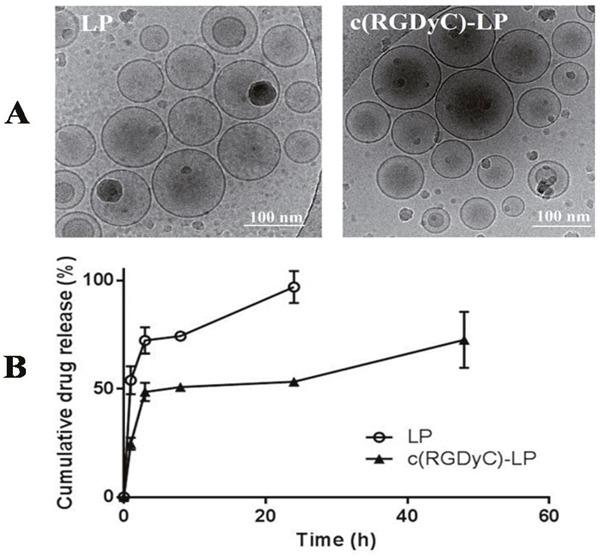
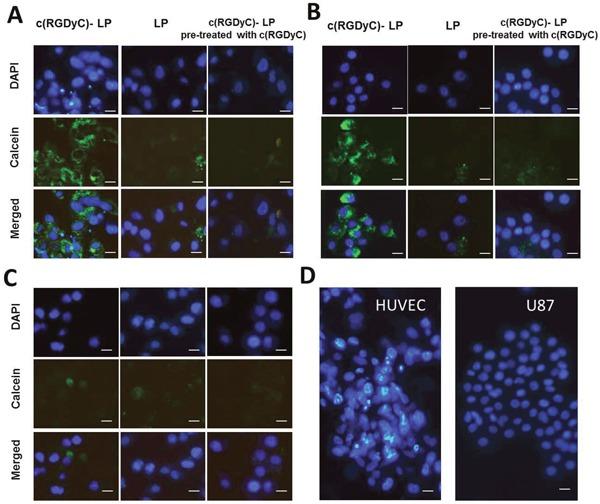
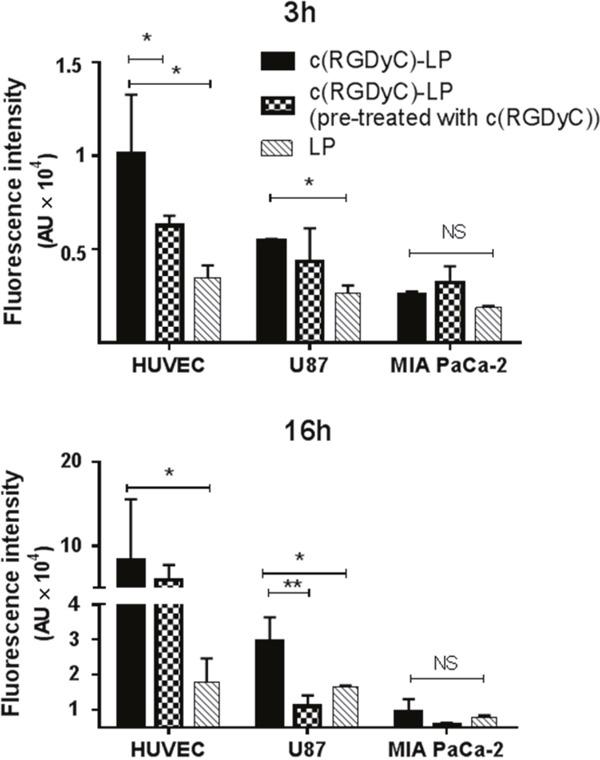
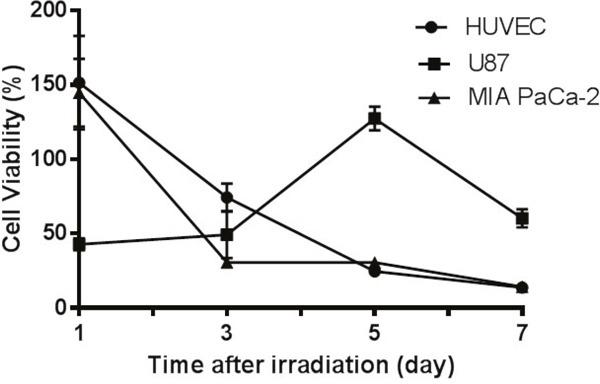
The efficacy of boron neutron capture therapy depends on the selective delivery of 10B to the target. Integrins αvβ3 are transmembrane receptors over-expressed in both glioblastoma cells and its neovasculature. In this study, a novel approach to dual-target glioblastoma vasculature and tumor cells was investigated. Liposomes (124 nm) were conjugated with a αvβ3 ligand, cyclic arginine-glycine-aspartic acid-tyrosine-cysteine peptide (c(RGDyC)-LP) (1% molar ratio) through thiol-maleimide coupling. Expression of αvβ3 in glioblastoma cells (U87) and human umbilical vein endothelial cells (HUVEC), representing tumor angiogenesis, was determined using Western Blotting with other cells as references. The results showed that both U87 and HUVEC had stronger expression of αvβ3 than other cell types, and the degree of cellular uptake of c(RGDyC)-LP correlated with the αvβ3-expression levels of the cells. In contrast, control liposomes without c(RGDyC) showed little cellular uptake, regardless of cell type. In an in vitro boron neutron capture therapy study, the c(RGDyC)-LP containing sodium borocaptate generated more rapid and significant lethal effects to both U87 and HUVEC than the control liposomes and drug solution. Interestingly, neutron irradiated U87 and HUVEC showed different types of subsequent cell death. In conclusion, this study has demonstrated the potential of a new dual-targeting strategy using c(RGDyC)-LP to improve boron neutron capture therapy for glioblastoma.
硼中子俘获疗法的疗效取决于将硼-10选择性地输送到靶标。整合素αvβ3是在胶质母细胞瘤细胞及其新生血管中均过度表达的跨膜受体。在本研究中,研究了一种双靶向胶质母细胞瘤血管和肿瘤细胞的新方法。通过硫醇-马来酰亚胺偶联,将脂质体(124纳米)与αvβ3配体环精氨酸-甘氨酸-天冬氨酸-酪氨酸-半胱氨酸肽(c(RGDyC)-LP)(摩尔比1%)偶联。以其他细胞为对照,采用蛋白质免疫印迹法测定了代表肿瘤血管生成的胶质母细胞瘤细胞(U87)和人脐静脉内皮细胞(HUVEC)中αvβ3的表达。结果显示,U87和HUVEC中αvβ3的表达均强于其他细胞类型,且c(RGDyC)-LP的细胞摄取程度与细胞的αvβ3表达水平相关。相比之下,不含c(RGDyC)的对照脂质体无论细胞类型如何,细胞摄取都很少。在一项体外硼中子俘获疗法研究中,含硼卡钠的c(RGDyC)-LP对U87和HUVEC产生的致死作用比对照脂质体和药物溶液更快且更显著。有趣的是,中子照射后的U87和HUVEC表现出不同类型的后续细胞死亡。总之,本研究证明了使用c(RGDyC)-LP的新型双靶向策略在改善胶质母细胞瘤硼中子俘获疗法方面的潜力。



 Zotero 插件