
线粒体与衰老:在心脏、骨骼肌和脂肪组织中的作用
Mitochondria and ageing: role in heart, skeletal muscle and adipose tissue.
作者信息
Boengler Kerstin, Kosiol Maik, Mayr Manuel, Schulz Rainer, Rohrbach Susanne
机构信息
Institute of Physiology, Justus Liebig University Giessen, Aulweg 129, 35392, Giessen, Germany.
King's British Heart Foundation Centre, King's College London, 125 Coldharbour Lane, London, SE5 9NU, UK.
出版信息
J Cachexia Sarcopenia Muscle. 2017 Jun;8(3):349-369. doi: 10.1002/jcsm.12178. Epub 2017 Apr 21.
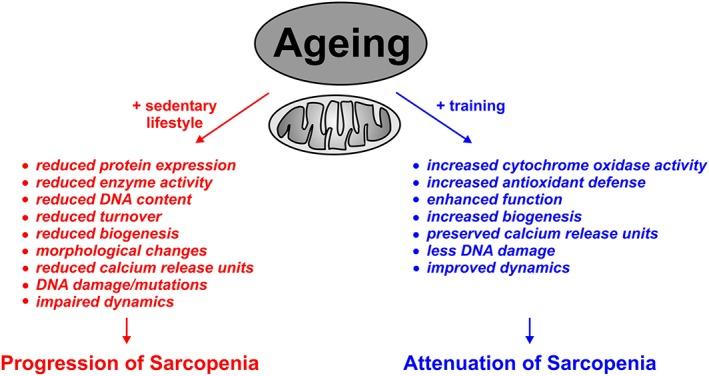
Age is the most important risk factor for most diseases. Mitochondria play a central role in bioenergetics and metabolism. In addition, several lines of evidence indicate the impact of mitochondria in lifespan determination and ageing. The best-known hypothesis to explain ageing is the free radical theory, which proposes that cells, organs, and organisms age because they accumulate reactive oxygen species (ROS) damage over time. Mitochondria play a central role as the principle source of intracellular ROS, which are mainly formed at the level of complex I and III of the respiratory chain. Dysfunctional mitochondria generating less ATP have been observed in various aged organs. Mitochondrial dysfunction comprises different features including reduced mitochondrial content, altered mitochondrial morphology, reduced activity of the complexes of the electron transport chain, opening of the mitochondrial permeability transition pore, and increased ROS formation. Furthermore, abnormalities in mitochondrial quality control or defects in mitochondrial dynamics have also been linked to senescence. Among the tissues affected by mitochondrial dysfunction are those with a high-energy demand and thus high mitochondrial content. Therefore, the present review focuses on the impact of mitochondria in the ageing process of heart and skeletal muscle. In this article, we review different aspects of mitochondrial dysfunction and discuss potential therapeutic strategies to improve mitochondrial function. Finally, novel aspects of adipose tissue biology and their involvement in the ageing process are discussed.
年龄是大多数疾病最重要的风险因素。线粒体在生物能量学和新陈代谢中起着核心作用。此外,多条证据表明线粒体在寿命决定和衰老过程中具有影响。解释衰老最著名的假说是自由基理论,该理论提出细胞、器官和生物体衰老的原因是它们随着时间的推移积累了活性氧(ROS)损伤。线粒体作为细胞内ROS的主要来源发挥着核心作用,ROS主要在呼吸链的复合体I和III水平形成。在各种衰老器官中都观察到功能失调的线粒体产生的ATP减少。线粒体功能障碍包括不同的特征,包括线粒体含量减少、线粒体形态改变、电子传递链复合体活性降低、线粒体通透性转换孔开放以及ROS形成增加。此外,线粒体质量控制异常或线粒体动力学缺陷也与衰老有关。受线粒体功能障碍影响的组织包括那些能量需求高因而线粒体含量高的组织。因此,本综述重点关注线粒体在心脏和骨骼肌衰老过程中的影响。在本文中,我们综述了线粒体功能障碍的不同方面,并讨论了改善线粒体功能的潜在治疗策略。最后,讨论了脂肪组织生物学的新方面及其在衰老过程中的作用。

 Zotero 插件